
Switch off
Oliver Optic
THE CLASSIC COLLECTION · 1896
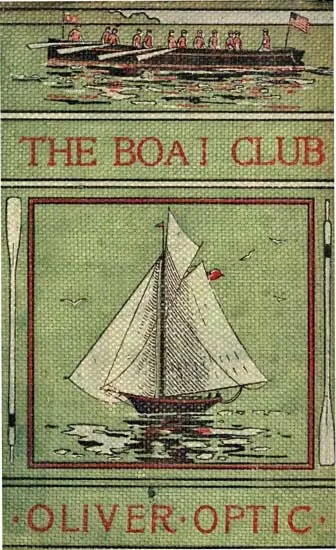
"The Boat Club; or, The Bunkers of Rippleton" by Oliver Optic is a novel written in the late 19th century. Targeted primarily at young readers, the narrative centers around themes of friendship, moral decisions, and the joys of outdoor adventures. The story particularly follows Frank Sedley and his friends as they navigate their relationships while engaging in club activities centered around boating on Wood Lake. The beginning of the book introduces us to Frank Sedley and his friend Charles Hardy during the lead-up to the Fourth of July. As they discuss their plans for the celebration, Frank contemplates using their saved money to help a local widow and her children instead of spending it on fireworks and treats. Their decision to support the widow highlights their growing sense of responsibility and compassion. The initial chapters establish the boys' characters, their strong friendship, and their diverse backgrounds, ultimately paving the way for their involvement with the titular boat club and the adventures that await them on the lake.
Introduction adapted from the source catalogue; source summaries may be automatically generated.
Free to read · English · 46,119 words · No account needed
MAKE TIME FOR A GOOD BOOK
On by default. Untick to stop anonymous reading totals. Each page counts after 10 seconds in view. How this works.
Anonymous counting is on unless you have switched it off.
There was no visible object which seemed to suggest a name for the
miniature sea; but just then the band began to play "Washington's
March."
"Call it Washington Sea, boys," said Mrs. Sedley.
The name was given, but the geography lesson could not proceed while
the music continued.
"Stand by to lay on your oars!" Frank commanded. "Oars!"
The oarsmen levelled their oars, feathering the blades, and listening to the march. The Bunkers, attracted by the music of the band, followed the Sylph at a respectful distance. The presence of Uncle Ben and Mrs. Sedley was a restraint upon them, and they conducted themselves with tolerable decorum. The band ceased playing, and Mrs. Sedley continued her instructions.
"What is a gulf or bay?"
"A portion of the sea extending into the land."
"Can you give me an example?"
"Weston Bay," replied Fred, laughing.
"And perhaps, before the expedition concludes its voyage, we shall find something which may be called a gulf."
"I know where there is a gulf," said Charles.
"Now, Frank, you may go through the strait," said Fred.
"Is it safe? I don't know how deep the water is."
"I am glad to see you are careful," said Mrs. Sedley. "You can ask
Uncle Ben."
"Sylph, ahoy!" shouted Frank, rising.
"What boat's that?" roared Uncle Ben, in reply.
"The Zephyr, of and from Rippleton," returned the coxswain. "Can you tell me what depth of water there is in this passage?"
"Where's your chart?"
"We must have a chart of the lake," suggested Fred.
"That we must. Who shall draw it?"
"Fred Harper."
"We have no chart. Will you give me the depth of water inside the
island?" continued Frank.
"Short fathom," replied Uncle Ben.
"We are none the wiser," interposed Charles. "How much is a fathom?"
"Six feet," answered Tony.
"But he don't say how much short."
"Can we go through in safety, Uncle Ben?"
"Ay, ay; but trail your oars."
Frank let the crew pull several smart strokes, and then ordered them to trail. The Zephyr darted through the narrow passage.
"Now for the name of the strait," said Frank.
"You seem to be at a loss for names; I think you had better call these divisions after the members of the club," suggested Mrs. Sedley.
"So we can; the memory of great travellers and navigators has been handed down to their posterity by geographical names,--Hudson Bay, Mount Franklin, Cook's Straits, for example," said Fred Harper, laughing heartily.
The proposition received a ready assent; and the strait was called Graham Strait, after the boy who pulled the second oar.
"But the island?" said Charles.
Your reading position is saved on this browser. Take it to another device with a library code. Reading pages adapt to text, rather than matching a printed edition.
BEHIND THE BOOK
This eBook is for the use of anyone anywhere in the United States and most other parts of the world at no cost and with almost no restrictions whatsoever. You may copy it, give it away or re-use it under the terms of the Project Gutenberg License included with this eBook or online at www.gutenberg.org. If you are not located in the United States, you will have to check the laws of the country where you are located before using this eBook. Read the source licence.
The original source file, including credits and licence, is retained by this library. Request an original-format copy at no charge. Please include the book title and Project Gutenberg identifier #24557.
KEEP YOUR CURIOSITY GOING
Coulson Kernahan

Maurice Baring
Frances Wright
Cécile Tormay

Frederic Jesup Stimson

W. H. P. (William Henry Pope) Jarvis
