
Switch off
Oliver Optic
THE CLASSIC COLLECTION · 1896
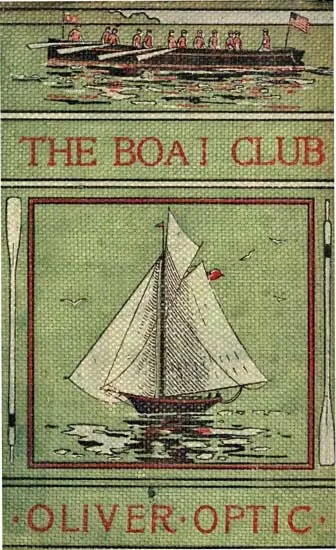
"The Boat Club; or, The Bunkers of Rippleton" by Oliver Optic is a novel written in the late 19th century. Targeted primarily at young readers, the narrative centers around themes of friendship, moral decisions, and the joys of outdoor adventures. The story particularly follows Frank Sedley and his friends as they navigate their relationships while engaging in club activities centered around boating on Wood Lake. The beginning of the book introduces us to Frank Sedley and his friend Charles Hardy during the lead-up to the Fourth of July. As they discuss their plans for the celebration, Frank contemplates using their saved money to help a local widow and her children instead of spending it on fireworks and treats. Their decision to support the widow highlights their growing sense of responsibility and compassion. The initial chapters establish the boys' characters, their strong friendship, and their diverse backgrounds, ultimately paving the way for their involvement with the titular boat club and the adventures that await them on the lake.
Introduction adapted from the source catalogue; source summaries may be automatically generated.
Free to read · English · 46,119 words · No account needed
MAKE TIME FOR A GOOD BOOK
On by default. Untick to stop anonymous reading totals. Each page counts after 10 seconds in view. How this works.
Anonymous counting is on unless you have switched it off.
The testimony was substantially the same as at the examination. It was proved that Tony was in the wood-house, had seen the wallet, and left his companions to find Farmer Whipple; that he had been seen to put something into his pocket, and finally that the lost wallet, with a portion of the money, had been found in his pocket.
It was a clear case, and when the evidence was concluded Mrs. Weston
sobbed bitterly.
"Be comforted, madam, your son shall be proved innocent in a few
moments," said Squire Benson.
The cross examination of Tim Bunker was very long and very severe; and though he still adhered to the story he had told at the examination, he was confused, stammered a great deal, and tried to be saucy to the lawyer. His statements were so contradictory at times, that a general disposition to laugh pervaded the minds of the audience. At these times, when he so grossly crossed himself, Squire Benson looked significantly at the jury, as though to invite their special attention to the discrepancies.
Tony's counsel then opened the case for the defence. His address was very short, but very pointed and forcible.
The first witness was Mr. Doolittle, the store-keeper, who testified to the facts concerning the twenty dollar bill.
"Is that the bill you marked?" asked the lawyer, handing him a
bank-note.
"It is," replied the witness, after examining it.
"You are willing to swear that is the bill?"
"I am."
"Please state to the court and jury the means by which you identify
it."
The witness exhibited his shop-card upon the back of it, and pointed
out several other peculiarities which he had observed while stamping
it.
"Mr. Stevens," said the lawyer. "That will do, Mr. Doolittle."
The person called took the stand. He was a stranger in Rippleton, and the audience wondered what he could possibly know about it.
"Your business, Mr. Stevens?" continued the lawyer, scratching
furiously with his pen.
"I keep a hardware store in Boston."
"Did you ever see this bill?" and Squire Benson handed him the
bank-note.
"I have."
"State, if you please, what you know about it."
"It was given to me in payment for a fowling-piece."
"When?"
The witness gave the date.
"Can you swear to the bill?"
"I can; I wrote my name and the day of the month on it at the time;
here they are."
"Indeed! how happened you to do that?"
"I did it at the request of the gentleman who sits by your side;" and the witness pointed to Captain Sedley.
"Who was the person that gave you the bill?"
"I do not know his name."
"Could you identify him?"
"I could."
Your reading position is saved on this browser. Take it to another device with a library code. Reading pages adapt to text, rather than matching a printed edition.
BEHIND THE BOOK
This eBook is for the use of anyone anywhere in the United States and most other parts of the world at no cost and with almost no restrictions whatsoever. You may copy it, give it away or re-use it under the terms of the Project Gutenberg License included with this eBook or online at www.gutenberg.org. If you are not located in the United States, you will have to check the laws of the country where you are located before using this eBook. Read the source licence.
The original source file, including credits and licence, is retained by this library. Request an original-format copy at no charge. Please include the book title and Project Gutenberg identifier #24557.
KEEP YOUR CURIOSITY GOING
Coulson Kernahan

Maurice Baring
Frances Wright
Cécile Tormay

Frederic Jesup Stimson

W. H. P. (William Henry Pope) Jarvis
