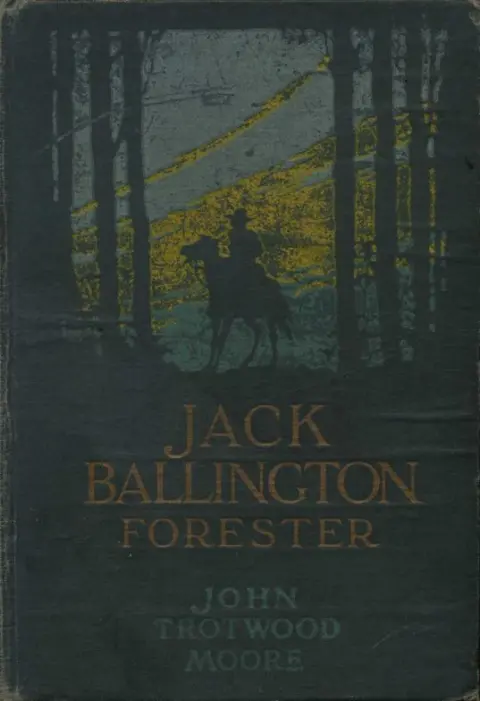
Jack Ballington, Forester
John Trotwood Moore
THE CLASSIC COLLECTION · 1906
"The Bishop of Cottontown: A Story of the Southern Cotton Mills" by John Trotwood Moore is a novel written in the early 20th century. The story is set in the Southern cotton mills of Tennessee and deals with themes of ambition, social class, and the struggles of working-class individuals. Key characters introduced include Richard Travis, a man of strength but lacking moral integrity, and Helen Conway, a young woman entwined in the intricate social dynamics and romantic tensions of her community. The opening of the novel paints a vivid picture of the beauty of the cotton plant, likening its life cycle to artistic creation. It introduces the setting with descriptions emphasizing the vibrant landscape of the Tennessee Valley, reflecting on the area's harvests and the complexities of life in the cotton mills. The narrative transitions to characters like Richard Travis, who is portrayed with a blend of physical strength and moral weaknesses, and introduces the trace of romantic tension surrounding Helen Conway. This first section establishes a foundation of both lyrical descriptions and hints at deeper social issues, setting the stage for the unfolding drama amidst the struggle for existence in a changing Southern landscape.
Introduction adapted from the source catalogue; source summaries may be automatically generated.
Free to read · English · 154,383 words · No account needed
MAKE TIME FOR A GOOD BOOK
On by default. Untick to stop anonymous reading totals. Each page counts after 10 seconds in view. How this works.
Anonymous counting is on unless you have switched it off.
Jud got one eye in working order soon enough to see a cloud of sand and dust rolling down the road, from the rear of which only the stub of a tail could be seen, curled spasmodically downward toward the earth.
Jud could scarcely believe his eyes--Bonaparte--the champion
dog--running--running like that?
"Whut--whut--whut,"--he stammered, "Whut did he do to Bonaparte?"
Then he saw Archie B. up the road toward home, rolling in the sand
with shouts of laughter.
"If I git my hands on you," yelled Jud, shaking his fist at the boy,
"I'll swaller you alive."
"That's what the fly-ketcher said to the butterfly," shouted back
Archie B.
It was a half hour before Jud got all the fine eggshell out of his eyes. After that he decided to let the Butts family alone for the present. But as he rode away he was heard to say again:
"Whut--whut--whut did he do to Bonaparte?"
Archie B. was still rolling on the ground, and chuckling now and then in fits of laughter, when a determined, motherly looking, fat girl appeared at the doorway of the family cottage. It was his sister, Patsy Butts:
"Maw," she exclaimed, "I wish you'd look at Archie B. I bet he's done
sump'in."
There was a parental manner in her way. Her one object in life, evidently, was to watch Archie B.
"You Archie B.," yelled his mother, a sallow little woman of quick nervous movements, "air you havin' a revulsion down there? What air you been doin' anyway? Now, you git up from there and go see why Ozzie B. don't fetch the cows home."
Archie B. arose and went down the road whistling.
A ground squirrel ran into a pile of rocks. Archie B. turned the rocks about until he found the nest, which he examined critically and with care. He fingered it carefully and patted it back into shape. "Nice little nes'," he said--"that settles it--I thought they lined it with fur." Then he replaced the rocks and arose to go.
A quarter of a mile down the road he stopped and listened.
He heard his brother, Ozzie B., sobbing and weeping.
Ozzie B. was his twin brother--his "after clap"--as Archie B. called him. He was timid, uncertain, pious and given to tears--"bo'hn on a wet Friday"--as Archie B. had often said. He was always the effect of Archie B.'s cause, the illustration of his theorem, the solution of his problem of mischief, the penalty of his misdemeanors.
Presently Ozzie B. came in sight, hatless and driving his cows along, but sobbing in that hiccoughy way which is the final stage of an acute thrashing.
Your reading position is saved on this browser. Take it to another device with a library code. Reading pages adapt to text, rather than matching a printed edition.
John Trotwood Moore
BEHIND THE BOOK
This eBook is for the use of anyone anywhere in the United States and most other parts of the world at no cost and with almost no restrictions whatsoever. You may copy it, give it away or re-use it under the terms of the Project Gutenberg License included with this eBook or online at www.gutenberg.org. If you are not located in the United States, you will have to check the laws of the country where you are located before using this eBook. Read the source licence.
The original source file, including credits and licence, is retained by this library. Request an original-format copy at no charge. Please include the book title and Project Gutenberg identifier #23637.
KEEP YOUR CURIOSITY GOING
Coulson Kernahan

Maurice Baring
Frances Wright
Cécile Tormay

Frederic Jesup Stimson

W. H. P. (William Henry Pope) Jarvis