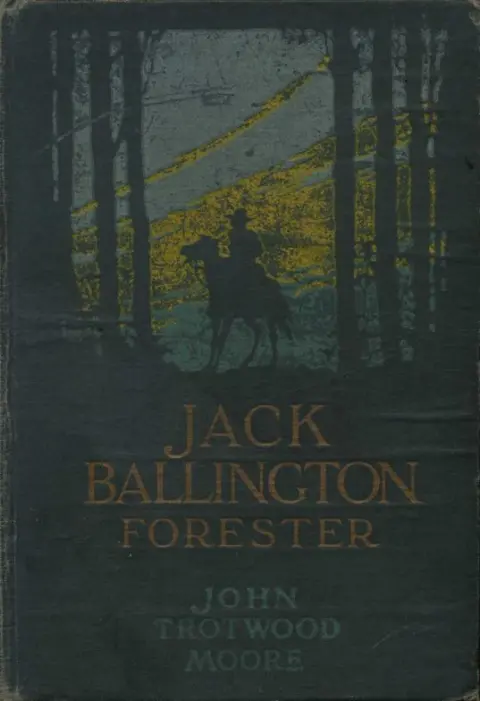
Jack Ballington, Forester
John Trotwood Moore
THE CLASSIC COLLECTION · 1906
"The Bishop of Cottontown: A Story of the Southern Cotton Mills" by John Trotwood Moore is a novel written in the early 20th century. The story is set in the Southern cotton mills of Tennessee and deals with themes of ambition, social class, and the struggles of working-class individuals. Key characters introduced include Richard Travis, a man of strength but lacking moral integrity, and Helen Conway, a young woman entwined in the intricate social dynamics and romantic tensions of her community. The opening of the novel paints a vivid picture of the beauty of the cotton plant, likening its life cycle to artistic creation. It introduces the setting with descriptions emphasizing the vibrant landscape of the Tennessee Valley, reflecting on the area's harvests and the complexities of life in the cotton mills. The narrative transitions to characters like Richard Travis, who is portrayed with a blend of physical strength and moral weaknesses, and introduces the trace of romantic tension surrounding Helen Conway. This first section establishes a foundation of both lyrical descriptions and hints at deeper social issues, setting the stage for the unfolding drama amidst the struggle for existence in a changing Southern landscape.
Introduction adapted from the source catalogue; source summaries may be automatically generated.
Free to read · English · 154,383 words · No account needed
MAKE TIME FOR A GOOD BOOK
On by default. Untick to stop anonymous reading totals. Each page counts after 10 seconds in view. How this works.
Anonymous counting is on unless you have switched it off.
When the mill opened the next day, there was work for Jud Carpenter. He came in and approached the superintendent's desk briskly.
"Well, suh, hu' many to-day?" he asked.
Kingsley looked over his list of absentees.
"Four, and two of them spinners. Carpenter, you must go at once and see about it. They are playing off, I am sure."
"Lem'me see the list, suh,"--and he ran his eye over the names.
"Bud Billings--plague his old crotchety head--. He kno's that machine's got to run, whether no. Narthin's the matter with him--bet a dollar his wife licked him last night an' he's mad about it."
"That will do us no good," said Kingsley--"what he is mad about. That machine must be started at once. The others you can see afterwards."
Carpenter jerked his slouch hat down over his eyes and went quickly
out.
In half an hour he was back again. His hat was off, his face was red, his shaggy eyebrows quivered with angry determination, as, with one hand in the collar of the frightened Bud, he pulled the slubber into the superintendent's presence.
Following her husband came Mrs. Billings--a small, bony, wiry, black-eyed woman, with a firmly set mouth and a perpetual thunder-cloud on her brow--perhaps the shadow of her coarse, crow-black hair.
While Jud dragged him, she carried a stick and prodded Bud in the rear. Nor was she chary in abuse.
Jerked into the superintendent's presence, Bud's scared eyes darted here and there as if looking for a door to break through, and all the time they were silently protesting. His hands, too, joined in the protest; one of them wagged beseechingly behind appealing to his spouse to desist--the other went through the same motion in front begging Jud Carpenter for mercy.
But not a word did he utter--not even a grunt did he make.
They halted as quickly as they entered. Bud's eyes sought the ceiling, the window, the floor,--anywhere but straight ahead of him.
His wife walked up to the superintendent's desk--she was hot and flushed. Her small black eyes, one of which was cocked cynically, flashed fire, her coarse hair fell across her forehead, or was plastered to her head with perspiration.
It was pathetic to look at Bud, with his deep-set, scared eyes. Kingsley had never heard him speak a word, nor had he even been able to catch his eye. But he was the best slubber in the mill--tireless, pain-staking. His place could not be filled.
Your reading position is saved on this browser. Take it to another device with a library code. Reading pages adapt to text, rather than matching a printed edition.
John Trotwood Moore
BEHIND THE BOOK
This eBook is for the use of anyone anywhere in the United States and most other parts of the world at no cost and with almost no restrictions whatsoever. You may copy it, give it away or re-use it under the terms of the Project Gutenberg License included with this eBook or online at www.gutenberg.org. If you are not located in the United States, you will have to check the laws of the country where you are located before using this eBook. Read the source licence.
The original source file, including credits and licence, is retained by this library. Request an original-format copy at no charge. Please include the book title and Project Gutenberg identifier #23637.
KEEP YOUR CURIOSITY GOING
Coulson Kernahan

Maurice Baring
Frances Wright
Cécile Tormay

Frederic Jesup Stimson

W. H. P. (William Henry Pope) Jarvis