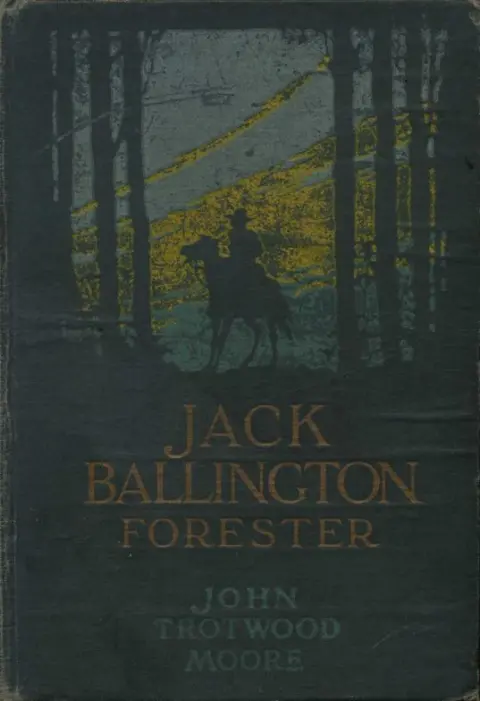
Jack Ballington, Forester
John Trotwood Moore
THE CLASSIC COLLECTION · 1906
"The Bishop of Cottontown: A Story of the Southern Cotton Mills" by John Trotwood Moore is a novel written in the early 20th century. The story is set in the Southern cotton mills of Tennessee and deals with themes of ambition, social class, and the struggles of working-class individuals. Key characters introduced include Richard Travis, a man of strength but lacking moral integrity, and Helen Conway, a young woman entwined in the intricate social dynamics and romantic tensions of her community. The opening of the novel paints a vivid picture of the beauty of the cotton plant, likening its life cycle to artistic creation. It introduces the setting with descriptions emphasizing the vibrant landscape of the Tennessee Valley, reflecting on the area's harvests and the complexities of life in the cotton mills. The narrative transitions to characters like Richard Travis, who is portrayed with a blend of physical strength and moral weaknesses, and introduces the trace of romantic tension surrounding Helen Conway. This first section establishes a foundation of both lyrical descriptions and hints at deeper social issues, setting the stage for the unfolding drama amidst the struggle for existence in a changing Southern landscape.
Introduction adapted from the source catalogue; source summaries may be automatically generated.
Free to read · English · 154,383 words · No account needed
MAKE TIME FOR A GOOD BOOK
On by default. Untick to stop anonymous reading totals. Each page counts after 10 seconds in view. How this works.
Anonymous counting is on unless you have switched it off.
"I'd like to git you into the mill," said Jud. "I'd put you to wuck doin' somethin' that 'ud be worth while."
"Oh, yes, you would for a few years," sneered back Archie B. "Then
you'd put me under the groun', where I'd have plenty o' time to
res'."
"I'm goin' up there now to see yo' folks an' see if I can't git you
into the mill."
"Oh, you are?--Well, don't be in sech a hurry an' look heah at yo' snake-skin fust--didn't I tell you it 'ud be lined with a snake-skin?" And he threw down a last year's snake-skin which Bonaparte proceeded to rend with great fury.
"Now, come under here," went on Archie B. persuasively, "and I'll sho' you they're not pearly white, like a wood-pecker's, but cream-colored with little purple splotches scratched over 'em--like a fly-ketcher's."
Jud rode under and looked up. As he did so Archie B. suddenly turned the nest upside down, that Jud might see the eggs, and as he looked up four eggs shot out before he could duck his head, and caught him squarely between his shaggy eyes. Blinded, smeared with yelk and smarting with his eyes full of fine broken shell, he scrambled from his horse, with many oaths, and began feeling for the little branch of water which ran nearby.
"I'll cut that tree down, but I'll git you and wring yo' neck," he shouted, while Bonaparte endeavored to tear it down with his teeth.
But Archie B. did not wait. Slowly he slid down the tree, while Bonaparte, thunder-struck with joy, waited at the foot, his eyes glaring, his mouth wide open, anticipating the feast on fresh boy meat. Can he be--dare he be--coming down? Right into my jaws, too? The very thought of it stopped his snarls.
Jud's curses filled the air.
Down--down, slid Archie B., both legs locked around the tree, until some ten feet above the dog, and, then tantalizingly, just out of reach, he suddenly tightened his brown brakes of legs, and thrusting his hand in his pocket, pulled out a small rubber ball. Reaching over, he squirted half of its contents over the dog, which still sat snarling, half in fury and half in wonder.
Then something happened. Jud could not see, being down on his knees in the little stream, washing his eyes, but he first heard demoniacal barks proceed from Bonaparte, ending in wailful snorts, howls and whines, beginning at the foot of the tree and echoing in a fast vanishing wail toward home.
Your reading position is saved on this browser. Take it to another device with a library code. Reading pages adapt to text, rather than matching a printed edition.
John Trotwood Moore
BEHIND THE BOOK
This eBook is for the use of anyone anywhere in the United States and most other parts of the world at no cost and with almost no restrictions whatsoever. You may copy it, give it away or re-use it under the terms of the Project Gutenberg License included with this eBook or online at www.gutenberg.org. If you are not located in the United States, you will have to check the laws of the country where you are located before using this eBook. Read the source licence.
The original source file, including credits and licence, is retained by this library. Request an original-format copy at no charge. Please include the book title and Project Gutenberg identifier #23637.
KEEP YOUR CURIOSITY GOING
Coulson Kernahan

Maurice Baring
Frances Wright
Cécile Tormay

Frederic Jesup Stimson

W. H. P. (William Henry Pope) Jarvis