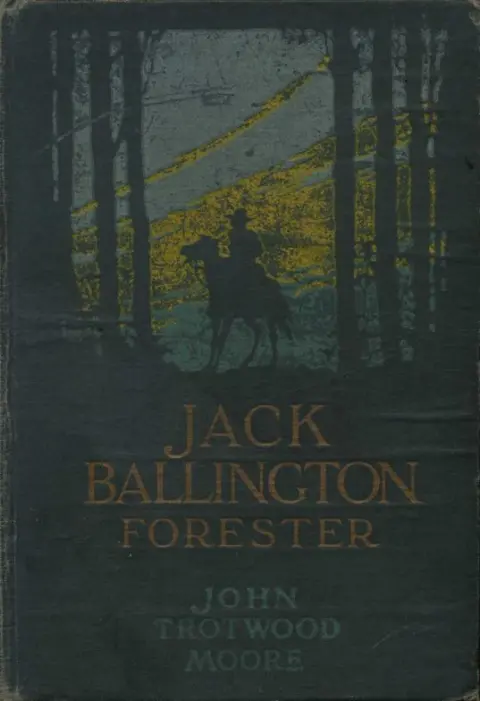
Jack Ballington, Forester
John Trotwood Moore
THE CLASSIC COLLECTION · 1906
"The Bishop of Cottontown: A Story of the Southern Cotton Mills" by John Trotwood Moore is a novel written in the early 20th century. The story is set in the Southern cotton mills of Tennessee and deals with themes of ambition, social class, and the struggles of working-class individuals. Key characters introduced include Richard Travis, a man of strength but lacking moral integrity, and Helen Conway, a young woman entwined in the intricate social dynamics and romantic tensions of her community. The opening of the novel paints a vivid picture of the beauty of the cotton plant, likening its life cycle to artistic creation. It introduces the setting with descriptions emphasizing the vibrant landscape of the Tennessee Valley, reflecting on the area's harvests and the complexities of life in the cotton mills. The narrative transitions to characters like Richard Travis, who is portrayed with a blend of physical strength and moral weaknesses, and introduces the trace of romantic tension surrounding Helen Conway. This first section establishes a foundation of both lyrical descriptions and hints at deeper social issues, setting the stage for the unfolding drama amidst the struggle for existence in a changing Southern landscape.
Introduction adapted from the source catalogue; source summaries may be automatically generated.
Free to read · English · 154,383 words · No account needed
MAKE TIME FOR A GOOD BOOK
On by default. Untick to stop anonymous reading totals. Each page counts after 10 seconds in view. How this works.
Anonymous counting is on unless you have switched it off.
The cotton blossom is the only flower that is born in the shuttle of a sunbeam and dies in a loom.
It is the most beautiful flower that grows, and needs only to become rare to be priceless--only to die to be idealized.
For the world worships that which it hopes to attain, and our ideals are those things just out of our reach.
Satiety has ten points and possession is nine of them.
If, in early August, the delicately green leaves of this most aristocratic of all plants, instead of covering acres of Southland shimmering under a throbbing sun, peeped daintily out, from among the well-kept beds of some noble garden, men would flock to see that plant, which, of all plants, looks most like a miniature tree.
A stout-hearted plant,--a tree, dwarfed, but losing not its dignity.
Then, one morning, with the earliest sunrise, and born of it, there emerges from the scalloped sea-shell of the bough an exquisite, pendulous, cream-white blossom, clasping in its center a golden yellow star, pinked with dawn points of light, and, setting high up under its sky of milk-white petals flanked with yellow stars, it seems to the little nestling field-wrens born beneath it to be the miniature arch of daybreak, ere the great eye of the morning star closes.
Later, when the sun rises and the sky above grows pink and purple, it, too, changes its color from pink to purple, copying the sky from zone to zone, from blue to deeper blue, until, at late evening the young nestlings may look up and say, in their bird language: "It is twilight."
What other flower among them can thus copy Nature, the great master?
Under every sky is a sphere, and under this sky picture, when night
falls and closes it, a sphere is born. And in that sphere is all of
earth.
Its oils and its minerals are there, and one day, becoming too full of richness, it bursts, and throws open a five-roomed granary, stored with richer fabric than ever came from the shuttles of Fez and holding globes of oil such as the olives of Hebron dreamed not of.
And in that fabric is the world clothed.
Oh, little loom of the cotton-plant, poet that can show us the sky, painter that paints it, artisan that reaches out, and, from the skein of a sunbeam, the loom of the air and the white of its own soul, weaves the cloth that clothes the world!
From dawn and darkness building a loom. From sunlight and shadow weaving threads of such fineness that the spider's were ropes of sand and the hoar frost's but clumsy icicles.
Your reading position is saved on this browser. Take it to another device with a library code. Reading pages adapt to text, rather than matching a printed edition.
John Trotwood Moore
BEHIND THE BOOK
This eBook is for the use of anyone anywhere in the United States and most other parts of the world at no cost and with almost no restrictions whatsoever. You may copy it, give it away or re-use it under the terms of the Project Gutenberg License included with this eBook or online at www.gutenberg.org. If you are not located in the United States, you will have to check the laws of the country where you are located before using this eBook. Read the source licence.
The original source file, including credits and licence, is retained by this library. Request an original-format copy at no charge. Please include the book title and Project Gutenberg identifier #23637.
KEEP YOUR CURIOSITY GOING
Coulson Kernahan

Maurice Baring
Frances Wright
Cécile Tormay

Frederic Jesup Stimson

W. H. P. (William Henry Pope) Jarvis