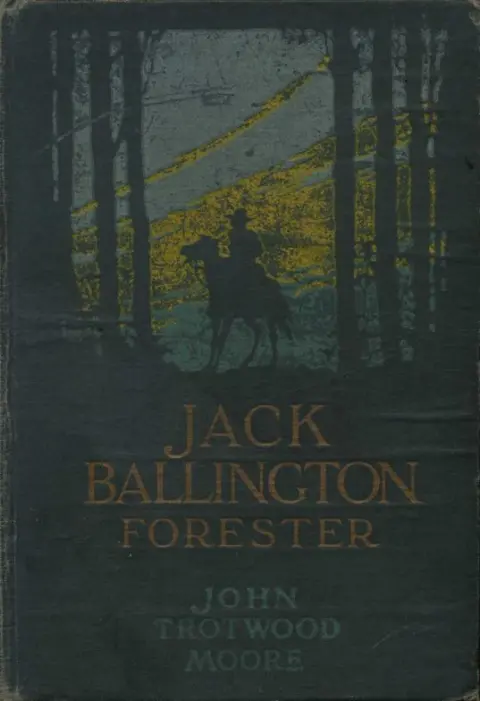
Jack Ballington, Forester
John Trotwood Moore
THE CLASSIC COLLECTION · 1906
"The Bishop of Cottontown: A Story of the Southern Cotton Mills" by John Trotwood Moore is a novel written in the early 20th century. The story is set in the Southern cotton mills of Tennessee and deals with themes of ambition, social class, and the struggles of working-class individuals. Key characters introduced include Richard Travis, a man of strength but lacking moral integrity, and Helen Conway, a young woman entwined in the intricate social dynamics and romantic tensions of her community. The opening of the novel paints a vivid picture of the beauty of the cotton plant, likening its life cycle to artistic creation. It introduces the setting with descriptions emphasizing the vibrant landscape of the Tennessee Valley, reflecting on the area's harvests and the complexities of life in the cotton mills. The narrative transitions to characters like Richard Travis, who is portrayed with a blend of physical strength and moral weaknesses, and introduces the trace of romantic tension surrounding Helen Conway. This first section establishes a foundation of both lyrical descriptions and hints at deeper social issues, setting the stage for the unfolding drama amidst the struggle for existence in a changing Southern landscape.
Introduction adapted from the source catalogue; source summaries may be automatically generated.
Free to read · English · 154,383 words · No account needed
MAKE TIME FOR A GOOD BOOK
On by default. Untick to stop anonymous reading totals. Each page counts after 10 seconds in view. How this works.
Anonymous counting is on unless you have switched it off.
The Bishop's flock consisted of two distinct classes: Cottontowners
and Hillites.
"There's only a fair sprinklin' of Hillites that lives nigh about here," said the Bishop, "an' they come because it suits them better than the high f'lutin' services in town. When a Christian gits into a church that's over his head, he is soon food for devil-fish."
The line of demarcation, even in the Bishop's small flock, was easily seen. The Hillites, though lean and lanky, were swarthy, healthy and full of life. "But Cottontown," said the Bishop, as he looked down on his congregation--"Cottontown jes' naturally feels tired."
It was true. Years in the factory had made them dead, listless, soulless and ambitionless creatures. To look into their faces was like looking into the cracked and muddy bottom of a stream which once ran.
Their children were there also--little tots, many of them, who worked in the factory because no man nor woman in all the State cared enough for them to make a fight for their childhood.
They were children only in age. Their little forms were not the forms of children, but of diminutive men and women, on whose backs the burden of earning their living had been laid, ere the frames had acquired the strength to bear it.
Stunted in mind and body, they were little solemn, pygmy peoples, whom poverty and overwork had canned up and compressed into concentrated extracts of humanity. The flavor--the juices of childhood--had been pressed out.
"'N no wonder," thought the Bishop, as he looked down upon them from his crude platform, "for them little things works six days every week in the factory from sun-up till dark, an' often into the night, with jes' forty minutes at noon to bolt their food. O God," he said softly to himself, "You who caused a stream of water to spring up in the wilderness that the life of an Ishmaelite might be saved, make a stream of sentiment to flow from the heart of the world to save these little folks."
Miss Patsy Butts, whose father, Elder Butts of the Hard-shell faith, owned a fertile little valley farm beyond the mountain, was organist. She was fat and so red-faced that at times she seemed to be oiled.
She was painfully frank and suffered from acute earnestness.
And now, being marriageable, she looked always about her with shy,
quick, expectant glances.
The other object in life, to Patsy, was to watch her younger brother, Archie B., and see that he kept out of mischief. And perhaps the commonest remark of her life was:
"Maw, jus' look at Archie B.!"
Your reading position is saved on this browser. Take it to another device with a library code. Reading pages adapt to text, rather than matching a printed edition.
John Trotwood Moore
BEHIND THE BOOK
This eBook is for the use of anyone anywhere in the United States and most other parts of the world at no cost and with almost no restrictions whatsoever. You may copy it, give it away or re-use it under the terms of the Project Gutenberg License included with this eBook or online at www.gutenberg.org. If you are not located in the United States, you will have to check the laws of the country where you are located before using this eBook. Read the source licence.
The original source file, including credits and licence, is retained by this library. Request an original-format copy at no charge. Please include the book title and Project Gutenberg identifier #23637.
KEEP YOUR CURIOSITY GOING
Coulson Kernahan

Maurice Baring
Frances Wright
Cécile Tormay

Frederic Jesup Stimson

W. H. P. (William Henry Pope) Jarvis