THE CLASSIC COLLECTION✦An outlaw’s diary: the CommuneCLASSIC FREE BOOKS
An outlaw’s diary: the Commune
Cécile Tormay
THE CLASSIC COLLECTION · 1918
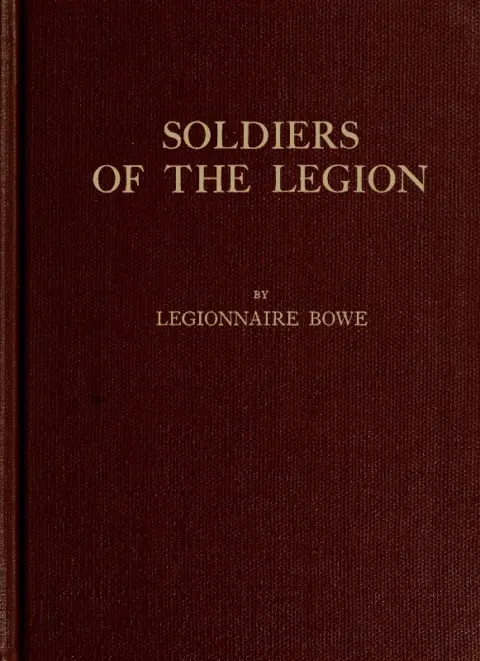
"Soldiers of the Legion, Trench-Etched" by John Bowe is a historical account written in the early 20th century. This narrative sheds light on the experiences of American volunteers who enlisted in the French Foreign Legion during World War I, aiming to capture the essence of camaraderie, sacrifice, and the diverse backgrounds of the legionnaires. The author, a veteran himself, aims to provide both a personal and broader view of these soldiers' motivations and encounters on the battlefield. At the start of the book, Bowe introduces his own journey as he prepares to join the Foreign Legion in France. He recounts his initial experiences at the Hotel des Invalides in Paris, where a mix of international soldiers undergoes intense training amid the backdrop of an advancing German army. The narrative emphasizes the harsh conditions, the diverse personalities present, and the immediate need for men at the front, ultimately highlighting the strong sense of unity and equality among the legionnaires, despite their varied origins. As Bowe transitions into his training, the opening sets the stage for a gripping exploration of war, identity, and the shared human experience amidst the chaos of conflict.
Introduction adapted from the source catalogue; source summaries may be automatically generated.
Free to read · English · 44,707 words · No account needed
MAKE TIME FOR A GOOD BOOK
On by default. Untick to stop anonymous reading totals. Each page counts after 10 seconds in view. How this works.
Anonymous counting is on unless you have switched it off.
In his last letter he wrote:—”Last night we slept in the second line trenches (not so bad), but today we are nose to nose with the enemy on the frontiest of fronts. It is the damnedest life imaginable. You are no longer treated like an irresponsible ass, but like a man, while you live the life of a beast or a savage.
=Guy Augustine=, of San Francisco, son of the U. S. Consul to Barcelona, member of the Foreign Legion, was decorated with the Croix de Guerre for bravery at Chalons-Sur-Marne, July 14, 1917.
=Sylvain Rosenberg=, New York, 23 years of age, son of Max Rosenberg, with the 19th Company of the 251st Regiment, wounded on the Marne, Sept. 7, 1914;—in Argonne, Dec. 8, 1915,—cited in the Orders of the Day,—and killed March 15, 1916, at Verdun.
=The Lafayette Escadrille=, No. 124, is an offspring of the Legion, formed by Rockwell, Curtis, Thaw, Hall, Back, Chapman, Cowdin and Prince, who kept pounding the Colonel of the Legion on the back, so much that he gave his consent, to get rid of them. It has formed a nucleus of All-Americans that became the start, or foundation, of that immense fleet of aeroplanes that is to furnish the eyes that will find the weak places in the enemy’s line through which the Allies will march to victory. First Americans to carry their national flag into action as a fighting unit, April 11, 1917.
Originally called the Franco-American Escadrille, but the name was changed to satisfy pro-Germans, who claimed to be Americans, but these aviators did not change their emblem. The Red Indian sign is still on the machines. The old boys from the Legion are in the seats, and we hope to see every man an officer, dressed in the uniform of his own country.
About the time the United States entered the war, the Americans of the Legion offered their services to the American Government at home and were not then accepted and the following letter, among others, was sent to the New York Herald by a French lady:—
=”American Veterans in France.=
“April 28, 1917.
“Sir:—May I ask through your columns why it is that those few Americans, brave enough to seek voluntarily, while their country was still neutral, the ranks, of our army, have not yet been claimed by their own Government, whose citizens they remain, while all at home are apparently receiving commissions and honor, are these men to remain sergeants and soldiers in the French Army, unrecognized and unhonored by their mother country?
“To me, their part was such a beautiful one, to leave home and luxury and peace for this carnage to follow their ideals, to risk death voluntarily, if it aid their friends.
Your reading position is saved on this browser. Take it to another device with a library code. Reading pages adapt to text, rather than matching a printed edition.
BEHIND THE BOOK
This eBook is for the use of anyone anywhere in the United States and most other parts of the world at no cost and with almost no restrictions whatsoever. You may copy it, give it away or re-use it under the terms of the Project Gutenberg License included with this eBook or online at www.gutenberg.org. If you are not located in the United States, you will have to check the laws of the country where you are located before using this eBook. Read the source licence.
The original source file, including credits and licence, is retained by this library. Request an original-format copy at no charge. Please include the book title and Project Gutenberg identifier #54057.
KEEP YOUR CURIOSITY GOING
Cécile Tormay

Moritz Busch
John L. Ransom
Frances Wright
Cécile Tormay

Mabel Potter Daggett