THE CLASSIC COLLECTION✦An outlaw’s diary: the CommuneCLASSIC FREE BOOKS
An outlaw’s diary: the Commune
Cécile Tormay
THE CLASSIC COLLECTION · 1918
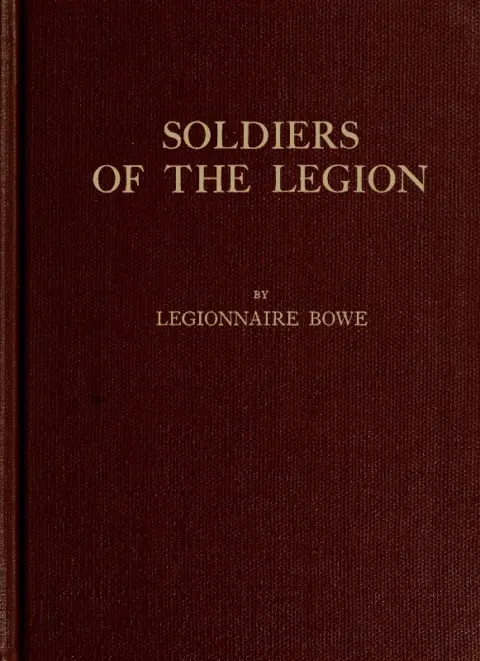
"Soldiers of the Legion, Trench-Etched" by John Bowe is a historical account written in the early 20th century. This narrative sheds light on the experiences of American volunteers who enlisted in the French Foreign Legion during World War I, aiming to capture the essence of camaraderie, sacrifice, and the diverse backgrounds of the legionnaires. The author, a veteran himself, aims to provide both a personal and broader view of these soldiers' motivations and encounters on the battlefield. At the start of the book, Bowe introduces his own journey as he prepares to join the Foreign Legion in France. He recounts his initial experiences at the Hotel des Invalides in Paris, where a mix of international soldiers undergoes intense training amid the backdrop of an advancing German army. The narrative emphasizes the harsh conditions, the diverse personalities present, and the immediate need for men at the front, ultimately highlighting the strong sense of unity and equality among the legionnaires, despite their varied origins. As Bowe transitions into his training, the opening sets the stage for a gripping exploration of war, identity, and the shared human experience amidst the chaos of conflict.
Introduction adapted from the source catalogue; source summaries may be automatically generated.
Free to read · English · 44,707 words · No account needed
MAKE TIME FOR A GOOD BOOK
On by default. Untick to stop anonymous reading totals. Each page counts after 10 seconds in view. How this works.
Anonymous counting is on unless you have switched it off.
Within this present generation, men like Lord Kitchener, King Peter of Serbia, Vernof, a Russian prince, and Albert F. Nordmann, who died in Algeria and was reported a relative of Kaiser Wilhelm II, belonged to this famous corps. This chapter presents some illustrious foreigners who have served during the present war.
=Nagar Aza=, son of the Persian minister to France, decorated for bravery and three times cited in Army Orders, again cited and decorated for brilliant conduct at Auberieve, April 17, 1917.
=Edwin Bucher=, a Swiss sculptor, pupil of Roden and Bourdelle, has marked the resting places of the Foreign Legion by carving exquisite figures on the solid walls of everlasting rock.
=Marquis de Montesquion=, compelled to leave the French Army because his Catholic soul would not permit him to dismantle churches, joined the Foreign Legion. On Sept. 28, 1915, when acting as Lieutenant in Battalion G, 2nd Legion, he saw a German white flag projecting from the enemy’s position. He went over with eight men to take possession and all were shot down by the treacherous enemy and killed.
=M. Lobedef=, a Russian, promoted to lieutenant in 1915. He later returned to Russia and became Minister of Marine.
=Abel Djebelis=, a Maltese, winner of the Marathon race between Windsor and London, England, June, 1914. He was wounded at Champagne in 1915 and on the Somme in 1916, by two bullets each time. While waiting to be mustered out at Lyons, July, 1917, he entered a race under the name of Marius, and won from twenty competitors. Discharged for disability.
=M. Valsamakis=, a Greek, rose to a lieutenancy in the Legion and was decorated with the Legion of Honor. He returned home and was arrested in Athens for participating in the street riots of December, 1916.
=Piechkoff Gorky=, Russian, son of Maxim Gorky, the novelist, had an arm blown away by a shell. He received the Legion of Honor for bravery and is now attached to the Russian Mission in France.
=Bruno and Peppino Garibaldi=, Italians, sons of an illustrious father, killed in bayonet attack in Artois, spring of 1915. French admirers have had their profiles, in a medal, fitted into the statue of Garibaldi in the Square Lowendal, Paris. The square is named for one Legionnaire, the statue is built for another.
=Eilyaken=, an Egyptian, was attending the Conservatory of Music at Brussels when the war broke out. A natural born actor, he burlesqued the military system of the Legion so accurately that the sous-officers managed to keep him in prison in order to silence his cutting sarcasm. He was shot, square through both cheek bones, in the Champagne attack, in 1915, and carried to shelter on the back of an officer. Mustered out in 1916.
Your reading position is saved on this browser. Take it to another device with a library code. Reading pages adapt to text, rather than matching a printed edition.
BEHIND THE BOOK
This eBook is for the use of anyone anywhere in the United States and most other parts of the world at no cost and with almost no restrictions whatsoever. You may copy it, give it away or re-use it under the terms of the Project Gutenberg License included with this eBook or online at www.gutenberg.org. If you are not located in the United States, you will have to check the laws of the country where you are located before using this eBook. Read the source licence.
The original source file, including credits and licence, is retained by this library. Request an original-format copy at no charge. Please include the book title and Project Gutenberg identifier #54057.
KEEP YOUR CURIOSITY GOING
Cécile Tormay

Moritz Busch
John L. Ransom
Frances Wright
Cécile Tormay

Mabel Potter Daggett