THE CLASSIC COLLECTION✦An outlaw’s diary: the CommuneCLASSIC FREE BOOKS
An outlaw’s diary: the Commune
Cécile Tormay
THE CLASSIC COLLECTION · 1918
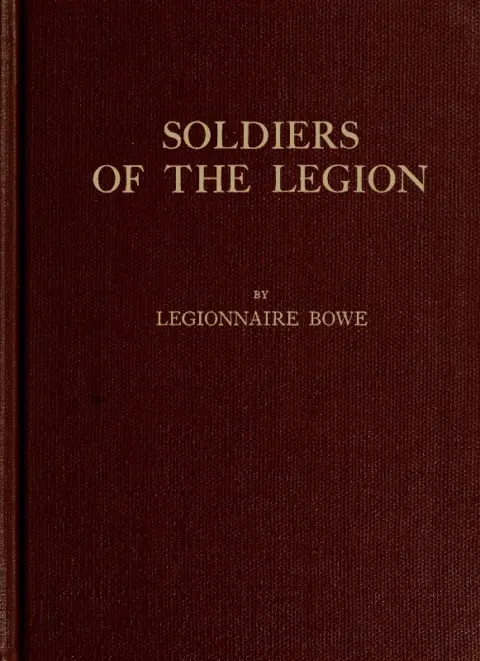
"Soldiers of the Legion, Trench-Etched" by John Bowe is a historical account written in the early 20th century. This narrative sheds light on the experiences of American volunteers who enlisted in the French Foreign Legion during World War I, aiming to capture the essence of camaraderie, sacrifice, and the diverse backgrounds of the legionnaires. The author, a veteran himself, aims to provide both a personal and broader view of these soldiers' motivations and encounters on the battlefield. At the start of the book, Bowe introduces his own journey as he prepares to join the Foreign Legion in France. He recounts his initial experiences at the Hotel des Invalides in Paris, where a mix of international soldiers undergoes intense training amid the backdrop of an advancing German army. The narrative emphasizes the harsh conditions, the diverse personalities present, and the immediate need for men at the front, ultimately highlighting the strong sense of unity and equality among the legionnaires, despite their varied origins. As Bowe transitions into his training, the opening sets the stage for a gripping exploration of war, identity, and the shared human experience amidst the chaos of conflict.
Introduction adapted from the source catalogue; source summaries may be automatically generated.
Free to read · English · 44,707 words · No account needed
MAKE TIME FOR A GOOD BOOK
On by default. Untick to stop anonymous reading totals. Each page counts after 10 seconds in view. How this works.
Anonymous counting is on unless you have switched it off.
The Foreign Legion has a notable record, which extends back to the Crusades. Then, French and Anglo-Saxon marched together, and fought to save the world for Christianity. History, repeating itself, after centuries, today, we see the same forces, side by side, fighting, dying, not only for Christianity, but for civilization. On the result of this clash with the barbarous Hun depends the preservation of the world.
At Pontevrault, twenty miles from Saumer, in the valley of the Loire, rest the remains of Richard Coeur-de-Lion, whose Anglo-Saxon heart, worn with hardship and suffering, ceased beating under the sunny skies of France, pierced by the poisoned arrow of a mysterious assassin from the far East.
Beneath the pavement, in front of the Church of the Holy Sepulchre, in Jerusalem, lie the remains of Philip D’Aubigne, a French knight, who fulfilled his vow to lay himself upon the threshold of that church which marks the place where rests the body of our Lord and Savior, Jesus Christ.
As the Anglo-Saxon perished in France, and the Frenchman died in Jerusalem, both for the cause of Right and Justice, today, millions leave native land to meet that organized force, which seeks to conquer, subdue, and enslave the people of all earth’s free countries.
Among ancient soldiers of the Foreign Legion were Broglie of Broglie, Rantzan, Lowendall, the Duke of Berwick, John Hitton, the son of an African king, and the Scottish Stuarts, with many other knights and men of note.
For their devotion, especially that of the Swiss Guards to the French Kings, the Legionnaires, were respected, even by their enemies, the Revolutionists, who, April 20, 1792, appealed to them to “desert the cause of Royal oppression, range themselves under the flag of France, and consecrate their efforts to the defense of liberty.” They responded, gathered under the tri-color, and, in 1795, commanded by Angereau, Marshal of France, one of Napoleon Bonaparte’s most trusted generals, won such renown that companies—frequently whole regiments of foreigners—flocked to their standard. In 1799, there were incorporated a regiment of Italians, a regiment of Poles and a regiment of Maltese. These made the campaign of Egypt with Napoleon. In 1809, a Portuguese, a Greek and an Irish regiment joined. In 1812, came a regiment of Mamelukes, who, January 7, 1814, had their name changed to Chasseurs of the Orient.
The Foreign Legion helped save France for the people in the Revolution. They shared in the glory and pomp of Napoleon’s dazzling career. They marched and suffered through the retreat from Moscow. Napoleon, on his return from Elba, created eight Regiments of the Foreign Legion, who shared the fate of the world’s greatest soldier at Waterloo.
Your reading position is saved on this browser. Take it to another device with a library code. Reading pages adapt to text, rather than matching a printed edition.
BEHIND THE BOOK
This eBook is for the use of anyone anywhere in the United States and most other parts of the world at no cost and with almost no restrictions whatsoever. You may copy it, give it away or re-use it under the terms of the Project Gutenberg License included with this eBook or online at www.gutenberg.org. If you are not located in the United States, you will have to check the laws of the country where you are located before using this eBook. Read the source licence.
The original source file, including credits and licence, is retained by this library. Request an original-format copy at no charge. Please include the book title and Project Gutenberg identifier #54057.
KEEP YOUR CURIOSITY GOING
Cécile Tormay

Moritz Busch
John L. Ransom
Frances Wright
Cécile Tormay

Mabel Potter Daggett