THE CLASSIC COLLECTION✦An outlaw’s diary: the CommuneCLASSIC FREE BOOKS
An outlaw’s diary: the Commune
Cécile Tormay
THE CLASSIC COLLECTION · 1918
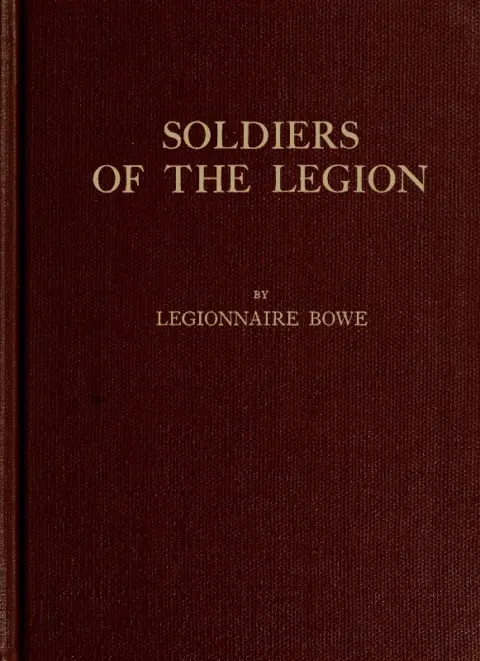
"Soldiers of the Legion, Trench-Etched" by John Bowe is a historical account written in the early 20th century. This narrative sheds light on the experiences of American volunteers who enlisted in the French Foreign Legion during World War I, aiming to capture the essence of camaraderie, sacrifice, and the diverse backgrounds of the legionnaires. The author, a veteran himself, aims to provide both a personal and broader view of these soldiers' motivations and encounters on the battlefield. At the start of the book, Bowe introduces his own journey as he prepares to join the Foreign Legion in France. He recounts his initial experiences at the Hotel des Invalides in Paris, where a mix of international soldiers undergoes intense training amid the backdrop of an advancing German army. The narrative emphasizes the harsh conditions, the diverse personalities present, and the immediate need for men at the front, ultimately highlighting the strong sense of unity and equality among the legionnaires, despite their varied origins. As Bowe transitions into his training, the opening sets the stage for a gripping exploration of war, identity, and the shared human experience amidst the chaos of conflict.
Introduction adapted from the source catalogue; source summaries may be automatically generated.
Free to read · English · 44,707 words · No account needed
MAKE TIME FOR A GOOD BOOK
On by default. Untick to stop anonymous reading totals. Each page counts after 10 seconds in view. How this works.
Anonymous counting is on unless you have switched it off.
From France in his last letter home he wrote,—“If anything happens to me you may be sure that I was on my way to victory for these troops may have been demolished, but never beaten.
He preferred to become a Petit Zephyr de la Legion Etrangere and to sleep, like the birds, under the open sky, surrounded by congenial comrades, exchanging horizons with each season.
=J. S. Carstairs=, a Harvard graduate, was a member of the Foreign
Legion.
=Geo. W. Ganson= put in the first winter in the trenches with the Foreign Legion. He was a Harvard graduate whose ministerial manner did not prevent the mud from hanging to his clothes, nor the whiskers on his face. He was mustered out and went back to America, but he returned to France in 1917 and went into the artillery service.
=Robert Pellissier=, a Harvard graduate, became a sergeant in Chasseur Alpins. He was killed on the Somme, August 29, 1916.
=Henry Augustus Coit=, a Harvard man, died of injuries received at the
front, August 7, 1916.
=Robert L. Culbert=, New York City, was killed in action in Belgium.
=Albert N. Depew=, an American youth, wears his Veterans of Foreign Wars badge beside his Croix de Guerre. He has been a gunner and chief petty officer in the United States navy, a member of the Foreign Legion, also captain of a gun turret on the French battle ship Cassard. After his honorable discharge from the American navy, he entered French service, was transferred to the Legion, fought on the west front, and participated in the spectacular Gallipoli campaign, was captured on the steamship Georgic by the Moewe, a German commerce raider, and spent months of torture in a German prison camp. He has written a book, “Gunner Depew”; and is at present on a speechmaking tour of America.
=Demetire=, St. Louis, Mo., soldier of the Legion, killed four Germans,—two with grenades, two with rifle, in an outpost engagement the night previous to the attack of April 17, 1917. Going over the top the following day, he was killed.
=Henry Beech Needham=, American journalist, was killed near Paris, 1915, while making a trial flight with Lieutenant Warneford, who was the first man to, alone, bring down a Zeppelin machine.
=D. Parrish Starr=, a Harvard graduate, was killed in action September
15, 1916.
=Andrew C. Champollion=, New York, an American, painter by profession, Harvard graduate, a big game hunter, went to the front March 1st, 1915. He was a descendant of the Champollion, who deciphered the Rosetta Stone, and grandson of Austin Carbin. His ancestors had followed Napoleon’s Eagles through Italy and Egypt and this boy was killed by a bullet in the forehead at Bois le Pietre, March 23, 1915.
Your reading position is saved on this browser. Take it to another device with a library code. Reading pages adapt to text, rather than matching a printed edition.
BEHIND THE BOOK
This eBook is for the use of anyone anywhere in the United States and most other parts of the world at no cost and with almost no restrictions whatsoever. You may copy it, give it away or re-use it under the terms of the Project Gutenberg License included with this eBook or online at www.gutenberg.org. If you are not located in the United States, you will have to check the laws of the country where you are located before using this eBook. Read the source licence.
The original source file, including credits and licence, is retained by this library. Request an original-format copy at no charge. Please include the book title and Project Gutenberg identifier #54057.
KEEP YOUR CURIOSITY GOING
Cécile Tormay

Moritz Busch
John L. Ransom
Frances Wright
Cécile Tormay

Mabel Potter Daggett