THE CLASSIC COLLECTION✦Black Nick, the hermit of the hills; or, The expiated crime A story of Burgoyne’s surrenderCLASSIC FREE BOOKS
Black Nick, the hermit of the hills; or, The expiated crime A story of Burgoyne’s surrender
Frederick Whittaker
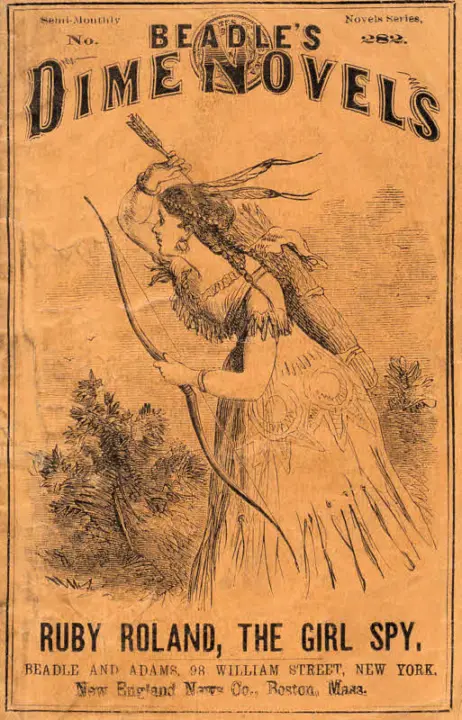
THE CLASSIC COLLECTION · 1873
"Ruby Roland, the Girl Spy; or, Simon Kenton’s Protege" by Frederick Whittaker is a historical novel written in the late 19th century. The story is set in the early period of American frontier life and follows the adventures of Ruby Roland, a young girl with ties to Native American tribes, and Simon Kenton, a famed frontiersman and scout. Together, they navigate the dangers of the wilderness, confront hostile forces, and unveil the greater political tensions of the time. The opening of the novel introduces Simon Kenton, who is initially engaged in a cautious maneuver across the Kentucky River while scouting for dangers, highlighting his experience and instincts as a ranger. As he navigates the treacherous landscape, he unexpectedly encounters another scout, leading to a tense moment of mistaken identity, which underscores the perilous nature of their environment. Shortly after, the narrative introduces Ruby Roland, who asserts her agency and bravery, prompting tension as both she and Kenton face the lurking threats of warfare and treachery. The chapter sets a gripping tone, intertwining themes of survival, identity, and the complexities of relationships in a tumultuous era.
Introduction adapted from the source catalogue; source summaries may be automatically generated.
Free to read · English · 35,021 words · No account needed
MAKE TIME FOR A GOOD BOOK
On by default. Untick to stop anonymous reading totals. Each page counts after 10 seconds in view. How this works.
Anonymous counting is on unless you have switched it off.
Clark heard the mocking words and wondered at the lad’s temerity, even while his anger rose to white heat. Frank looked so little and slender, so utterly unable to cope with the powerful and incensed colonel, that such a taunt as his conduct implied made it seem as if he must be crazy.
For the first time the words of Simon Kenton, as to the boy having been sun-struck, recurred to his mind, and for the moment a thrill of pity came to Clark. But as he looked at the boy and noted the quiet bravado of his manner, the supposition became untenable.
“There is too much method for madness, there,” thought the border
leader.
And, as he came to this conclusion, a stern frown settled on his brow, and he went to the windows. He carefully closed the shutters and locked the French casements so that no one could see in. Then, looking into an inner room, he ascertained that there were no more openings to be guarded.
He closed and locked the door of communication with equal deliberation, then advanced to the table at which Frank sat, and laid his hand heavily on his shoulder.
“Now, sir,” said Clark, between his shut teeth, “what is the meaning of
this?”
The lad looked up at him with an eye as fierce as his own.
“It means--take your hands off!”
For all answer Clark shook him fiercely, for it seemed as if the threat imbued him with ten-fold rage.
But, to his surprise, after the first fierce look, the boy did not either writhe or struggle, although the nervous grip of the powerful borderer must have caused intense pain, as the fingers sunk into his shoulder.
Feeling almost ashamed of himself, Clark released his hold, for the first feeling of the soft, delicate shoulder he had griped had convinced him that Frank was a mere child in his hands. He struck down the boy’s feet off the table with his open hand, and then released him, casting himself down in an opposite chair.
“Now, sir,” he said, sternly, “since you have learned your manners, tell me what is the meaning of all this?”
The little adjutant was quite silent, but he was breathing hard, and had changed his position. His face was now turned away from Clark and hidden by the tangled mass of curls. He made no answer.
After a while Clark repeated the question.
“Well, sir, what does this mean? Why have you, whom I have treated like my own son, suddenly found that nothing will do for you but insulting your colonel and exciting mutiny among my troops?”
Your reading position is saved on this browser. Take it to another device with a library code. Reading pages adapt to text, rather than matching a printed edition.
BEHIND THE BOOK
This eBook is for the use of anyone anywhere in the United States and most other parts of the world at no cost and with almost no restrictions whatsoever. You may copy it, give it away or re-use it under the terms of the Project Gutenberg License included with this eBook or online at www.gutenberg.org. If you are not located in the United States, you will have to check the laws of the country where you are located before using this eBook. Read the source licence.
The original source file, including credits and licence, is retained by this library. Request an original-format copy at no charge. Please include the book title and Project Gutenberg identifier #56620.
KEEP YOUR CURIOSITY GOING
Cécile Tormay

Moritz Busch
Coulson Kernahan
John L. Ransom

Maurice Baring
Frances Wright