THE CLASSIC COLLECTION✦Black Nick, the hermit of the hills; or, The expiated crime A story of Burgoyne’s surrenderCLASSIC FREE BOOKS
Black Nick, the hermit of the hills; or, The expiated crime A story of Burgoyne’s surrender
Frederick Whittaker
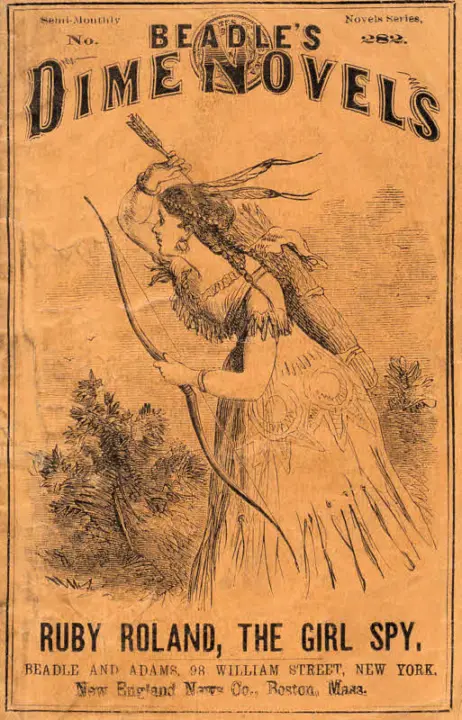
THE CLASSIC COLLECTION · 1873
"Ruby Roland, the Girl Spy; or, Simon Kenton’s Protege" by Frederick Whittaker is a historical novel written in the late 19th century. The story is set in the early period of American frontier life and follows the adventures of Ruby Roland, a young girl with ties to Native American tribes, and Simon Kenton, a famed frontiersman and scout. Together, they navigate the dangers of the wilderness, confront hostile forces, and unveil the greater political tensions of the time. The opening of the novel introduces Simon Kenton, who is initially engaged in a cautious maneuver across the Kentucky River while scouting for dangers, highlighting his experience and instincts as a ranger. As he navigates the treacherous landscape, he unexpectedly encounters another scout, leading to a tense moment of mistaken identity, which underscores the perilous nature of their environment. Shortly after, the narrative introduces Ruby Roland, who asserts her agency and bravery, prompting tension as both she and Kenton face the lurking threats of warfare and treachery. The chapter sets a gripping tone, intertwining themes of survival, identity, and the complexities of relationships in a tumultuous era.
Introduction adapted from the source catalogue; source summaries may be automatically generated.
Free to read · English · 35,021 words · No account needed
MAKE TIME FOR A GOOD BOOK
On by default. Untick to stop anonymous reading totals. Each page counts after 10 seconds in view. How this works.
Anonymous counting is on unless you have switched it off.
“I mean,” said the priest, quietly, “that every one in Kaskaskia, except Colonel Clark, is fully aware that he has fallen in love with Mademoiselle Roland, and that he is jealous of a mere boy, because that boy is a favorite of mademoiselle’s. Why, colonel, they are making songs about it in the streets.”
Even as the priest spoke, they heard a chorus of lads in the street, as the young rascals passed under the windows, singing at the top of their voices a doggerel ditty, to the old air of “Malbrook,” better known nowadays as “We won’t go home till morning.” Clark listened, and turned red and pale alternately, as he clutched his sword-hilt; for the boys were coupling his own name with Ruby’s in the disrespectful manner common to French gamin and New York “bhoy” alike.
For the benefit of our readers we append the song, with a free
translation:
“Le Colonel Clark est brave,
Mais il n’est qu’un esclave
Sous la main si douce et suave
De Mademoiselle Rubie Roland,
La demoiselle sauvage et belle-elle-elle,
La belle et sauvage demoiselle-elle-elle.
“Car Mademoiselle Rubie, la belle,
Le pousse debout de sa selle
Cette brave et sauvage demoiselle,
La demoiselle Rubie Roland,
La demoiselle Rubie Roland--and--and, etc.”[4]
No English words can convey, however, the mocking accent of the refrain in the chorus, and Clark was so much enraged that he would have rushed out into the street, had not father Gibault thrown himself into the way, crying:
“Hold, monsieur, in heaven’s name what are you about to do? Consider, that you will make yourself ridiculous. These people must sing, or they will plot.”
The colonel saw the folly of which he had nearly been guilty, and restrained himself. A moment later, he saw cause to congratulate himself, for, as he stood by the window, looking down at the impudent boys, the old French town constable made his appearance in the nick of time, and promptly collared two of the young scamps.
“You see, monsieur,” said father Gibault, pointing, “you did well to leave our old authorities in force. The old people will not suffer you to be insulted. See old Antoine. He knows hows to deal with the Kaskaskia boys.”
In effect, old Antoine seemed to be equal to the occasion, for he was a very strong old man, and he knocked the heads of the two boys together several times, with a force that made them howl again, while the rest of the lately uproarious group looked on, from afar off, in great dismay.
Your reading position is saved on this browser. Take it to another device with a library code. Reading pages adapt to text, rather than matching a printed edition.
BEHIND THE BOOK
This eBook is for the use of anyone anywhere in the United States and most other parts of the world at no cost and with almost no restrictions whatsoever. You may copy it, give it away or re-use it under the terms of the Project Gutenberg License included with this eBook or online at www.gutenberg.org. If you are not located in the United States, you will have to check the laws of the country where you are located before using this eBook. Read the source licence.
The original source file, including credits and licence, is retained by this library. Request an original-format copy at no charge. Please include the book title and Project Gutenberg identifier #56620.
KEEP YOUR CURIOSITY GOING
Cécile Tormay

Moritz Busch
Coulson Kernahan
John L. Ransom

Maurice Baring
Frances Wright