THE CLASSIC COLLECTION✦Black Nick, the hermit of the hills; or, The expiated crime A story of Burgoyne’s surrenderCLASSIC FREE BOOKS
Black Nick, the hermit of the hills; or, The expiated crime A story of Burgoyne’s surrender
Frederick Whittaker
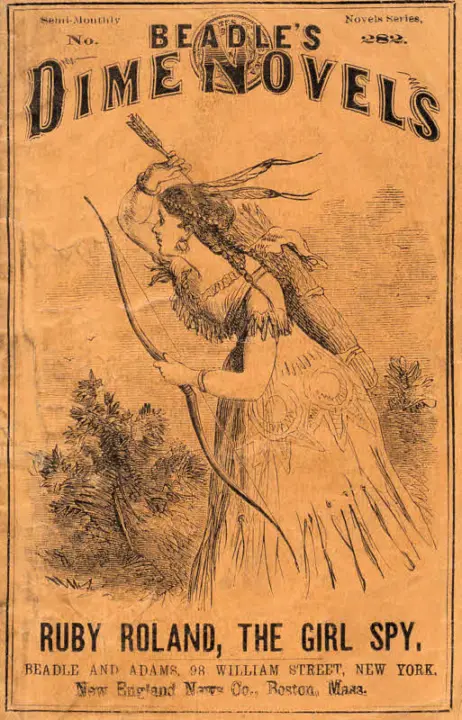
THE CLASSIC COLLECTION · 1873
"Ruby Roland, the Girl Spy; or, Simon Kenton’s Protege" by Frederick Whittaker is a historical novel written in the late 19th century. The story is set in the early period of American frontier life and follows the adventures of Ruby Roland, a young girl with ties to Native American tribes, and Simon Kenton, a famed frontiersman and scout. Together, they navigate the dangers of the wilderness, confront hostile forces, and unveil the greater political tensions of the time. The opening of the novel introduces Simon Kenton, who is initially engaged in a cautious maneuver across the Kentucky River while scouting for dangers, highlighting his experience and instincts as a ranger. As he navigates the treacherous landscape, he unexpectedly encounters another scout, leading to a tense moment of mistaken identity, which underscores the perilous nature of their environment. Shortly after, the narrative introduces Ruby Roland, who asserts her agency and bravery, prompting tension as both she and Kenton face the lurking threats of warfare and treachery. The chapter sets a gripping tone, intertwining themes of survival, identity, and the complexities of relationships in a tumultuous era.
Introduction adapted from the source catalogue; source summaries may be automatically generated.
Free to read · English · 35,021 words · No account needed
MAKE TIME FOR A GOOD BOOK
On by default. Untick to stop anonymous reading totals. Each page counts after 10 seconds in view. How this works.
Anonymous counting is on unless you have switched it off.
In a moment Clark strode forward to where the audacious officer stood, with a look of concentrated fury on his face. The backwoods leader possessed a furious temper, which he generally controlled only by exercise of an iron will. For a moment every one in the room thought that he was about to strike the boy down, and big Bill Harrod half-stepped forward to lay hands on his commander.
But, ere the big captain reached him, Clark had controlled his passion by a mighty effort, and spoke in a low, hoarse tone:
“Boy, while this expedition lasts, I command here. When it is over, I’ll give you satisfaction on equal terms. Think yourself lucky that I do not strangle you here. It is but your weakness protects you now. But do not dare again to breathe one word of disrespect toward the lady whom I saw this morning, or I will not answer for my forbearance. I have business. Go.”
He pointed to the door with a trembling finger, his face ashy pale, his eyes glittering dangerously. The little adjutant saluted, gravely, and went to the door.
At the door he turned and said, in a tone of indescribable insolency:
“What a coil, gentlemen, about a little squaw!”
Big Bill Harrod rushed at him with a stifled guffaw, and hustled him
off, growling:
“You tarnation sarcy little cuss, d’yer want ter get killed? Cunnel’s madder than twenty wildcats now.”
And indeed the good-natured borderer’s action was the only thing that brought Clark to his senses, for the exasperated chief had already half drawn his sword.
But as Harrod carried the boy down-stairs, the other officers gathered round Clark, expostulating, and Kenton remarked:
“Cunnel, the little cuss hev gone crazy, you may bet. He never acted so afore, and it’s b’en a tearin’ hot day. I suspicion he’s b’en sun-struck.”
“Drunk, more likely,” said Helm, in a tone of contempt. “Those boys are not fit to trust with a bottle of applejack. They go cracked in five minutes.”
“Let it pass, gentlemen,” said Clark, impatiently. “Remember we have business to do, and this priest and his friends are at the gate by this time. I’ll attend to that boy in due time. Now get ready to receive this deputation.”
They settled themselves in chairs round the room, and soon Bill Harrod lumbered in, escorting father Gibault and five venerable citizens, who trembled as if their last hour had come, and remained near the door, bowing confusedly, and looking among the ragged, dirty figures before them as if doubting the evidence of their senses.
At last the priest faltered out to Harrod:
Your reading position is saved on this browser. Take it to another device with a library code. Reading pages adapt to text, rather than matching a printed edition.
BEHIND THE BOOK
This eBook is for the use of anyone anywhere in the United States and most other parts of the world at no cost and with almost no restrictions whatsoever. You may copy it, give it away or re-use it under the terms of the Project Gutenberg License included with this eBook or online at www.gutenberg.org. If you are not located in the United States, you will have to check the laws of the country where you are located before using this eBook. Read the source licence.
The original source file, including credits and licence, is retained by this library. Request an original-format copy at no charge. Please include the book title and Project Gutenberg identifier #56620.
KEEP YOUR CURIOSITY GOING
Cécile Tormay

Moritz Busch
Coulson Kernahan
John L. Ransom

Maurice Baring
Frances Wright