THE CLASSIC COLLECTION✦Black Nick, the hermit of the hills; or, The expiated crime A story of Burgoyne’s surrenderCLASSIC FREE BOOKS
Black Nick, the hermit of the hills; or, The expiated crime A story of Burgoyne’s surrender
Frederick Whittaker
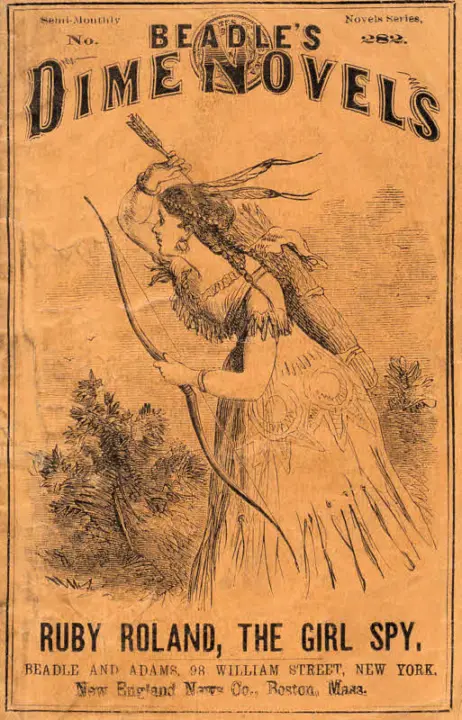
THE CLASSIC COLLECTION · 1873
"Ruby Roland, the Girl Spy; or, Simon Kenton’s Protege" by Frederick Whittaker is a historical novel written in the late 19th century. The story is set in the early period of American frontier life and follows the adventures of Ruby Roland, a young girl with ties to Native American tribes, and Simon Kenton, a famed frontiersman and scout. Together, they navigate the dangers of the wilderness, confront hostile forces, and unveil the greater political tensions of the time. The opening of the novel introduces Simon Kenton, who is initially engaged in a cautious maneuver across the Kentucky River while scouting for dangers, highlighting his experience and instincts as a ranger. As he navigates the treacherous landscape, he unexpectedly encounters another scout, leading to a tense moment of mistaken identity, which underscores the perilous nature of their environment. Shortly after, the narrative introduces Ruby Roland, who asserts her agency and bravery, prompting tension as both she and Kenton face the lurking threats of warfare and treachery. The chapter sets a gripping tone, intertwining themes of survival, identity, and the complexities of relationships in a tumultuous era.
Introduction adapted from the source catalogue; source summaries may be automatically generated.
Free to read · English · 35,021 words · No account needed
MAKE TIME FOR A GOOD BOOK
On by default. Untick to stop anonymous reading totals. Each page counts after 10 seconds in view. How this works.
Anonymous counting is on unless you have switched it off.
Honest Picard never dreamed that his flat-boat, which had conveyed so many loads of cabbage to Kaskaskia, would come one July night, to be a transport for ferocious enemies. But it was even so, now. Loaded down to the water’s edge with wild-looking backwoodsmen, it served as a ferry for the three companies destined to attack the town, and, in less than an hour after, the whole body was on its silent way to Kaskaskia.
At the moment of starting, Clark led the remaining company down the river toward the fort, only about a half-mile below. The men proceeded in Indian file, stealing along like ghosts; and a person a hundred yards off could have suspected nothing.
In a short time the gray bastions of the fort loomed up before them, standing at the edge of a high bank, down which one of its outworks stretched to the water’s edge.
The leader stayed his men with a signal and stole forward himself to reconnoiter, when the sound of voices in gay conversation struck his ear; and, the moment after, a little postern door low down by the water, opened, and two men came out and advanced toward the Americans as if careless of danger.
Without an order given, every one of the invaders sunk down to the earth in an instant and vanished from view, leaving Clark alone in the middle of the open glacis.
The commander did not drop. He knew that he had been seen, for the two men halted and seemed undecided whether to advance or not.
Suddenly one of them called out in French:
“Qui vive? (Who goes there?) Is it thou, Picard?”
Clark started violently. It was the voice of the missing adjutant. With admirable presence of mind he imitated the voice and rustic accent of the gardener, answering:
“It is I, indeed. Has the doctor gone back yet? My wife is sick.”
“The doctor went back at sunset,” answered Frank, “but here is Poirier, the hospital steward. He and I were coming over to break a bottle with thee, Picard; but, since thy wife is sick, Poirier shall do what he can.”
“Come on then, in God’s name,” said Clark, turning away to aid the stratagem. “You have a lancet to let blood, without doubt. Hasten, ere it be too late. She has fits.”
“Come on, Poirier,” cried the little adjutant; and the hospital steward, completely deceived, hurried along after Clark, until in the midst of the crouching borderers.
In another moment he was surrounded, and a dozen knives brandished at his throat, with a sternly whispered command to keep silence, if he valued his life.
Your reading position is saved on this browser. Take it to another device with a library code. Reading pages adapt to text, rather than matching a printed edition.
BEHIND THE BOOK
This eBook is for the use of anyone anywhere in the United States and most other parts of the world at no cost and with almost no restrictions whatsoever. You may copy it, give it away or re-use it under the terms of the Project Gutenberg License included with this eBook or online at www.gutenberg.org. If you are not located in the United States, you will have to check the laws of the country where you are located before using this eBook. Read the source licence.
The original source file, including credits and licence, is retained by this library. Request an original-format copy at no charge. Please include the book title and Project Gutenberg identifier #56620.
KEEP YOUR CURIOSITY GOING
Cécile Tormay

Moritz Busch
Coulson Kernahan
John L. Ransom

Maurice Baring
Frances Wright