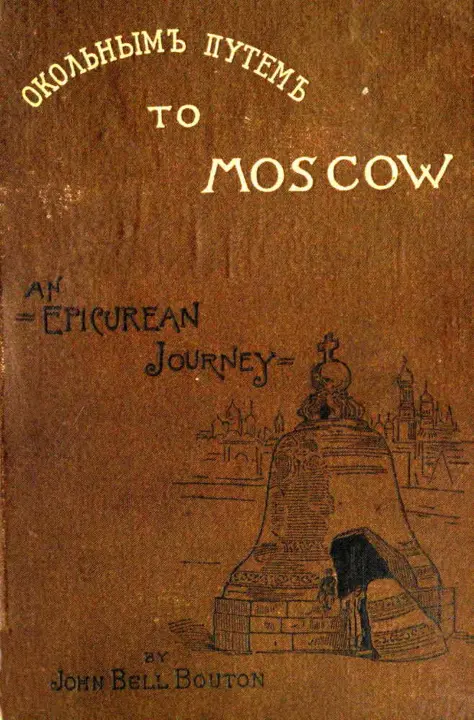
Roundabout to Moscow: An Epicurean Journey
John Bell Bouton
THE CLASSIC COLLECTION · 1864
"Round the Block: An American Novel" by John Bell Bouton is a fictional work likely written in the mid-19th century. The narrative begins by vividly depicting a neighborhood characterized by contrasting settings—posh, seemingly empty brownstone houses on one side and lively, bustling shops and homes for working-class families on the opposite. The story primarily revolves around three bachelors, Marcus Wilkeson, Fayette Overtop, and Matthew Maltboy, who embark on a series of social interactions within their block, exploring themes of neighborliness and community amidst their varied daily lives. The opening of the novel introduces readers to the ornate yet lifeless dwellings on the east side of the block and the contrasting vibrancy on the west side. As the three bachelors settle into their shared home, Overtop proposes an experiment in socializing, advocating for engaging with their neighbors to better understand their community. This leads to humorous exchanges and the deepening relationships between the protagonists as they navigate social calls, interactions with their eccentric neighbors, and the pursuit of companionship, all while their personal quirks and backgrounds unfold. The narrative sets a lively tone that promises both comedic moments and reflections on human interaction in a densely populated urban setting.
Introduction adapted from the source catalogue; source summaries may be automatically generated.
Free to read · English · 151,552 words · No account needed
MAKE TIME FOR A GOOD BOOK
On by default. Untick to stop anonymous reading totals. Each page counts after 10 seconds in view. How this works.
Anonymous counting is on unless you have switched it off.
"I am very glad to hear of it, sir," said Bog, awkwardly, but with an air of profound respect. "How--how is the masheen, sir?" Bog asked the question hurriedly, as if the machine were a sick person, whose health he had until then forgotten to inquire after.
"Getting on finely, Bog. Only two or three springs, a cog here, a ratchet here, a band at this point, and a lever up there (Mr. Minford touched portions of the machine rapidly), and then look out for a noise!"
"A noise!" repeated Bog, with juvenile earnestness.
"Not an explosion, my good fellow, but tremendous public excitement--plenty of fame, mixed with a good deal of abuse at first, and a little money, I hope." The inventor's eyes flashed with the fire that Bog had often seen; and when he emphasized the word "little," Bog knew that he meant to express the boundlessness of the wealth that his labors would bring to him.
"I believe it," said Bog, with sincerity pictured in every lineament of his honest face. "I've always believed it."
"So you have, my dear Bog; and your faith has often cheered me," replied the inventor, patronizingly. "By the way, how's your aunt?"
"Oh, yes; how is your aunt, Bog?" asked Pet. "I had quite forgotten
her."
"She's pooty well, ony them rheumatics troubles her some. They're workin' their way from her left arm into her head, aunt says. Week afore last they was in her feet, and they've ben clear round her and goin' back agen since then. Queer things, them rheumatics!"
"They are very painful, Bog, you know," said Pet.
"Yes; so aunt says." Bog did not add, as he might have truly done, "A
thousand times a day."
"Give her my kind regards, Bog, and say I will call and see her,"
continued Pet.
"My respectful regards also," added Mr. Minford.
"Thank you," said the boy; "but I guess you better not call, Miss Minford. Aunt's a good woman, but kind o' cur'us, you know. Them rheumatics has made a great change in her." Bog here referred, but made no verbal allusion, to a certain friendly call which Pet had once made upon his aunt, on which occasion that elderly lady had entertained her visitor with a monologue two hours long, giving her a complete history of the malady, from its birth in the right great toe, three years previous, through all its eccentric phenomena, to that stage of the disease which made it, as the venerable sufferer observed with, some pride, the "very wust case the doctors ever heerd of."
Your reading position is saved on this browser. Take it to another device with a library code. Reading pages adapt to text, rather than matching a printed edition.
John Bell Bouton
BEHIND THE BOOK
This eBook is for the use of anyone anywhere in the United States and most other parts of the world at no cost and with almost no restrictions whatsoever. You may copy it, give it away or re-use it under the terms of the Project Gutenberg License included with this eBook or online at www.gutenberg.org. If you are not located in the United States, you will have to check the laws of the country where you are located before using this eBook. Read the source licence.
The original source file, including credits and licence, is retained by this library. Request an original-format copy at no charge. Please include the book title and Project Gutenberg identifier #12243.
KEEP YOUR CURIOSITY GOING
Coulson Kernahan

Maurice Baring
Frances Wright
Cécile Tormay

Frederic Jesup Stimson

W. H. P. (William Henry Pope) Jarvis