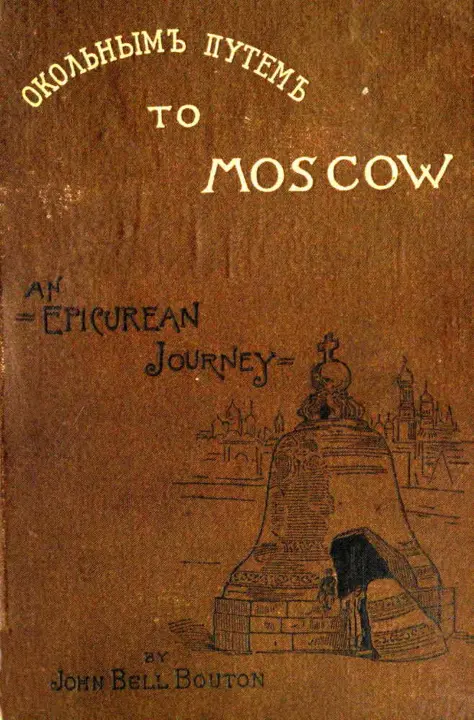
Roundabout to Moscow: An Epicurean Journey
John Bell Bouton
THE CLASSIC COLLECTION · 1864
"Round the Block: An American Novel" by John Bell Bouton is a fictional work likely written in the mid-19th century. The narrative begins by vividly depicting a neighborhood characterized by contrasting settings—posh, seemingly empty brownstone houses on one side and lively, bustling shops and homes for working-class families on the opposite. The story primarily revolves around three bachelors, Marcus Wilkeson, Fayette Overtop, and Matthew Maltboy, who embark on a series of social interactions within their block, exploring themes of neighborliness and community amidst their varied daily lives. The opening of the novel introduces readers to the ornate yet lifeless dwellings on the east side of the block and the contrasting vibrancy on the west side. As the three bachelors settle into their shared home, Overtop proposes an experiment in socializing, advocating for engaging with their neighbors to better understand their community. This leads to humorous exchanges and the deepening relationships between the protagonists as they navigate social calls, interactions with their eccentric neighbors, and the pursuit of companionship, all while their personal quirks and backgrounds unfold. The narrative sets a lively tone that promises both comedic moments and reflections on human interaction in a densely populated urban setting.
Introduction adapted from the source catalogue; source summaries may be automatically generated.
Free to read · English · 151,552 words · No account needed
MAKE TIME FOR A GOOD BOOK
On by default. Untick to stop anonymous reading totals. Each page counts after 10 seconds in view. How this works.
Anonymous counting is on unless you have switched it off.
Profiting by Mrs. Frump's friendly suggestion, Matthew had exhausted all his resources of conversation in an effort to interest Miss Trapper. She had listened, and had returned faultlessly proper replies, and had conducted herself so much like all the other young women that Matthew had ever met, that he was puzzled to guess in what respect her singularity consisted. He longed to see a piece of that mind, which, according to Mrs. Frump, she was in the habit of exhibiting to people. He was soon gratified.
Miss Trapper had remarked, that, in a few days, she was going to visit her friends in Chemung County, and would probably remain there three months. It struck Matthew as the right time to make a point.
"Then I shall not see you, Miss Trapper, during all that time!" he said,
with a sigh.
Miss Trapper levelled a sharp glance at him, and said, "I suppose not."
The remark was tartly made; but Matthew had noticed that she habitually
spoke quick and short.
"Our acquaintance has thus far been very pleasant, Miss Trapper; at least on my side," whispered Matthew. "Must it stop here?"
To which Miss Trapper replied, "I don't know."
Though the observation was not encouraging, it was, on the other hand,
not entirely forbidding.
"Since we are to be separated for three months, Miss Trapper, might I solicit the great privilege of corresponding with you occasionally?"
Miss Trapper's thin lips expelled two words, like shot out of a gun:
"What for?"
"What for?" echoed the amazed Matthew. "Why--for the pleasure of exchanging our ideas, you know."
"That would be a bore," said Miss Trapper.
"I didn't understand you," said Matthew, distrusting his ears.
"I said it would be a bore--a bore!" returned Miss Trapper, with painful distinctness. "I hate letter writing."
"Oh! ah! Do you?" said Matthew, feebly. "Perhaps you would like some pickled cauliflower, Miss Trapper?"
"Thank you."
Matthew handed the pickled cauliflower to her, and held his tongue, satisfied with what he had seen of Miss Trapper's singularity, and not at all anxious to receive a larger piece of her mind.
"I am doomed to be a bachelor," thought Matthew, with a suppressed groan. But Hope, which attends upon fat and lean men alike, whispered in his mind's ear, "Why not marry a woman as fat as yourself?"
"A capital idea!" thought Matthew "and if there's no other way to find one, I'll advertise for her."
Your reading position is saved on this browser. Take it to another device with a library code. Reading pages adapt to text, rather than matching a printed edition.
John Bell Bouton
BEHIND THE BOOK
This eBook is for the use of anyone anywhere in the United States and most other parts of the world at no cost and with almost no restrictions whatsoever. You may copy it, give it away or re-use it under the terms of the Project Gutenberg License included with this eBook or online at www.gutenberg.org. If you are not located in the United States, you will have to check the laws of the country where you are located before using this eBook. Read the source licence.
The original source file, including credits and licence, is retained by this library. Request an original-format copy at no charge. Please include the book title and Project Gutenberg identifier #12243.
KEEP YOUR CURIOSITY GOING
Coulson Kernahan

Maurice Baring
Frances Wright
Cécile Tormay

Frederic Jesup Stimson

W. H. P. (William Henry Pope) Jarvis