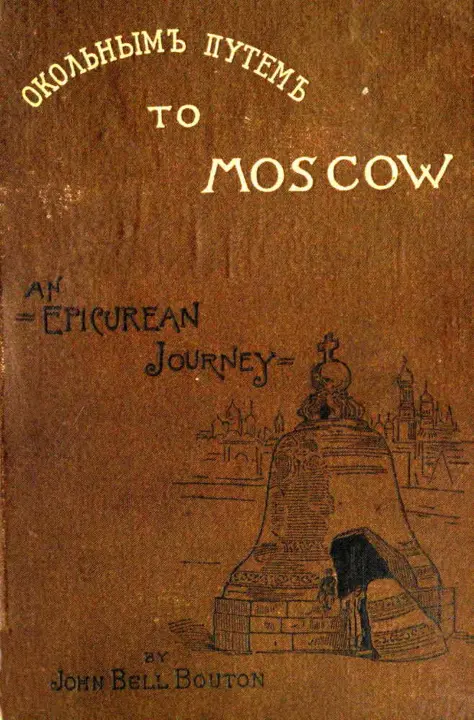
Roundabout to Moscow: An Epicurean Journey
John Bell Bouton
THE CLASSIC COLLECTION · 1864
"Round the Block: An American Novel" by John Bell Bouton is a fictional work likely written in the mid-19th century. The narrative begins by vividly depicting a neighborhood characterized by contrasting settings—posh, seemingly empty brownstone houses on one side and lively, bustling shops and homes for working-class families on the opposite. The story primarily revolves around three bachelors, Marcus Wilkeson, Fayette Overtop, and Matthew Maltboy, who embark on a series of social interactions within their block, exploring themes of neighborliness and community amidst their varied daily lives. The opening of the novel introduces readers to the ornate yet lifeless dwellings on the east side of the block and the contrasting vibrancy on the west side. As the three bachelors settle into their shared home, Overtop proposes an experiment in socializing, advocating for engaging with their neighbors to better understand their community. This leads to humorous exchanges and the deepening relationships between the protagonists as they navigate social calls, interactions with their eccentric neighbors, and the pursuit of companionship, all while their personal quirks and backgrounds unfold. The narrative sets a lively tone that promises both comedic moments and reflections on human interaction in a densely populated urban setting.
Introduction adapted from the source catalogue; source summaries may be automatically generated.
Free to read · English · 151,552 words · No account needed
MAKE TIME FOR A GOOD BOOK
On by default. Untick to stop anonymous reading totals. Each page counts after 10 seconds in view. How this works.
Anonymous counting is on unless you have switched it off.
"I wish you joy," said he. "And you too, Mr. Frump. I never had the pleasure of meeting you often, though I had frequently heard of you. With regard to those unpleasant family difficulties in which you became involved, they are now at an end; for Gusty's parents are both dead, and the old house and farm are sold. Let bygones be bygones."
"So say I, Mr. Van Quintem," said Mr. Frump, grasping the extended hand. "As for my wife's relatives, I'm sure I allers forgave 'em. As for the old house and farm, if you like, Gusty, we'll buy it back agin."
Mrs. Frump, still resting on her husband's shoulder, sobbed a little, and clung closer about him.
"Here is one friend of the family," continued Amos, in his pleasantest manner, pointing to Matthew, "whom I don't know by name, though we've scraped an off-hand 'quaintance."
"Mr. Frump--Matthew Maltboy, Esq.," said old Van Quintem.
Matthew, like Mrs. Frump, had fully appreciated the awkwardness of his situation, and had kept a rigid silence since the returned Californian resumed possession of his wife. The minute after Mr. Frump's identity had been established, Matthew could have hugged him with ecstasy. But, having lost the widow, his fickle mind straightway began to discover in her a great many excellencies that he had never seen before. Therefore, when he submitted his hand to the grip of Mr. Frump, his face expressed a strangely mingled joy and regret.
"I like you," said Mr. Frump, "and, as soon as wifey and I commence housekeepin' agin, I'll expect lots o' visits from you. Whenever I'm not at home, wifey'll make everything comfortable. Won't you, dear?"
"If you wish it," replied Mrs. Frump, looking up into his face, which was not a repulsive one, "for your word shall always be my law."
"I must say," said Matthew, his face exhibiting unqualified admiration for Mr. Frump, "that you are the most generous man I ever met. And, if Mrs. Frump will promise to introduce me to some nice young woman, that she could recommend for a wife, perhaps I'll accept your invitation."
"I'll get you a wife in less than a week," said Mrs. F., who was rejoiced that the interview between her recovered husband and late suitor had ended peacefully.
"But one thing you haven't yet explained, Amos," said old Van Quintem. "How did you get into Crumley's employment?"
Your reading position is saved on this browser. Take it to another device with a library code. Reading pages adapt to text, rather than matching a printed edition.
John Bell Bouton
BEHIND THE BOOK
This eBook is for the use of anyone anywhere in the United States and most other parts of the world at no cost and with almost no restrictions whatsoever. You may copy it, give it away or re-use it under the terms of the Project Gutenberg License included with this eBook or online at www.gutenberg.org. If you are not located in the United States, you will have to check the laws of the country where you are located before using this eBook. Read the source licence.
The original source file, including credits and licence, is retained by this library. Request an original-format copy at no charge. Please include the book title and Project Gutenberg identifier #12243.
KEEP YOUR CURIOSITY GOING
Coulson Kernahan

Maurice Baring
Frances Wright
Cécile Tormay

Frederic Jesup Stimson

W. H. P. (William Henry Pope) Jarvis