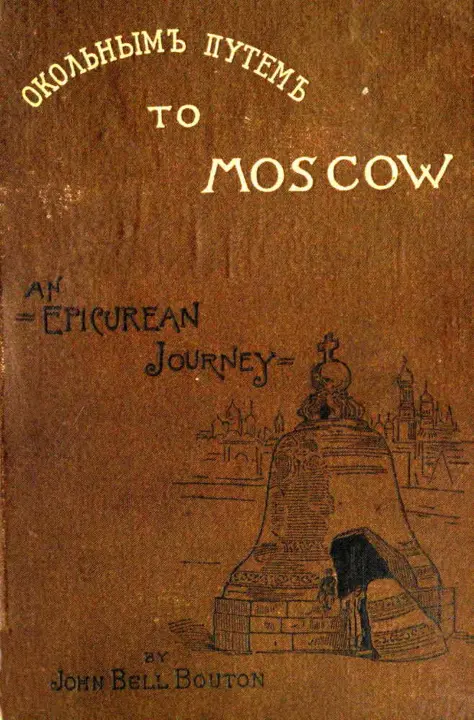
Roundabout to Moscow: An Epicurean Journey
John Bell Bouton
THE CLASSIC COLLECTION · 1864
"Round the Block: An American Novel" by John Bell Bouton is a fictional work likely written in the mid-19th century. The narrative begins by vividly depicting a neighborhood characterized by contrasting settings—posh, seemingly empty brownstone houses on one side and lively, bustling shops and homes for working-class families on the opposite. The story primarily revolves around three bachelors, Marcus Wilkeson, Fayette Overtop, and Matthew Maltboy, who embark on a series of social interactions within their block, exploring themes of neighborliness and community amidst their varied daily lives. The opening of the novel introduces readers to the ornate yet lifeless dwellings on the east side of the block and the contrasting vibrancy on the west side. As the three bachelors settle into their shared home, Overtop proposes an experiment in socializing, advocating for engaging with their neighbors to better understand their community. This leads to humorous exchanges and the deepening relationships between the protagonists as they navigate social calls, interactions with their eccentric neighbors, and the pursuit of companionship, all while their personal quirks and backgrounds unfold. The narrative sets a lively tone that promises both comedic moments and reflections on human interaction in a densely populated urban setting.
Introduction adapted from the source catalogue; source summaries may be automatically generated.
Free to read · English · 151,552 words · No account needed
MAKE TIME FOR A GOOD BOOK
On by default. Untick to stop anonymous reading totals. Each page counts after 10 seconds in view. How this works.
Anonymous counting is on unless you have switched it off.
"Why is it," thought Matthew, stretching himself in his chair, and looking critically at the widow, who was knitting crotchet work, "why is it that I no longer adore her? She is just as pretty, just as amiable, just as affectionate as ever. Now, why don't I care a button for her at this moment?" Matthew was not a transcendental philosopher; and the true answers to these questions did not come to him.
Old Van Quintem, pale and beautiful in his declining years, sat by the window that opened on the green leaves of the back yard, calmly smoking his pipe, and thinking, with a holy sadness, of his dead wife and his worse-than-dead son. The old gentleman, and the two quiet affianced ones, who sat near him, made up a well-dressed and handsome group; the pictorial effect of which was suddenly marred by the apparition of a stranger in the doorway.
He was tall, muscular, and what little could be seen of his face through a heavy growth of whiskers was mild and prepossessing, in spite of two large scars just visible below the broad brim of a rough hat. His dress was faded and dirty.
The stranger stood in the doorway, and surveyed the occupants of the
room.
Old Van Quintem looked at the intruder a moment, and then said, as if remembering something, "Are you the man sent by Crumley to mend my piazza railing?"
There was the least hesitation in the man's voice, as he answered, "Yes, sir. I'm here to do that job." His voice was a deep growl, as of a grizzly bear half tamed.
"Where are your tools?" asked old Van Quintem.
The stranger communed with himself, and then replied, in the most natural manner, "I s'pose I only want a saw, a hammer, and a few nails. You have 'em, haven't yer?"
"You're a funny sort of carpenter, to travel without your tools. Do you know, now, that you look more like a California miner than a carpenter?"
"That's not very 'markable," returned the stranger, in profound guttural accents, "considerin' as how I come from California this week."
"You have brought home tons of gold, I dare say," said old Van Quintem,
playfully.
"A little," growled the stranger. "The diggins was poor in Calaveras County when I fust went there, but latterly they improved."
At the mention of Calaveras County, the widow suddenly fixed her eyes upon the stranger, and then dropped them on her crotchet work.
Your reading position is saved on this browser. Take it to another device with a library code. Reading pages adapt to text, rather than matching a printed edition.
John Bell Bouton
BEHIND THE BOOK
This eBook is for the use of anyone anywhere in the United States and most other parts of the world at no cost and with almost no restrictions whatsoever. You may copy it, give it away or re-use it under the terms of the Project Gutenberg License included with this eBook or online at www.gutenberg.org. If you are not located in the United States, you will have to check the laws of the country where you are located before using this eBook. Read the source licence.
The original source file, including credits and licence, is retained by this library. Request an original-format copy at no charge. Please include the book title and Project Gutenberg identifier #12243.
KEEP YOUR CURIOSITY GOING
Coulson Kernahan

Maurice Baring
Frances Wright
Cécile Tormay

Frederic Jesup Stimson

W. H. P. (William Henry Pope) Jarvis