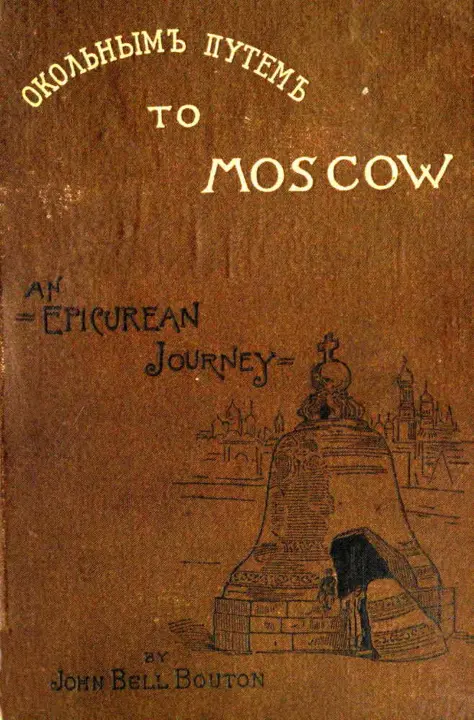
Roundabout to Moscow: An Epicurean Journey
John Bell Bouton
THE CLASSIC COLLECTION · 1864
"Round the Block: An American Novel" by John Bell Bouton is a fictional work likely written in the mid-19th century. The narrative begins by vividly depicting a neighborhood characterized by contrasting settings—posh, seemingly empty brownstone houses on one side and lively, bustling shops and homes for working-class families on the opposite. The story primarily revolves around three bachelors, Marcus Wilkeson, Fayette Overtop, and Matthew Maltboy, who embark on a series of social interactions within their block, exploring themes of neighborliness and community amidst their varied daily lives. The opening of the novel introduces readers to the ornate yet lifeless dwellings on the east side of the block and the contrasting vibrancy on the west side. As the three bachelors settle into their shared home, Overtop proposes an experiment in socializing, advocating for engaging with their neighbors to better understand their community. This leads to humorous exchanges and the deepening relationships between the protagonists as they navigate social calls, interactions with their eccentric neighbors, and the pursuit of companionship, all while their personal quirks and backgrounds unfold. The narrative sets a lively tone that promises both comedic moments and reflections on human interaction in a densely populated urban setting.
Introduction adapted from the source catalogue; source summaries may be automatically generated.
Free to read · English · 151,552 words · No account needed
MAKE TIME FOR A GOOD BOOK
On by default. Untick to stop anonymous reading totals. Each page counts after 10 seconds in view. How this works.
Anonymous counting is on unless you have switched it off.
Now Matthew had, in these fleeting fifteen minutes, thought up no plan of settlement. Being taken aback by the sudden reappearance of the creditors, he did not know what to propose.
"Everything fixed, I s'pose?" said Rickarts, the shoemaker.
When Matthew was in strong doubt what to do in any case, it was his invariable custom to postpone. "I think," he feebly suggested, "that we had better postpone final action, say till three P.M. It would give us time--"
"Can't come it!" "No go!" "Now, or never!" were some of the exclamations which went up from the excited crowd.
Matthew was too good natured to quarrel with these insinuations. "My friends," said he, "as you appear to have unlimited confidence in each other, suppose you appoint a committee to dispose of this property, which my client generously" (cries of "Oh! oh!") "turns over to you, and divide the proceeds among yourselves pro rata"
The creditors looked at each other suspiciously. A want of that childlike trust which, in a perfect state of society should exist between man and man, was unhappily too apparent.
Just then, when Matthew was at his wits' end, the police man who guarded the front door entered the room, and delivered a note to Mr. Whedell. That gentleman perused it languidly, and passed it to Matthew.
"Good news," said he. "Mr. Abernuckle, the owner of these premises, who was intending to move in to-day, writes that he will not be able to take possession until noon to-morrow. Therefore, I say, let the creditors employ an auctioneer, hang out the red flag, sell, and divide, before that period arrives."
The large creditors were silent--Quigg veiling his dissatisfaction under a look of complete misanthropy--but the small ones, headed by Rickarts, the shoemaker, highly commended it.
"Besides," added a butter man, who had originally been in the mock-auction line, "don't ye see, we can all stay at the auction, and kind o' bid on the things. Hey?" The butter man nodded at the lesser creditors.
The idea took; only a few of the larger creditors holding out against
it.
"My friends," again observed Matthew, drawing on his stores of legal knowledge, "you seem to forget that, if my client chose to resist your claims, he could retain a large amount of furniture as household articles under the law, which exempts certain necessary things. But, with rare magnanimity, he gives up all."
The allusion to magnanimity produced some derisive laughs, which
slightly nettled Matthew.
"Auction it off," said he, "or we throw ourselves back on our reserved
rights."
Your reading position is saved on this browser. Take it to another device with a library code. Reading pages adapt to text, rather than matching a printed edition.
John Bell Bouton
BEHIND THE BOOK
This eBook is for the use of anyone anywhere in the United States and most other parts of the world at no cost and with almost no restrictions whatsoever. You may copy it, give it away or re-use it under the terms of the Project Gutenberg License included with this eBook or online at www.gutenberg.org. If you are not located in the United States, you will have to check the laws of the country where you are located before using this eBook. Read the source licence.
The original source file, including credits and licence, is retained by this library. Request an original-format copy at no charge. Please include the book title and Project Gutenberg identifier #12243.
KEEP YOUR CURIOSITY GOING
Coulson Kernahan

Maurice Baring
Frances Wright
Cécile Tormay

Frederic Jesup Stimson

W. H. P. (William Henry Pope) Jarvis