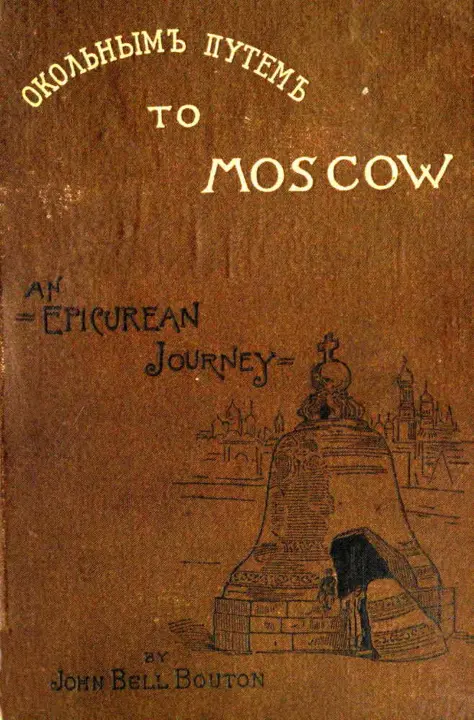
Roundabout to Moscow: An Epicurean Journey
John Bell Bouton
THE CLASSIC COLLECTION · 1864
"Round the Block: An American Novel" by John Bell Bouton is a fictional work likely written in the mid-19th century. The narrative begins by vividly depicting a neighborhood characterized by contrasting settings—posh, seemingly empty brownstone houses on one side and lively, bustling shops and homes for working-class families on the opposite. The story primarily revolves around three bachelors, Marcus Wilkeson, Fayette Overtop, and Matthew Maltboy, who embark on a series of social interactions within their block, exploring themes of neighborliness and community amidst their varied daily lives. The opening of the novel introduces readers to the ornate yet lifeless dwellings on the east side of the block and the contrasting vibrancy on the west side. As the three bachelors settle into their shared home, Overtop proposes an experiment in socializing, advocating for engaging with their neighbors to better understand their community. This leads to humorous exchanges and the deepening relationships between the protagonists as they navigate social calls, interactions with their eccentric neighbors, and the pursuit of companionship, all while their personal quirks and backgrounds unfold. The narrative sets a lively tone that promises both comedic moments and reflections on human interaction in a densely populated urban setting.
Introduction adapted from the source catalogue; source summaries may be automatically generated.
Free to read · English · 151,552 words · No account needed
MAKE TIME FOR A GOOD BOOK
On by default. Untick to stop anonymous reading totals. Each page counts after 10 seconds in view. How this works.
Anonymous counting is on unless you have switched it off.
The summery Chiffield answered, with a hearty laugh: "I see," said he; "it's a regular sell on both sides. However, neither of us is worse off than he was, since neither of us had anything. As for me, I have gained one point, for I have a tolerably good-looking wife."
Mr. Whedell was about to retort in a vein of unmitigated ferocity, when Mrs. Chiffield, who had been listening in the entry, and could contain herself no longer, rushed into the room, and, brandishing a small clenched hand in the face of her laughing spouse, forcibly observed:
"You sneaking, swindling, cheating, lying, black-hearted, ill-looking pauper, scoundrel, and vagabond!"
"Very prettily said," remarked the imperturbable Chiffield.
"You miserable thief!" continued his matrimonial partner, aiming a blow at him, which he playfully parried; "why didn't you tell me you were a beggar?"
"Why? Because you didn't ask me. For that matter, why didn't you or your father tell me that you were beggars?"
"I sha'n't answer your insulting questions, you mean, deceiving, ugly, ungentlemanly--" (no other epithet suggesting itself.) At this crisis, the infuriated wife burst into tears, and wished several times that she was dead.
"Poor, dear wifey!" said the emollient Chiffield.
"None of your 'poor dears' to my daughter, you jailbird!" screamed Mr.
Whedell.
"Now, don't get excited, father-in-law."
"How dare you call me father-in-law, sir!"
"Perhaps you prefer the more endearing epithet of 'poppy,' sir?"
"Monster! will you leave my house?"
"Have you any good old brandy on hand?" asked Chiffield.
"Brandy! No. If you want brandy, sir, go to the d---l for it."
"Not quite so far, thank you," retorted Chiffield the genial; "but I don't mind walking to the next corner for a smash."
Chiffield rose, put on his hat, and stepped toward the door.
"Good-by, wifey. I sha'n't be gone long."
A growl, bisected by a sob, was the only reply.
"By-by, poppy," said Chiffield, with a flippant wave of the hand.
Mr. Whedell cast at him a look of scorn, to which justice could be done in no known language; and Chiffield, with a bow of exceeding grace, left father and child to their reflections.
Your reading position is saved on this browser. Take it to another device with a library code. Reading pages adapt to text, rather than matching a printed edition.
John Bell Bouton
BEHIND THE BOOK
This eBook is for the use of anyone anywhere in the United States and most other parts of the world at no cost and with almost no restrictions whatsoever. You may copy it, give it away or re-use it under the terms of the Project Gutenberg License included with this eBook or online at www.gutenberg.org. If you are not located in the United States, you will have to check the laws of the country where you are located before using this eBook. Read the source licence.
The original source file, including credits and licence, is retained by this library. Request an original-format copy at no charge. Please include the book title and Project Gutenberg identifier #12243.
KEEP YOUR CURIOSITY GOING
Coulson Kernahan

Maurice Baring
Frances Wright
Cécile Tormay

Frederic Jesup Stimson

W. H. P. (William Henry Pope) Jarvis