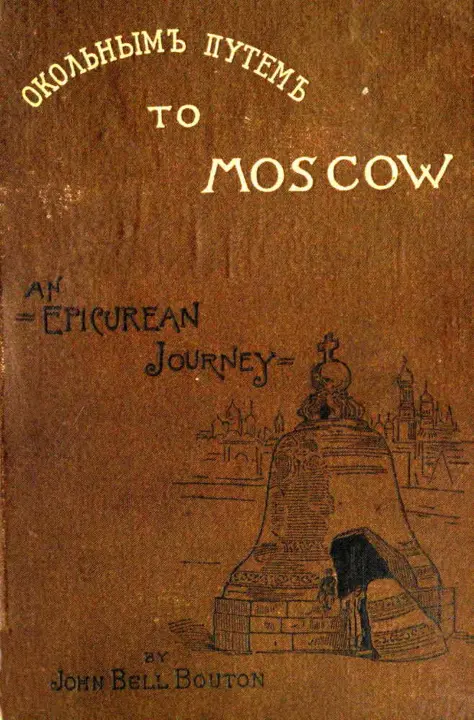
Roundabout to Moscow: An Epicurean Journey
John Bell Bouton
THE CLASSIC COLLECTION · 1864
"Round the Block: An American Novel" by John Bell Bouton is a fictional work likely written in the mid-19th century. The narrative begins by vividly depicting a neighborhood characterized by contrasting settings—posh, seemingly empty brownstone houses on one side and lively, bustling shops and homes for working-class families on the opposite. The story primarily revolves around three bachelors, Marcus Wilkeson, Fayette Overtop, and Matthew Maltboy, who embark on a series of social interactions within their block, exploring themes of neighborliness and community amidst their varied daily lives. The opening of the novel introduces readers to the ornate yet lifeless dwellings on the east side of the block and the contrasting vibrancy on the west side. As the three bachelors settle into their shared home, Overtop proposes an experiment in socializing, advocating for engaging with their neighbors to better understand their community. This leads to humorous exchanges and the deepening relationships between the protagonists as they navigate social calls, interactions with their eccentric neighbors, and the pursuit of companionship, all while their personal quirks and backgrounds unfold. The narrative sets a lively tone that promises both comedic moments and reflections on human interaction in a densely populated urban setting.
Introduction adapted from the source catalogue; source summaries may be automatically generated.
Free to read · English · 151,552 words · No account needed
MAKE TIME FOR A GOOD BOOK
On by default. Untick to stop anonymous reading totals. Each page counts after 10 seconds in view. How this works.
Anonymous counting is on unless you have switched it off.
Three policemen guarded the door, within which no one was admitted but the coroner, the jury, witnesses, a few political friends of the coroner, who exhibited passes from him, and about twenty-five reporters, fifteen of whom really belonged to newspapers, and the remainder had a general connection with the press, which could never be clearly defined and established. To the magic word "reporter," accompanied by the flourish of a pencil and a roll of paper, the three policemen smiled obsequiously, and unbarred the way. Seeing how well this plan worked, two gentlemen of inelegant leisure, and at least one pickpocket, provided themselves with rolls of paper and pencils, and, giving the password, were admitted.
As the carriage rolled round the corner of the street, bringing Marcus in full view of these acres of men, women, and children--all waiting for him--the little courage which he had plucked up failed him, as plucked-up courage generally does. The sound of mingled laughter, jokes, oaths, and exclamations of impatience reached his ears.
"Great heavens!" he cried; "and I am to face all these people!" If his features could have been seen, at that instant, by some person who thought himself skilled in physiognomy, he would have been unhesitatingly pronounced guilty of several murders. Marcus sat in the rear part of the coach, and he leaned back to avoid observation.
As the carriage entered the outskirts of the throng, they became aware that it contained the man of their desires. Five small boys, who had run all the way from the station house, had brought the exciting intelligence. The vehicle was at once surrounded by clamorous people.
"Say, Mister, wich is the murderer, hey?" asked a red-shirted fellow of Matthew Maltboy, whose corpulent figure squeezed the thin form of Fayette Overtop into a corner of the front seat.
Maltboy was not quick at thinking; but, on this occasion, a brave thought came into his head before he could turn to the speaker. "I am the prisoner," said he.
"I knowed you wos," was the red-shirted reply, "by your--ugly face."
"Thank you," said Matthew, meekly.
"That's the chap that killed the old man--him with the big chops," said the red-shirted individual to his numerous red and other shirted friends about.
"What! that fat cuss with the pig eyes?"
"Zackly!"
"He's the puffick image of his portrait in the--Weekly, isn't he?"
"Like as two peas."
There was truth in this; for the artist who sketched the portraits, had inadvertently placed Marcus's name under Matthew's portrait, and vice versa.
Your reading position is saved on this browser. Take it to another device with a library code. Reading pages adapt to text, rather than matching a printed edition.
John Bell Bouton
BEHIND THE BOOK
This eBook is for the use of anyone anywhere in the United States and most other parts of the world at no cost and with almost no restrictions whatsoever. You may copy it, give it away or re-use it under the terms of the Project Gutenberg License included with this eBook or online at www.gutenberg.org. If you are not located in the United States, you will have to check the laws of the country where you are located before using this eBook. Read the source licence.
The original source file, including credits and licence, is retained by this library. Request an original-format copy at no charge. Please include the book title and Project Gutenberg identifier #12243.
KEEP YOUR CURIOSITY GOING
Coulson Kernahan

Maurice Baring
Frances Wright
Cécile Tormay

Frederic Jesup Stimson

W. H. P. (William Henry Pope) Jarvis