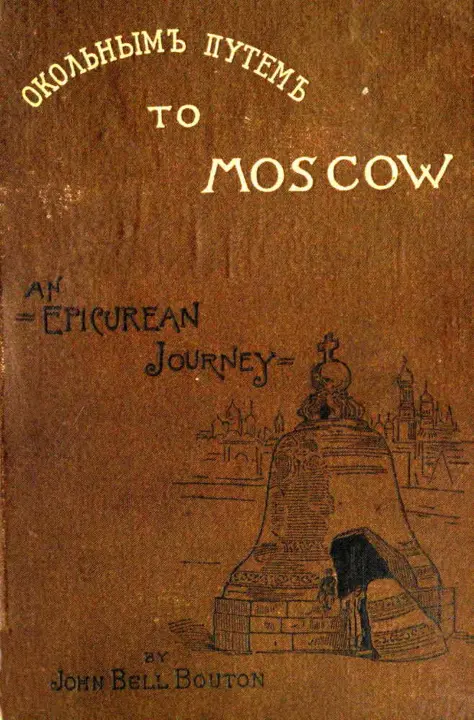
Roundabout to Moscow: An Epicurean Journey
John Bell Bouton
THE CLASSIC COLLECTION · 1864
"Round the Block: An American Novel" by John Bell Bouton is a fictional work likely written in the mid-19th century. The narrative begins by vividly depicting a neighborhood characterized by contrasting settings—posh, seemingly empty brownstone houses on one side and lively, bustling shops and homes for working-class families on the opposite. The story primarily revolves around three bachelors, Marcus Wilkeson, Fayette Overtop, and Matthew Maltboy, who embark on a series of social interactions within their block, exploring themes of neighborliness and community amidst their varied daily lives. The opening of the novel introduces readers to the ornate yet lifeless dwellings on the east side of the block and the contrasting vibrancy on the west side. As the three bachelors settle into their shared home, Overtop proposes an experiment in socializing, advocating for engaging with their neighbors to better understand their community. This leads to humorous exchanges and the deepening relationships between the protagonists as they navigate social calls, interactions with their eccentric neighbors, and the pursuit of companionship, all while their personal quirks and backgrounds unfold. The narrative sets a lively tone that promises both comedic moments and reflections on human interaction in a densely populated urban setting.
Introduction adapted from the source catalogue; source summaries may be automatically generated.
Free to read · English · 151,552 words · No account needed
MAKE TIME FOR A GOOD BOOK
On by default. Untick to stop anonymous reading totals. Each page counts after 10 seconds in view. How this works.
Anonymous counting is on unless you have switched it off.
The singular individual in black was seen to tremble with increased violence. His eyes rolled more wildly, while his face took on a chalkier hue. He stepped back, as if to insure his retreat. Then, mustering all his resolution, he said:
"M-Mrs. M-Mrs. Slapman, you--you ought to be a-ashamed of yourself!"
The real character of the strange actor was now made evident, and the whole house was hushed in awe and expectation. There was not a man or woman present but knew too well the folly of mingling in a family quarrel. So they held their tongues, and enjoyed the scene.
Mrs. Slapman turned to the audience. She was pale, but perfectly
composed. She said:
"Ladies and gentlemen, this is my husband, a very quiet and well-behaved man, whose only fault is excessive nervousness. This fault, I am sorry to say, he encourages, by constantly smoking cigars and drinking strong black tea. He has been indulging in both of these stimulants to-night, till he is quite beside himself. I trust you will excuse and pity him. He has no other vices that I know of."
Then, turning to her husband, whose hands had now dropped listlessly by
his side, she added:
"My dear, bathe your head, and go to bed immediately."
He struggled to say something in the presence of this calm embodiment of satire, but could not. Hanging down his head, and looking very silly, he slinked off the stage.
"Now, ladies and gentlemen," said Mrs. Slapman, "after an interval of fifteen minutes, we will proceed with the comedietta of 'A Morning Call,' as if nothing had happened."
When she had said this, Mrs. Slapman fainted--this time in earnest. She was caught in the arms of Fayette Overtop, who immediately, and with the utmost delicacy, resigned her to the arms of Miss Wick (Bidette), and of several other ladies, who came upon the stage and proffered salts, cologne, and other restoratives.
The gentlemen present, actors and audience, unanimously decided that the best thing for them to do, under all the circumstances, was to leave the premises.
This they did as soon as they could, reserving all discussion of the painful event of the evening for the free air of the street.
As Overtop, very serious, and Maltboy, very jovial, were about to descend the steps to the sidewalk, they were met by a messenger, who desired them to go with him immediately to the station house to see some friends (names forgotten) who had been arrested, and had sent for them.
Thither they went, and experienced the greatest surprise of the evening.
Your reading position is saved on this browser. Take it to another device with a library code. Reading pages adapt to text, rather than matching a printed edition.
John Bell Bouton
BEHIND THE BOOK
This eBook is for the use of anyone anywhere in the United States and most other parts of the world at no cost and with almost no restrictions whatsoever. You may copy it, give it away or re-use it under the terms of the Project Gutenberg License included with this eBook or online at www.gutenberg.org. If you are not located in the United States, you will have to check the laws of the country where you are located before using this eBook. Read the source licence.
The original source file, including credits and licence, is retained by this library. Request an original-format copy at no charge. Please include the book title and Project Gutenberg identifier #12243.
KEEP YOUR CURIOSITY GOING
Coulson Kernahan

Maurice Baring
Frances Wright
Cécile Tormay

Frederic Jesup Stimson

W. H. P. (William Henry Pope) Jarvis