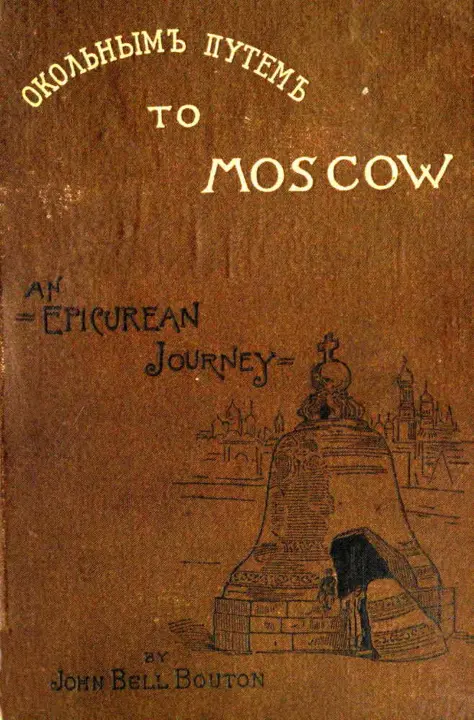
Roundabout to Moscow: An Epicurean Journey
John Bell Bouton
THE CLASSIC COLLECTION · 1864
"Round the Block: An American Novel" by John Bell Bouton is a fictional work likely written in the mid-19th century. The narrative begins by vividly depicting a neighborhood characterized by contrasting settings—posh, seemingly empty brownstone houses on one side and lively, bustling shops and homes for working-class families on the opposite. The story primarily revolves around three bachelors, Marcus Wilkeson, Fayette Overtop, and Matthew Maltboy, who embark on a series of social interactions within their block, exploring themes of neighborliness and community amidst their varied daily lives. The opening of the novel introduces readers to the ornate yet lifeless dwellings on the east side of the block and the contrasting vibrancy on the west side. As the three bachelors settle into their shared home, Overtop proposes an experiment in socializing, advocating for engaging with their neighbors to better understand their community. This leads to humorous exchanges and the deepening relationships between the protagonists as they navigate social calls, interactions with their eccentric neighbors, and the pursuit of companionship, all while their personal quirks and backgrounds unfold. The narrative sets a lively tone that promises both comedic moments and reflections on human interaction in a densely populated urban setting.
Introduction adapted from the source catalogue; source summaries may be automatically generated.
Free to read · English · 151,552 words · No account needed
MAKE TIME FOR A GOOD BOOK
On by default. Untick to stop anonymous reading totals. Each page counts after 10 seconds in view. How this works.
Anonymous counting is on unless you have switched it off.
"And yet no people in the world is more peaceable, nor more easily satisfied, than the people of this town," said the postmaster. "They only axes not to be imposed on. That's all."
"A kinder-hearted people don't live on the face of this earth," added Boolpin, stating the case in another way; "but you mustn't give them less than twenty-five cents' worth for a quarter."
Tiffles replied to the effect that he would give them a dollar's worth apiece; but, in his heart, he foresaw, with that remarkable prescience which is occasionally vouchsafed to mortals, that the panorama of Africa was doomed to be a bad failure; and he bitterly regretted that he had not tried some one of a dozen other immense speculations which he had thought of. But he determined to give one night's exhibition, whatever might be the consequences. "I may as well die for an old sheep as a lamb," thought Tiffles.
During this conversation, Patching was secretly studying the effect of the swamp, visible from the eastern windows; and Marcus was looking at the cracked wall in a fit of abstraction.
Tiffles had observed several times, that morning, a youth, or man, of singular aspect, following him. Occasionally, on turning around suddenly, he would see this person at his elbow. Looking behind, at the close of the colloquy with the landlord, he again saw the strange youth, or man. The being was nearly six feet high, and powerfully built, like a strong man of twenty-five. His face was childish even to the degree of silliness. The mouth opened like a flytrap; the eyes were small and intensely guileless. Only a few wrinkles, and a few hairs, which grew wide apart on his cheeks and chin, indicated his manhood. But the oddest feature was the falling away of his forehead, at an angle which a dirty greased cap, pulled over his brow, could not conceal.
"Well, sir, what do you want?" said Tiffles.
"If you please, sir," said the singular being, in a cracked voice, "yure the pannyrarmer, a'n't ye?"
"Not exactly, my lad, but I own it. And who are you?"
"My name's Stoop, if you please, sir."
Mr. Boolpin broke out with a laugh, which made the building reverberate. "It's the village idiot," said he. "He goes by the name of Stoop, which is short for Stupid. Ha! ha! Come, now, clear out, Stupid, and don't be bothering the gentleman."
The boy-man began to whimper, when Tiffles, recollecting an allusion to a semi-idiot in one of the postmaster's letters, said:
"Stay, my lad; I believe I owe you something."
Your reading position is saved on this browser. Take it to another device with a library code. Reading pages adapt to text, rather than matching a printed edition.
John Bell Bouton
BEHIND THE BOOK
This eBook is for the use of anyone anywhere in the United States and most other parts of the world at no cost and with almost no restrictions whatsoever. You may copy it, give it away or re-use it under the terms of the Project Gutenberg License included with this eBook or online at www.gutenberg.org. If you are not located in the United States, you will have to check the laws of the country where you are located before using this eBook. Read the source licence.
The original source file, including credits and licence, is retained by this library. Request an original-format copy at no charge. Please include the book title and Project Gutenberg identifier #12243.
KEEP YOUR CURIOSITY GOING
Coulson Kernahan

Maurice Baring
Frances Wright
Cécile Tormay

Frederic Jesup Stimson

W. H. P. (William Henry Pope) Jarvis