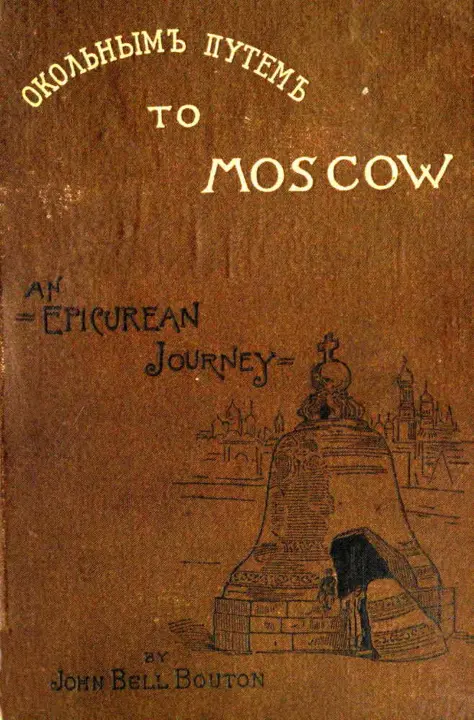
Roundabout to Moscow: An Epicurean Journey
John Bell Bouton
THE CLASSIC COLLECTION · 1864
"Round the Block: An American Novel" by John Bell Bouton is a fictional work likely written in the mid-19th century. The narrative begins by vividly depicting a neighborhood characterized by contrasting settings—posh, seemingly empty brownstone houses on one side and lively, bustling shops and homes for working-class families on the opposite. The story primarily revolves around three bachelors, Marcus Wilkeson, Fayette Overtop, and Matthew Maltboy, who embark on a series of social interactions within their block, exploring themes of neighborliness and community amidst their varied daily lives. The opening of the novel introduces readers to the ornate yet lifeless dwellings on the east side of the block and the contrasting vibrancy on the west side. As the three bachelors settle into their shared home, Overtop proposes an experiment in socializing, advocating for engaging with their neighbors to better understand their community. This leads to humorous exchanges and the deepening relationships between the protagonists as they navigate social calls, interactions with their eccentric neighbors, and the pursuit of companionship, all while their personal quirks and backgrounds unfold. The narrative sets a lively tone that promises both comedic moments and reflections on human interaction in a densely populated urban setting.
Introduction adapted from the source catalogue; source summaries may be automatically generated.
Free to read · English · 151,552 words · No account needed
MAKE TIME FOR A GOOD BOOK
On by default. Untick to stop anonymous reading totals. Each page counts after 10 seconds in view. How this works.
Anonymous counting is on unless you have switched it off.
"Charming, is she not?" said Maltboy.
"Hard to say, at this distance," returned Overtop, who, feeling
neglected in the matter of the rustic fence, was controversially
disposed.
"You may find it so," said Maltboy; "but as for me, the flash of her eyes--there, now, for instance!--is convincing enough."
"Perhaps you have seen her before," remarked Marcus Wilkeson.
"Perhaps," was that gentleman's answer, implying, by his accent and accompanying wink, that he had seen her repeatedly.
"And said nothing about her to us, you inveterate humbug," added Marcus.
Mr. Maltboy felt the compliment conveyed in the word "humbug"--as most people do when that accusation of shrewdness and deep dissembling is brought against them--and smiled.
"I confess," he replied, as he polished the window simultaneously with the performance of that process across the way, "I confess I have noticed her several times; but what was the use of mentioning it to a pair of woman haters like you?"
His two companions laughed pleasantly, thereby expressing their
gratification at the return compliment involved in the phrase
"woman haters."
"You are such dull fellows now," continued Maltboy, "that perhaps you will say this fair stranger is not looking at us; that she does not desire to be seen by us--that is, by me; and that her rubbing of the window with a handkerchief is not a signal which she expects to be answered."
"We say nothing," replied the disputatious Overtop. "We only wait for proof. It is easy to find out whether a signal is meant or not. Rub the window now."
Maltboy did so, concluding the act with an unmistakable flourish of the handkerchief. Whereupon the tall girl averted her face, pulled down the curtain, and eclipsed herself.
Wilkeson and Overtop laughed, and, with a common impulse, punched Maltboy triumphantly in the ribs--a friendly salute that was always vastly amusing to that gentleman.
"Be it understood, at this stage of affairs," said Marcus, solemnly, "that I reject the Overtop theory, and wash my hands of all responsibility for Maltboy's misdeeds.--Hallo! There he is again."
"Who? Where?" exclaimed his two friends.
"In the house nearly opposite--the one with the grape arbor. Isn't he a
fine old fellow?"
Overtop and Maltboy looked, and there saw, sitting at a window, and placidly gazing out of it, an old gentleman with long and thick white hair, a ruddy face, a white neckcloth, and a large projecting shirt frill--which were all the peculiarities of person and dress that could be distinctly made out. He was smoking a long pipe, and placidly rocking himself to and fro. His appearance, through the two windows, was that of a finely preserved relic of a past generation,
Your reading position is saved on this browser. Take it to another device with a library code. Reading pages adapt to text, rather than matching a printed edition.
John Bell Bouton
BEHIND THE BOOK
This eBook is for the use of anyone anywhere in the United States and most other parts of the world at no cost and with almost no restrictions whatsoever. You may copy it, give it away or re-use it under the terms of the Project Gutenberg License included with this eBook or online at www.gutenberg.org. If you are not located in the United States, you will have to check the laws of the country where you are located before using this eBook. Read the source licence.
The original source file, including credits and licence, is retained by this library. Request an original-format copy at no charge. Please include the book title and Project Gutenberg identifier #12243.
KEEP YOUR CURIOSITY GOING
Coulson Kernahan

Maurice Baring
Frances Wright
Cécile Tormay

Frederic Jesup Stimson

W. H. P. (William Henry Pope) Jarvis