
John Bull’s Womankind (Les Filles de John Bull)
Max O'Rell
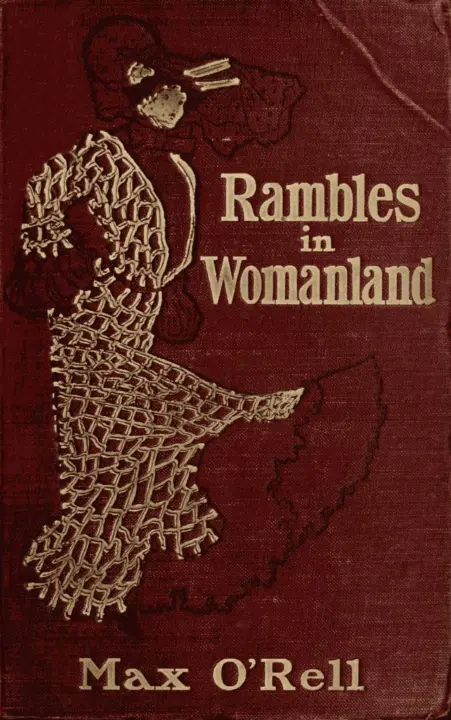
THE CLASSIC COLLECTION · 1903
"Rambles in Womanland" by Max O'Rell is a collection of essays written in the early 20th century. The book presents a series of reflections on women's roles, virtues, and complexities in society from a male perspective. Through satirical observations and critiques, O'Rell navigates themes of love, responsibility, and societal expectations placed upon women. At the start of the book, the author sets the stage for an engaging exploration of women's lives and the myths surrounding them. He offers witticisms about men’s perceptions of women, leading into a discussion about the virtues that men admire. The opening chapters offer a critique of gender dynamics, showcasing how women are often viewed as both idealized figures and as relegated to roles defined by men, all while calling for a more nuanced understanding of women's capabilities and their intrinsic value in society. O'Rell's insights suggest that love and relationships are complicated by societal expectations, and he advocates for mutual respect and equality between sexes.
Introduction adapted from the source catalogue; source summaries may be automatically generated.
Free to read · English · 62,376 words · No account needed
MAKE TIME FOR A GOOD BOOK
On by default. Untick to stop anonymous reading totals. Each page counts after 10 seconds in view. How this works.
Anonymous counting is on unless you have switched it off.
Nothing is more difficult to define than beauty. It is not something absolute, like truth; it differs according to times, countries, races, and individual tastes. Greek beauty is not Parisian beauty, English beauty is pretty well the opposite of Italian beauty.
A European beauty might strike a Chinaman as very ugly, and a Chinese beauty would find no admirer in Europe, except, perhaps, among blase people with the most fastidious tastes and ever in search of novelty.
The Buddha of the Hindoos has nothing in common with the Jupiter of the Greeks. Ancient art differs entirely from modern art.
In Antiquity, beauty consists in the harmony of the proportions, the purity of the lines, the nobility of form and attitude, the sobriety of the figure, and the coldness of the expression. In modern times, beauty consists in gracefulness, piquancy, intelligence, sentiment, vivacity, and exuberance of form.
But there are two kinds of beauty in women: that which is natural to them, and that which they can acquire by carefully studying what suits them best to wear, and how they can use to advantage their style of face and figure.
I have seen women absolutely transformed by the hands of a skilful dressmaker or a clever hairdresser.
The natural beauty is that happy ensemble of lines and expression which attract and charm the eyes. It is not at all indispensable that this ensemble should be harmonious. On the contrary, contrasts are often less cold and monotonous than perfect harmony, and the statuesque beauty generally leaves us unmoved.
The woman who looks amiable and cheerful is naturally beautiful--far more so than a woman with irreproachable sculptural outlines and features so regular that she makes you wish she had some redeeming defect or other. Perfection was attractive in ancient Greece; it is not now.
Perfection seldom looks amiable and bright, and modern beauty must look intelligent--brilliant even. Ancient Greece would not have looked at a turned-up nose; but such a nose denotes gaiety, wit, spirit of repartee, and we like it.
I hope I shall not offend that most talented of French actresses, Madame Rejane, or her admirers, by saying that Athens would have refused to look at her; but the Parisians, the descendants and successors of the Attic Greeks, love her, with her big mouth, square when it laughs, and her turned-up nose. To them she is the embodiment of liveliness, wit, and gaiety.
A small, piquante brunette, with small, keen eyes, thick lips, thin, alert; a blonde dishevelled, like a spaniel, with glorious form, will excite admiration--both are beautiful.
Your reading position is saved on this browser. Take it to another device with a library code. Reading pages adapt to text, rather than matching a printed edition.
BEHIND THE BOOK
This eBook is for the use of anyone anywhere in the United States and most other parts of the world at no cost and with almost no restrictions whatsoever. You may copy it, give it away or re-use it under the terms of the Project Gutenberg License included with this eBook or online at www.gutenberg.org. If you are not located in the United States, you will have to check the laws of the country where you are located before using this eBook. Read the source licence.
The original source file, including credits and licence, is retained by this library. Request an original-format copy at no charge. Please include the book title and Project Gutenberg identifier #33416.
KEEP YOUR CURIOSITY GOING

David Patterson (Spirit) Hatch

David Patterson (Spirit) Hatch

David Patterson (Spirit) Hatch

Ralph Waldo Emerson

Maurice Baring

Oscar Wilde & James McNeill Whistler


