
John Bull’s Womankind (Les Filles de John Bull)
Max O'Rell
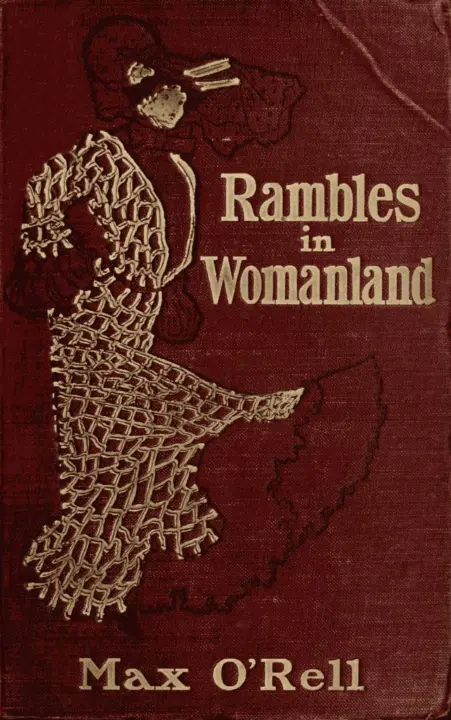
THE CLASSIC COLLECTION · 1903
"Rambles in Womanland" by Max O'Rell is a collection of essays written in the early 20th century. The book presents a series of reflections on women's roles, virtues, and complexities in society from a male perspective. Through satirical observations and critiques, O'Rell navigates themes of love, responsibility, and societal expectations placed upon women. At the start of the book, the author sets the stage for an engaging exploration of women's lives and the myths surrounding them. He offers witticisms about men’s perceptions of women, leading into a discussion about the virtues that men admire. The opening chapters offer a critique of gender dynamics, showcasing how women are often viewed as both idealized figures and as relegated to roles defined by men, all while calling for a more nuanced understanding of women's capabilities and their intrinsic value in society. O'Rell's insights suggest that love and relationships are complicated by societal expectations, and he advocates for mutual respect and equality between sexes.
Introduction adapted from the source catalogue; source summaries may be automatically generated.
Free to read · English · 62,376 words · No account needed
MAKE TIME FOR A GOOD BOOK
On by default. Untick to stop anonymous reading totals. Each page counts after 10 seconds in view. How this works.
Anonymous counting is on unless you have switched it off.
The Paris Presse had asked its male readers to mention which virtue they most admire in women. Here is the result, with the number of votes obtained by each virtue, and truly it is not an edifying result:
1. Faithfulness 8,278
2. Economy 7,496
3. Kindness 6,736
4. Order 5,052
5. Modesty 4,975
6. Devotion 4,782
7. Charity 4,575
8. Sweetness 4,565
9. Cleanliness 3,594
10. Patience 2,750
11. Maternal love 2,703
12. Industry 2,125
13. Courage 1,758
14. Discretion 1,687
15. Simplicity 1,580
16. Wisdom 1,417
17. Honesty 1,389
18. Amiability 1,273
19. Chastity 1,230
20. Propriety 969
21. Self-abnegation 868
Surely, here is food for reflections and comments. Economy, order, and devotion head the list; chastity and self-abnegation figure at the bottom. I should have imagined the last two virtues would have obtained the maximum of votes.
And is it not wonderful that the most beautiful trait in a woman's character--I mean Loyalty--should be altogether omitted from this list of twenty-one most characteristic virtues in women? Are we to conclude that loyalty is a virtue for men alone, such as willpower, magnanimity, energy, bravery, and straightforwardness?
And Sincerity, that most indispensable and precious virtue, which is supposed to make the friendship of men so valuable, is it not also a virtue that we should value in women?
Do men mean to say that loyalty and sincerity should not be or could not be expected to be found in women? Woman must be sweet, of course, and be economical. She must charm men and keep their house on the principles of the strictest order. Lovely!
I know men who allow their wives L1 a day to keep their houses in plenty, and who spend L2 every day at their club. Whatever the husband does, however, the wife must be faithful, and possess patience and self-abnegation. She must be resigned, and, mind you, always amiable and cheerful.
Poor dear fellow! the truth is, that when a man has spent a jolly evening at his club with the 'boys,' it is devilishly hard on him to come home at one or two in the morning and to find his wife not amiable, not cheerful, but suffering from the dumps, and, maybe, not even patient enough to have waited for him. Sometimes she does worse than this, the wretch! She suffers from toothache or neuralgia. What of that? She should be patient, resigned, amiable, and cheerful; c'est son metier.
Yes, on the threshold of the twentieth century we find man still considering woman as a pet animal or a nice little beast of burden; sometimes as both. I really should feel prouder of my sex if they would only be kind enough to assert that men are not beings inferior to monkeys and birds.
Your reading position is saved on this browser. Take it to another device with a library code. Reading pages adapt to text, rather than matching a printed edition.
BEHIND THE BOOK
This eBook is for the use of anyone anywhere in the United States and most other parts of the world at no cost and with almost no restrictions whatsoever. You may copy it, give it away or re-use it under the terms of the Project Gutenberg License included with this eBook or online at www.gutenberg.org. If you are not located in the United States, you will have to check the laws of the country where you are located before using this eBook. Read the source licence.
The original source file, including credits and licence, is retained by this library. Request an original-format copy at no charge. Please include the book title and Project Gutenberg identifier #33416.
KEEP YOUR CURIOSITY GOING

David Patterson (Spirit) Hatch

David Patterson (Spirit) Hatch

David Patterson (Spirit) Hatch

Ralph Waldo Emerson

Maurice Baring

Oscar Wilde & James McNeill Whistler


