
John Bull’s Womankind (Les Filles de John Bull)
Max O'Rell
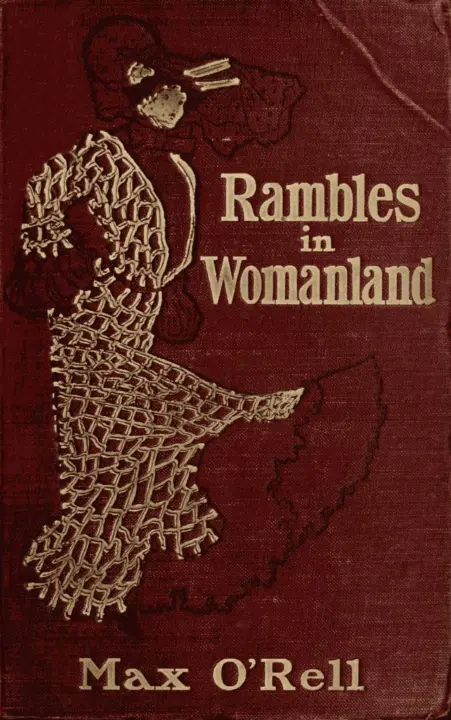
THE CLASSIC COLLECTION · 1903
"Rambles in Womanland" by Max O'Rell is a collection of essays written in the early 20th century. The book presents a series of reflections on women's roles, virtues, and complexities in society from a male perspective. Through satirical observations and critiques, O'Rell navigates themes of love, responsibility, and societal expectations placed upon women. At the start of the book, the author sets the stage for an engaging exploration of women's lives and the myths surrounding them. He offers witticisms about men’s perceptions of women, leading into a discussion about the virtues that men admire. The opening chapters offer a critique of gender dynamics, showcasing how women are often viewed as both idealized figures and as relegated to roles defined by men, all while calling for a more nuanced understanding of women's capabilities and their intrinsic value in society. O'Rell's insights suggest that love and relationships are complicated by societal expectations, and he advocates for mutual respect and equality between sexes.
Introduction adapted from the source catalogue; source summaries may be automatically generated.
Free to read · English · 62,376 words · No account needed
MAKE TIME FOR A GOOD BOOK
On by default. Untick to stop anonymous reading totals. Each page counts after 10 seconds in view. How this works.
Anonymous counting is on unless you have switched it off.
Heller, who has collected the greatest number of instances of extreme long life, found 1,000 persons who lived from 100 to 110, 60 from 110 to 120, 30 from 120 to 130, 15 from 130 to 140, 6 from 140 to 150, and one who lived to be 169 years of age.
French writes that from 1881 to 1890, in Massachusetts, there were 203 deaths of persons past the age of 100. Of these 153 were women and 50 were men. Let us add that the parts of the world which have supplied, in proportion to their population, the greatest number of centenarians, are New England, Scotland, and Brittany.
All these centenarians, without exception, have been found among the humbler classes, and most of them among peasants--that is to say, among the workers of the community who lead quiet, regular, and busy lives.
It is worthy of note that just those very principles which were laid down by the Founder of the Christian religion as best for the eternal welfare of the soul have been proved by the passing years to be best for the body also.
It is not those who are clad in purple and fine linen and fare sumptuously every day who are strong enough to climb to the clear heights of a great age. Neither titles nor wealth keep the feet from wearying of the uphill path of life.
They who would have their days long in the land must honour their great mother, Nature. They must walk in her ways. Nature does not rejoice in sluggards, therefore they must work, and the more steadily they work the longer they live.
Men of thought have always been distinguished for their age. Solon, Sophocles, Pindar, Anacreon, and Xenophon were octogenarians. Kant, Buffon, Goethe, Fontenelle, and Newton were over eighty. Michael Angelo and Titian were eighty-nine and ninety-nine respectively. Harvey, the discoverer of the circulation of the blood, lived to be eighty.
Victor Hugo was over eighty. Gladstone, who worked every minute of his life, always in search of new subjects to master, and who took his recreation in bodily work--gardening, cutting down his trees--died at eighty-eight.
Sidney Cooper, the English animal painter, whose work of last year will be exhibited at the Royal Academy, London, this year, died at ninety-nine, practically with his brushes in his hands.
The preponderance of females over males in the matter of long life is a striking fact. It is also constant. All authorities agree in this, that more women than men live to be very old. The more fragile pitcher is not so soon broken at the fountain. Why?
One would hardly expect woman, with all the dangers and sufferings attending motherhood, to last longer than man. Yet undoubtedly she does.
Your reading position is saved on this browser. Take it to another device with a library code. Reading pages adapt to text, rather than matching a printed edition.
BEHIND THE BOOK
This eBook is for the use of anyone anywhere in the United States and most other parts of the world at no cost and with almost no restrictions whatsoever. You may copy it, give it away or re-use it under the terms of the Project Gutenberg License included with this eBook or online at www.gutenberg.org. If you are not located in the United States, you will have to check the laws of the country where you are located before using this eBook. Read the source licence.
The original source file, including credits and licence, is retained by this library. Request an original-format copy at no charge. Please include the book title and Project Gutenberg identifier #33416.
KEEP YOUR CURIOSITY GOING

David Patterson (Spirit) Hatch

David Patterson (Spirit) Hatch

David Patterson (Spirit) Hatch

Ralph Waldo Emerson

Maurice Baring

Oscar Wilde & James McNeill Whistler


