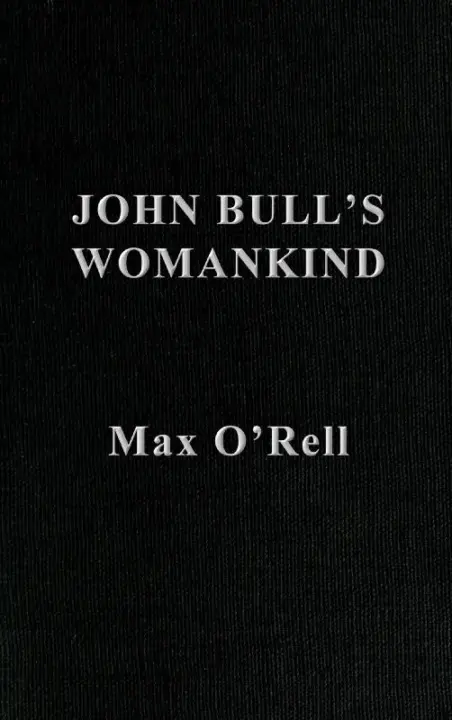
John Bull’s Womankind (Les Filles de John Bull)
Max O'Rell
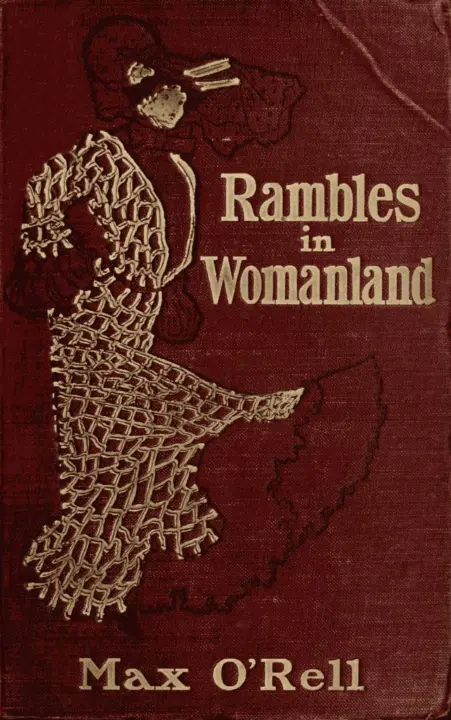
THE CLASSIC COLLECTION · 1903
"Rambles in Womanland" by Max O'Rell is a collection of essays written in the early 20th century. The book presents a series of reflections on women's roles, virtues, and complexities in society from a male perspective. Through satirical observations and critiques, O'Rell navigates themes of love, responsibility, and societal expectations placed upon women. At the start of the book, the author sets the stage for an engaging exploration of women's lives and the myths surrounding them. He offers witticisms about men’s perceptions of women, leading into a discussion about the virtues that men admire. The opening chapters offer a critique of gender dynamics, showcasing how women are often viewed as both idealized figures and as relegated to roles defined by men, all while calling for a more nuanced understanding of women's capabilities and their intrinsic value in society. O'Rell's insights suggest that love and relationships are complicated by societal expectations, and he advocates for mutual respect and equality between sexes.
Introduction adapted from the source catalogue; source summaries may be automatically generated.
Free to read · English · 62,376 words · No account needed
MAKE TIME FOR A GOOD BOOK
On by default. Untick to stop anonymous reading totals. Each page counts after 10 seconds in view. How this works.
Anonymous counting is on unless you have switched it off.
There is to be met in society a man who is particularly provoking and supremely objectionable and offensive. He is about forty, very gentlemanly, self-possessed, irreproachably dressed, well informed, interesting talker, with a somewhat patronizing air, and an eternal smile of self-satisfaction on his face.
This man has compromised more women than many a 'devil of a fellow.' If you say before him, 'Mrs. X. is very beautiful, isn't she?' he says nothing, but smiles complacently. So you look at him and add:
'Oh, you know her, then?' He smiles again. 'You don't say so!' you
remark. 'I should have thought her a woman above the breath of
suspicion.'
He smiles still. You become persuaded that he is, or has been, on the most intimate terms with the lady in question.
Mention before him the name of any woman you like to choose, and if the woman is in the least fashionable, or renowned for her beauty or position, he smiles.
If at a ball he asks a lady to give him the pleasure of her partnership for a waltz or a polka, he leans close toward her, smiling at her in such a strange way that people believe he is telling her words of love, or, worse, that he is granted permission to do so.
If he calls on a lady on her reception day, he has a way to salute her, to kiss her hand, to look at her in a patronizing way that seems to say to the other callers:
'See how ceremonious I am with her before other people, and what a good
comedian I am!'
And he smiles, smiles, and smiles.
Women are ill at ease in his presence. They hate him, but as he is content with smiling, and goes no further, what are they to do? They avoid him when they can, his smiles are so compromising.
And they are right. His smiles are more compromising than bona fide
slander and calumny.
The men hate him, too, but they feel as powerless as the women do. They would like to slap his face, but you cannot say to a man:
'I slap your face because I saw you smile on hearing my wife's name.'
No, that would be too absurd. He knows it, and that is why he goes on
smiling. He is safe.
When he hears a bit of gossip on a woman, he immediately takes her defence, but in such a weak manner, and with such a smile on his face all the time, that people immediately come to the conclusion that 'it must be all true.'
Your reading position is saved on this browser. Take it to another device with a library code. Reading pages adapt to text, rather than matching a printed edition.
BEHIND THE BOOK
This eBook is for the use of anyone anywhere in the United States and most other parts of the world at no cost and with almost no restrictions whatsoever. You may copy it, give it away or re-use it under the terms of the Project Gutenberg License included with this eBook or online at www.gutenberg.org. If you are not located in the United States, you will have to check the laws of the country where you are located before using this eBook. Read the source licence.
The original source file, including credits and licence, is retained by this library. Request an original-format copy at no charge. Please include the book title and Project Gutenberg identifier #33416.
KEEP YOUR CURIOSITY GOING

David Patterson (Spirit) Hatch

David Patterson (Spirit) Hatch

David Patterson (Spirit) Hatch

Ralph Waldo Emerson

Maurice Baring

Oscar Wilde & James McNeill Whistler