THE CLASSIC COLLECTION✦An outlaw’s diary: the CommuneCLASSIC FREE BOOKS
An outlaw’s diary: the Commune
Cécile Tormay
THE CLASSIC COLLECTION · 1920
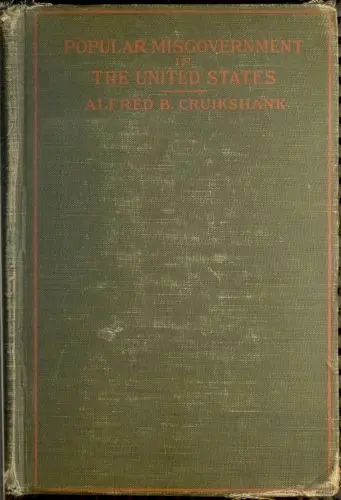
"Popular Misgovernment in the United States" by Alfred Byron Cruikshank is a political critique written in the early 20th century. The work discusses the perceived failures of popular governance in the United States, particularly focusing on the concept of universal suffrage and its implications for political corruption and inefficiency. Cruikshank argues that the unrestricted right to vote has led to the dominance of less qualified individuals in political office, leading to a governance that he views as ineffective and often corrupt. The opening of the book establishes a sense of urgency regarding the state of the American political system, highlighting the perceived threats of radical ideologies like Bolshevism, which he sees as a consequence of the failures of an unqualified electorate. Cruikshank emphasizes that the founding principles of governance should prioritize property ownership and societal contribution as qualifications for voters. He asserts that past political decisions, particularly the adoption of unqualified suffrage, have deteriorated American democracy, leading to governance characterized by inefficiency, corruption, and a disconnect from the virtues of the American foundations.
Introduction adapted from the source catalogue; source summaries may be automatically generated.
Free to read · English · 155,007 words · No account needed
MAKE TIME FOR A GOOD BOOK
On by default. Untick to stop anonymous reading totals. Each page counts after 10 seconds in view. How this works.
Anonymous counting is on unless you have switched it off.
The result of the watch dog programme even if successfully carried out, would therefore be the creation of an imperium in imperio; an irresponsible self-created governing oligarchy acting through the present class of worthless and corrupt politicians. A more complicated and mischievous political system nor one more likely to produce tyranny and public scandals could scarcely be devised. But though the watch dog scheme cannot be approved, its actual existence is a strong argument against manhood suffrage; for though bad reputation is not of itself proof of misconduct, yet it usually accompanies wrong doing; and when evidence of evil reputation is here added to the general as well as particular proof already furnished of the mischiefs resulting from manhood suffrage, the case against that system can hardly fail to be so materially strengthened as to be practically unanswerable.
The weakness and inferiority of our public officials afford opportunity for interference by another set of meddlers in public affairs who are of inferior breed to the watch dogs, and for the infusion of eccentric and fanatical ideas and theories into legislation and administration, such as would not occur in a well-founded governmental system. The class referred to is composed of political adventurers, eccentrics, cranks, and fanatics; people whose mental vision is inaccurate; who are out of harmony with nature and its operations, and whose undisciplined minds are filled with impracticable theories. Many of them are well-to-do idlers able to give time to the agitation of any cause they may happen to espouse. Compared with the watch dogs they are as the yellow dogs of politics. They function in every state as promoters of crank legislation, the history whereof in the United States would no doubt make, if compiled, a very interesting volume, containing many surprises to the general reader. While sane and prudent men are content to confine their attention to their private affairs, and while modest men, be they ever so well informed, are apt to doubt their own capacity in affairs of state, a certain class of cranks are always eager to meddle with politics; full of conceit they are not troubled with doubts as to the correctness of their own opinions. When one such takes up a fad, religious, moral, political or social, he becomes more and more engrossed in it; nothing else matters to him half so much; family and business are neglected; he writes for the newspapers; he attends and organizes public meetings; he serves on committees; he makes speeches; he circulates literature; he contributes to the cause within his means, which sometimes are large, and collects for it from others. When a “movement” as it is called is once fairly started it is sure to be joined by many with ulterior motives, impelled by vanity, by mere love of notoriety, by fondness for excitement; by those who seek the pleasure of serving on committees, of speaking in public, or of seeing their names in print; others come to make new acquaintances; to escape ennui; to become politically important. Under a strong and intelligent government these collections of faddists, adventurers, humbugs and fools would do little more harm than so many debating societies; but when, as now, those in power are of mediocre ability, weak calibre or politically timid, such societies are potent for mischief. The ordinary politician holding an office obtained perhaps by a majority of a few votes, or otherwise precarious in its tenure is easily frightened by a show of organization. Where the proposed new measure is one opposed to the pecuniary or political interests of the bosses the cranks get but slight attention; but where there are only principles involved their chances for success are often very good indeed. The fact that they are armed with theories however foolish, makes them appear mysterious and redoubtable antagonists to small politicians, who cannot understand principles or the motives of people professing principles. The official finds himself confronted and baited by an inexorable pack of those yellow dogs, small in number, but terrible in noise and clamor, who give him no rest; while on the other hand the sane and sensible folk of his constituency are not only silent and apparently indifferent but scarcely seem aware (as indeed most of them are not) of his name or existence. Getting no orders from his boss, who takes no interest in the matter one way or another, what wonder if the weary legislator or administrator, either becomes half convinced by the din of arguments which he is too weak or ignorant to answer, or frightened by the criticism he is receiving, yields at last with a sigh of relief. And so the crank project often goes through without public notice except the applause of the agitators, who print a triumphant account in the newspapers of the adoption of another “reform measure” and get one of their members to write it up in some magazine with a laudatory reference to himself and his associates. The effect of “crank” or yellow dog influence upon our weak state governments is another of the evil results of manhood suffrage.
Your reading position is saved on this browser. Take it to another device with a library code. Reading pages adapt to text, rather than matching a printed edition.
BEHIND THE BOOK
This eBook is for the use of anyone anywhere in the United States and most other parts of the world at no cost and with almost no restrictions whatsoever. You may copy it, give it away or re-use it under the terms of the Project Gutenberg License included with this eBook or online at www.gutenberg.org. If you are not located in the United States, you will have to check the laws of the country where you are located before using this eBook. Read the source licence.
The original source file, including credits and licence, is retained by this library. Request an original-format copy at no charge. Please include the book title and Project Gutenberg identifier #57862.
KEEP YOUR CURIOSITY GOING
Cécile Tormay

Moritz Busch
John L. Ransom
Frances Wright
Cécile Tormay

Mabel Potter Daggett