THE CLASSIC COLLECTION✦An outlaw’s diary: the CommuneCLASSIC FREE BOOKS
An outlaw’s diary: the Commune
Cécile Tormay
THE CLASSIC COLLECTION · 1920
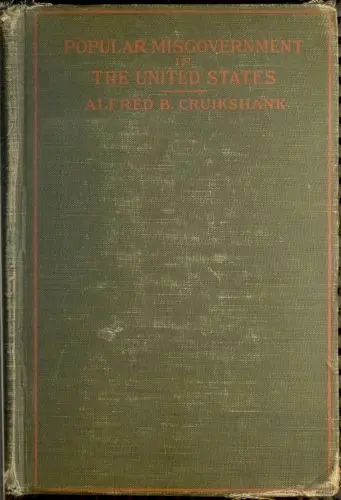
"Popular Misgovernment in the United States" by Alfred Byron Cruikshank is a political critique written in the early 20th century. The work discusses the perceived failures of popular governance in the United States, particularly focusing on the concept of universal suffrage and its implications for political corruption and inefficiency. Cruikshank argues that the unrestricted right to vote has led to the dominance of less qualified individuals in political office, leading to a governance that he views as ineffective and often corrupt. The opening of the book establishes a sense of urgency regarding the state of the American political system, highlighting the perceived threats of radical ideologies like Bolshevism, which he sees as a consequence of the failures of an unqualified electorate. Cruikshank emphasizes that the founding principles of governance should prioritize property ownership and societal contribution as qualifications for voters. He asserts that past political decisions, particularly the adoption of unqualified suffrage, have deteriorated American democracy, leading to governance characterized by inefficiency, corruption, and a disconnect from the virtues of the American foundations.
Introduction adapted from the source catalogue; source summaries may be automatically generated.
Free to read · English · 155,007 words · No account needed
MAKE TIME FOR A GOOD BOOK
On by default. Untick to stop anonymous reading totals. Each page counts after 10 seconds in view. How this works.
Anonymous counting is on unless you have switched it off.
The political oligarchies rule, have ruled and will continue to rule this country through the medium of the controllable vote. This is plainly inferable from what has already been said about the strength and operations of the Machine, and is in a vague way to some extent understood or at least suspected throughout the country. The object of this chapter is to emphasize it, to bring it home to the reader, to make him realize it, and to cause him to reflect upon it, and to thoroughly appreciate the absolute impossibility of throwing off the odious bondage of the politicians unless and until the suffrage is restricted to a well-qualified class of voters.
By the extension of the franchise to the unpropertied and thriftless class there was injected into the veins of the electoral body a new and poisonous element, the virus of cupidity. A certain portion of this class, the so-called floaters, is directly purchasable; another large portion is indirectly purchasable or controllable and capable of being organized on a basis of bargains made or understood. The vote therefore which by degrees as the organizations have developed has come to adhere to these predatory bands is not confined merely to the directly purchasable; it includes the controllables; all such as the organization reaches by the manipulation of low motives; by appeals to cupidity direct or indirect; by favors to themselves or their relatives, by rewards of public employment, whether as laborers, petty officers, policemen, firemen or the like; by protection, as in the case of gamblers, liquor sellers, and others who adhere to the organization for purposes of personal advantage. The organization therefore will always be permanent and effective because its members are materially interested in its existence and power.
The manner in which the controllable vote is marshalled to the polls is described by Eaton (Govt. of Municipalities, chap. V). Its existence is recognized by him as a reason why our great cities are not fit for home rule. He divides this vote into two classes: “the mercenary city vote” and “the vile city vote.” But this material is not confined to the large cities, it is to be found in towns and villages and wherever there are worthless, shiftless men. Writing in 1871 Sterne says: “The nomination for public offices is with us entirely in the hands of professional politicians” and this he states to be the case equally in both the country and cities. (Representative Government, p. 83.) The conditions have not changed since his time. The local political associations or bands organized for the securing, management and operation of the controllable vote have developed in the last century. They are now frequently able, especially in the large cities, to secure a considerable class of recruits of a type somewhat superior to the “floaters,” from among the social failures and misfits. Most of these are sloppy-minded fellows, who, tempted by social proclivities, or misled by weak ambitions and the appearance of political success, join the “Regular Organization” as they call it. Some of them are rather vicious; social degenerates or perverts; men who have not judgment and honesty enough to insure their voting right even in matters small enough to be within their mental grasp; and whose ideals are not honesty, justice, public honor, and intelligence, but smartness, cleverness and guile. Sometimes they are motived by prejudice and class hatred; often they are rabid, loud-mouthed radicals, anti-capitalists, etc. Others are weak and shiftless, people naturally harmless but incapable of correct observation in political and economic matters, or of correct reasoning upon what they observe; men who are recognized as failures in the world, more or less incapable of self-support; burdens on their relatives and friends, or on churches or societies with which they or their families are connected; men who never can get employment, or if they do, cannot keep it; fellows of lazy and careless habits who having failed to do their part in organized society have had to pay the penalty of their remissness. There are those who have got into a mental habit of chronic dissatisfaction with the established ethics of life and have finally grown to disbelieve in them altogether; who doubt whether honesty is the best policy; who are unable to recognize what it is that really constitutes success, or who fail to find the true path to reach it. To some of them the man who gets power or money at any price is the successful man and him they envy and applaud. They themselves hate to work or to deny themselves, merely in order to save or to accumulate; and yet they want money, and long for its possession, and finally grow to actually respect successful rogues political and other who seem to defy and triumph over the old established rules of social life. Bryce describes these organizations as he found them in New York City in 1894:
Your reading position is saved on this browser. Take it to another device with a library code. Reading pages adapt to text, rather than matching a printed edition.
BEHIND THE BOOK
This eBook is for the use of anyone anywhere in the United States and most other parts of the world at no cost and with almost no restrictions whatsoever. You may copy it, give it away or re-use it under the terms of the Project Gutenberg License included with this eBook or online at www.gutenberg.org. If you are not located in the United States, you will have to check the laws of the country where you are located before using this eBook. Read the source licence.
The original source file, including credits and licence, is retained by this library. Request an original-format copy at no charge. Please include the book title and Project Gutenberg identifier #57862.
KEEP YOUR CURIOSITY GOING
Cécile Tormay

Moritz Busch
John L. Ransom
Frances Wright
Cécile Tormay

Mabel Potter Daggett