THE CLASSIC COLLECTION✦An outlaw’s diary: the CommuneCLASSIC FREE BOOKS
An outlaw’s diary: the Commune
Cécile Tormay
THE CLASSIC COLLECTION · 1920
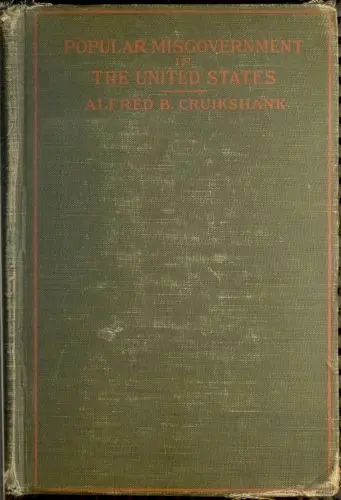
"Popular Misgovernment in the United States" by Alfred Byron Cruikshank is a political critique written in the early 20th century. The work discusses the perceived failures of popular governance in the United States, particularly focusing on the concept of universal suffrage and its implications for political corruption and inefficiency. Cruikshank argues that the unrestricted right to vote has led to the dominance of less qualified individuals in political office, leading to a governance that he views as ineffective and often corrupt. The opening of the book establishes a sense of urgency regarding the state of the American political system, highlighting the perceived threats of radical ideologies like Bolshevism, which he sees as a consequence of the failures of an unqualified electorate. Cruikshank emphasizes that the founding principles of governance should prioritize property ownership and societal contribution as qualifications for voters. He asserts that past political decisions, particularly the adoption of unqualified suffrage, have deteriorated American democracy, leading to governance characterized by inefficiency, corruption, and a disconnect from the virtues of the American foundations.
Introduction adapted from the source catalogue; source summaries may be automatically generated.
Free to read · English · 155,007 words · No account needed
MAKE TIME FOR A GOOD BOOK
On by default. Untick to stop anonymous reading totals. Each page counts after 10 seconds in view. How this works.
Anonymous counting is on unless you have switched it off.
A large addition to the list of political scandals contained in this book might be made by recourse to the archives of these watch dog associations and to the published reports of the charges made by them from time to time against the membership of the state and city legislative and administrative bodies, and to the evidence collected by them in support thereof, but space will not permit even the most condensed recital of this material. Let it suffice to present here the societies themselves, composed as they are of thousands of our citizens of best standing and information, as witnesses to the bad character and reputation of manhood suffrage. By their very existence they go far to establish the significant fact that the manhood suffrage state and local governments of the United States have utterly forfeited the respect and confidence of the American people.
It must not be supposed that by the work of these watch dog associations the evil of manhood suffrage operations is sensibly alleviated. On the contrary, when carefully considered, that work, though presumably well intended, must be considered as a public misfortune, and as resulting in an aggravation rather than a diminution of the evils of our misgovernment. In an individual instance their efforts may produce good effects limited to that special transaction, just as might be said of any voluntary interference with constituted authority; but in theory and in principle and in the large and final results, the practice of such interference is and must be politically noxious, and the case to justify it even in one instance must be indeed extreme. The public-spirited citizens who form an important part of their membership probably do not realize just what they are doing when they coerce the will of the chosen representatives of the people. They would be horrified at the suggestion of using physical force or physical threats upon legislators to compel them to deviate from their own best judgment; and yet they do not scruple to use what they call moral force to the same purpose, and such moral force as almost amounts to physical stress and coercion. The difference in effect between threatening a member of the legislature with a cudgel or with printed defamation issued by a powerful clique or league is not always appreciable. In either case the general result is the adoption of measures or modifications thereof reflecting rather the views of the threatening meddler than those of the public official in question or of the majority who elected him. This is a clear usurpation of power. Again, the watch dog operations do not offer any permanent result in return for this trampling down of popular government; their programme includes no method of improving the quality of our officials but only one for watching and nagging them. Third, it offers no security whatever that the volunteer or self-appointed government censors shall themselves be competent or worthy, or that they shall be anything more than idle and presumptuous fools or designing hypocrites. Fourth, others less worthy and disinterested, are by the example of these societies encouraged to similar acts. So that the final result of the watch dog plan is likely to amount to no more or other than this actual situation: A number of corrupt, weak and worthless legislatures, town boards, city councils, boards of supervisors, etc., constantly nagged, worried, insulted and pulled this way and that, by all kinds of people, including watch dog associations and their officers, newspaper men, cranks, fanatics, busybodies generally and possibly scamps and adventurers. Even suppose we make the extravagant supposition that no knaves or fools whatever, but only the better type of citizens do and will respond to the appeal to organize to boss the bosses, the system is still impracticable, and if practicable would be mischievous; since it would result in oligarchical tyranny. For the work proposed for these civic organizations and for their members would be enormous; it would require an acquaintance with legislative and other political methods far beyond that possible to any one who has any other business; it would necessitate among other things the careful scrutiny and thorough understanding of every bill or resolution introduced into the state or municipal legislature, and a steady watch from day to day of each of these bills, and of the members of the bodies where they may be pending, and especially of those of the committees having them under consideration. Besides this it involves the defense of every step taken, at the cost of endless controversy. As the ordinary citizen cannot possibly undertake this labor of supervising oversight of government activities, it is evident that if done at all by this volunteer method, it must fall to a comparatively few people who have means and leisure, or who have special interests to serve; or more likely, to hirelings employed by those people.
Your reading position is saved on this browser. Take it to another device with a library code. Reading pages adapt to text, rather than matching a printed edition.
BEHIND THE BOOK
This eBook is for the use of anyone anywhere in the United States and most other parts of the world at no cost and with almost no restrictions whatsoever. You may copy it, give it away or re-use it under the terms of the Project Gutenberg License included with this eBook or online at www.gutenberg.org. If you are not located in the United States, you will have to check the laws of the country where you are located before using this eBook. Read the source licence.
The original source file, including credits and licence, is retained by this library. Request an original-format copy at no charge. Please include the book title and Project Gutenberg identifier #57862.
KEEP YOUR CURIOSITY GOING
Cécile Tormay

Moritz Busch
John L. Ransom
Frances Wright
Cécile Tormay

Mabel Potter Daggett