THE CLASSIC COLLECTION✦An outlaw’s diary: the CommuneCLASSIC FREE BOOKS
An outlaw’s diary: the Commune
Cécile Tormay
THE CLASSIC COLLECTION · 1920
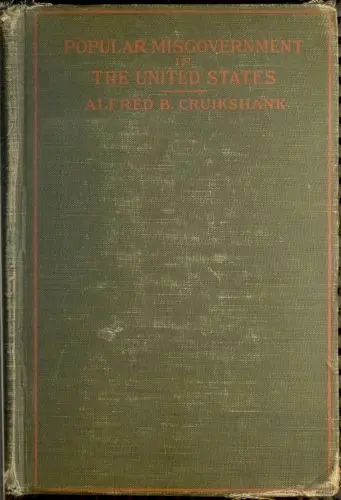
"Popular Misgovernment in the United States" by Alfred Byron Cruikshank is a political critique written in the early 20th century. The work discusses the perceived failures of popular governance in the United States, particularly focusing on the concept of universal suffrage and its implications for political corruption and inefficiency. Cruikshank argues that the unrestricted right to vote has led to the dominance of less qualified individuals in political office, leading to a governance that he views as ineffective and often corrupt. The opening of the book establishes a sense of urgency regarding the state of the American political system, highlighting the perceived threats of radical ideologies like Bolshevism, which he sees as a consequence of the failures of an unqualified electorate. Cruikshank emphasizes that the founding principles of governance should prioritize property ownership and societal contribution as qualifications for voters. He asserts that past political decisions, particularly the adoption of unqualified suffrage, have deteriorated American democracy, leading to governance characterized by inefficiency, corruption, and a disconnect from the virtues of the American foundations.
Introduction adapted from the source catalogue; source summaries may be automatically generated.
Free to read · English · 155,007 words · No account needed
MAKE TIME FOR A GOOD BOOK
On by default. Untick to stop anonymous reading totals. Each page counts after 10 seconds in view. How this works.
Anonymous counting is on unless you have switched it off.
The argument is frequently used in certain quarters that the vote in the hands of the unpropertied classes is a weapon of defense needed to protect their weakness against governmental oppression or to enable them to procure needful affirmative legislation. This argument though without real force is sufficiently plausible to merit attention.
The first and readiest answer is that the experiment has been tried and grievously failed. They have had the ballot ninety years and have used it for naught but mischief to themselves and others. The second answer is that governmental oppression of the poor in this country is an impossibility. It would only be possible through class legislation and there is no conceivable class legislation which would favor the prosperous people at the expense of their poorer fellow citizens. There has never been class legislation in this country, and it is impossible to devise, much more to enact it in a way to be effective, because we have no fixed classes. We may use the word “class” for convenience, but there is no permanent class of poor people any more than there is a fixed class of lazy or sickly or dissolute people, or of professional men or farmers or blacksmiths. There is at all times a body of skilled and one of unskilled laborers, but they are not fixed classes; nor are their members generally paupers or propertyless; most of them either have or expect to accumulate money or property either individually or in their families, and desire to have it secured to them by equal and just laws. The poor come from all ranks, occupations and families and so do the rich. The son of a rich farmer is a struggling doctor and the daughter of a laborer becomes the wife of a banker. In fact, the principal cause of the envy of the rich by the less rich is not usually that they belong to a fixed class, but the contrary, because they have not remained where they were but have managed by hook or crook to get ahead of their former associates. Class legislation scarcely exists today in any civilized country; it disappeared with the permanent classes of former days and is now merely a tradition of a gone-by period when no doubt the system of fixed classes served a necessary purpose. But even if we choose to consider the different occupations of men, or their pecuniary circumstances from time to time as class divisions, there is no possibility of unequal legislation affecting them, because it is so difficult as to be practically impossible to separate their interests so as to make such legislation profitable to any special interest. We may of course, to please our fancy, imagine attempts at class legislation even here and now. We may imagine enactments aimed at red-headed men or sculptors. And so we may dream of laws against the poor, enacted by a people whose charity and generosity to the poor and unfortunate is proverbial; but they will never be seriously considered in this country until we have become politically insane, in which case all democracy will be practically non-existent among us. As things actually are our intelligent people are fully aware that business prosperity to be real must be universal; that the well-being of the laboring people is absolutely essential to the well-being of the rest of the community, and they will never even consider a suggestion of legislation oppressive towards the wage earners. There are three principal bodies of propertied men; farmers, professional men and traders; who together constitute the bulk of the propertied electorate. No one can imagine the farmers as consenting to any persecution of the poor; and the successful traders and professional men are interested in the prosperity of their poorer neighbors; they are fed by a stream of wealth which comes from a surplus created and expended by the working classes. The business interests of all the people are so bound together that the prosperity of one is in reality the prosperity of all; the wealth of one furnishes a market for the industries of the other; the need of one man gives employment to his neighbor; and all this is true though the laborer and the employer and the trader and the customer are separated by mountains, plains, seas or national boundaries. All business workers, in whatever capacity, form part of a great joint enterprise, and the body of the poorer people have therefore no business interests which are antagonistic to those of the propertied class. Rather are they interested in the successes of the wealthy, of the capitalists, and especially of those of them who are engaged in mercantile pursuits, or manufacturing industries, because it is on such prosperity that their employment depends. And the situation in political matters is similar to that in business matters. What all need in government is ability and honesty; and the poor man might as well object to being medically treated by one of a wealthy family, as to object to a competent man sitting in the legislature or administering a public office because he is rich. From Washington down to Roosevelt the men of old and wealthy families have in politics always given the poor the benefit of disinterested and enlightened service.
Your reading position is saved on this browser. Take it to another device with a library code. Reading pages adapt to text, rather than matching a printed edition.
BEHIND THE BOOK
This eBook is for the use of anyone anywhere in the United States and most other parts of the world at no cost and with almost no restrictions whatsoever. You may copy it, give it away or re-use it under the terms of the Project Gutenberg License included with this eBook or online at www.gutenberg.org. If you are not located in the United States, you will have to check the laws of the country where you are located before using this eBook. Read the source licence.
The original source file, including credits and licence, is retained by this library. Request an original-format copy at no charge. Please include the book title and Project Gutenberg identifier #57862.
KEEP YOUR CURIOSITY GOING
Cécile Tormay

Moritz Busch
John L. Ransom
Frances Wright
Cécile Tormay

Mabel Potter Daggett