THE CLASSIC COLLECTION✦An outlaw’s diary: the CommuneCLASSIC FREE BOOKS
An outlaw’s diary: the Commune
Cécile Tormay
THE CLASSIC COLLECTION · 1920
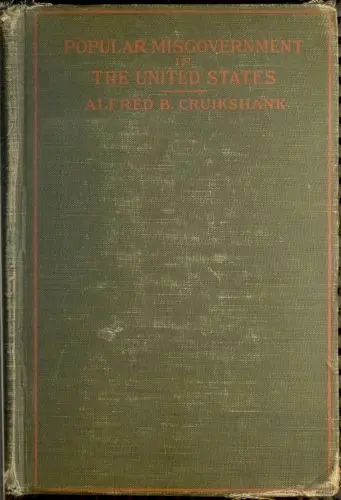
"Popular Misgovernment in the United States" by Alfred Byron Cruikshank is a political critique written in the early 20th century. The work discusses the perceived failures of popular governance in the United States, particularly focusing on the concept of universal suffrage and its implications for political corruption and inefficiency. Cruikshank argues that the unrestricted right to vote has led to the dominance of less qualified individuals in political office, leading to a governance that he views as ineffective and often corrupt. The opening of the book establishes a sense of urgency regarding the state of the American political system, highlighting the perceived threats of radical ideologies like Bolshevism, which he sees as a consequence of the failures of an unqualified electorate. Cruikshank emphasizes that the founding principles of governance should prioritize property ownership and societal contribution as qualifications for voters. He asserts that past political decisions, particularly the adoption of unqualified suffrage, have deteriorated American democracy, leading to governance characterized by inefficiency, corruption, and a disconnect from the virtues of the American foundations.
Introduction adapted from the source catalogue; source summaries may be automatically generated.
Free to read · English · 155,007 words · No account needed
MAKE TIME FOR A GOOD BOOK
On by default. Untick to stop anonymous reading totals. Each page counts after 10 seconds in view. How this works.
Anonymous counting is on unless you have switched it off.
The first national legislature to be elected by manhood suffrage without distinctions or qualifications was the notorious red radical French Convention which met at Paris, September 20th, 1792. It is that body which has the infamous celebrity of establishing and prosecuting the bloody tyranny known as the Terror, under which tens of thousands of innocent men and women of France were put to death because of their supposed political opinions. Though manhood suffrage may not be entirely and solely responsible for the excesses of the convention, yet it is safe to say that it helped create the machinery for the perpetration of the crimes and follies of the Terror; and that none of these excesses would have been committed by a body selected by a fairly qualified electorate. All that was good in the French Revolution was accomplished through a propertied electorate; and all that was worst was done under a manhood suffrage régime.
The French Revolution began in 1789 as a peaceable and rational reform movement. None of the writings of Rousseau which did so much to prepare the way for the great change had directly discussed the suffrage question. The French National Assembly which met in May, 1789, at Versailles, was a sane and dignified body, chosen by a qualified electorate, and there was in its deliberations no mention and in its membership probably no thought of universal suffrage.
There was never any necessity for physical violence or revolution in order to secure the attainment of all such political reforms as even from the most liberal standpoint were needed by France at that time. The government like all other governments of that day was ignorant of economic laws, and the people had suffered under inequalities in rank and privilege, and an antiquated and inadequate financial system; but the king and the nobility were pacifist, and in the main humanitarian and inclined to liberal measures. Within three months after the Assembly convened, the nobility in open meeting voluntarily surrendered their historic privileges. At that same session of 1789 the Assembly undertook a number of reforms and the re-establishment of France upon a firm constitutional and conservative basis with proper security for all classes. Had the revolutionary movement stopped there, and the better classes been permitted to carry out their intelligent schemes, France, under a constitutional monarchy, would have embarked upon a new career of prosperity, and the wars which have since devastated her would probably have been avoided. But the Radicals got the upper hand; on pretence of remedying the embarrassments arising from poor harvests and bad financiering they established universal suffrage and the rule of the rabble, which increased the miseries of the French people five fold, and speedily evolved the Terror and precipitated the ruin of the nation. A great many, perhaps most, of these radicals were men of little experience, governed by mere sentiment and passion; others, who ultimately became the working majority were men of low moral character and defective reasoning powers; lacking in principle; demagogues and adventurers; cranks and scoundrels, who, claiming to be the champions of an ideal democracy, found it to their advantage to spout balderdash with which to gain the applause of the ignorant and emotional masses. Their stupidities, antics, vagaries, thefts, and other minor rascalities and follies; their guillotinings, drownings, arsons, street slaughters and other butcheries and outrages; their confiscations and banishments are matters of history, and have to some extent been duplicated by the Bolsheviki rabble in Russia in our own day. To the tune of crazy cries for liberty and more liberty, they attacked property, vested rights, commerce, business, the church and the Christian religion, and plunged France into chaos. They murdered and outlawed her nobility and her priests, besides tens of thousands of innocent people who were neither priests nor nobles, including farmers, artisans, tradesmen, poets, artists and professional men, the best of the land. Under the first Republic, it is computed that a million French died of famine and hardship, the direct result of Radical legislation and Radical tyranny, and chargeable to a great extent to the operation of manhood suffrage. Nor is this the total record of their mischief. Their misdeeds produced a violent reaction which resulted in the placing on the French throne of Bonaparte, whose ambitions deluged Europe with blood. A generation later he was followed by another Bonaparte, equally a result (though less directly) of the Revolution; and he plunged France into a war with Germany, which in 1871 cost her the loss of Alsace and Lorraine and out of which the recent great war of 1914 was born.
Your reading position is saved on this browser. Take it to another device with a library code. Reading pages adapt to text, rather than matching a printed edition.
BEHIND THE BOOK
This eBook is for the use of anyone anywhere in the United States and most other parts of the world at no cost and with almost no restrictions whatsoever. You may copy it, give it away or re-use it under the terms of the Project Gutenberg License included with this eBook or online at www.gutenberg.org. If you are not located in the United States, you will have to check the laws of the country where you are located before using this eBook. Read the source licence.
The original source file, including credits and licence, is retained by this library. Request an original-format copy at no charge. Please include the book title and Project Gutenberg identifier #57862.
KEEP YOUR CURIOSITY GOING
Cécile Tormay

Moritz Busch
John L. Ransom
Frances Wright
Cécile Tormay

Mabel Potter Daggett