THE CLASSIC COLLECTION✦An outlaw’s diary: the CommuneCLASSIC FREE BOOKS
An outlaw’s diary: the Commune
Cécile Tormay
THE CLASSIC COLLECTION · 1872
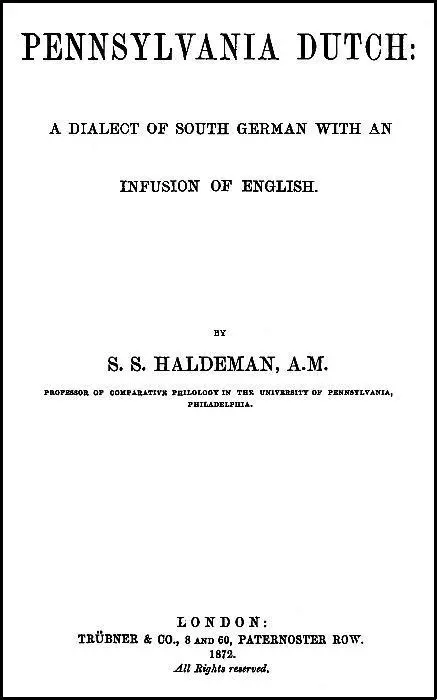
"Pennsylvania Dutch: A Dialect of South German With an Infusion of English" by S. S. Haldeman is a scientific publication written in the late 19th century. The book explores the unique linguistic characteristics of Pennsylvania Dutch, a dialect formed by German-speaking immigrants to Pennsylvania, highlighting its blend of South German roots and English influences. The text delves into various aspects of the dialect, including its phonology, vocabulary, and syntax, making it a valuable resource for those interested in comparative philology and language evolution. The opening of the work introduces the rationale behind studying this dialect, emphasizing its formation over a century within a linguistically diverse community. It describes the historical context of German immigration to Pennsylvania and how various dialects from regions like Rhenish Bavaria and Alsace contributed to the development of Pennsylvania Dutch. The author outlines the influences of limited interactions among the largely agricultural immigrant populations, which led to distinct linguistic changes, thus setting the stage for a detailed examination of phonology, vocabulary, and syntax in subsequent chapters.
Introduction adapted from the source catalogue; source summaries may be automatically generated.
Free to read · English · 27,823 words · No account needed
MAKE TIME FOR A GOOD BOOK
On by default. Untick to stop anonymous reading totals. Each page counts after 10 seconds in view. How this works.
Anonymous counting is on unless you have switched it off.
The ballads have many irregularities in spelling like--as, ash; is, ish; one, von; two, dwo; dwelf, dwelve, twelve, zwölf (for tvelf); chor, gorus; distants, tisaster; dretful; tredful; eck (the correct form), egg; het, head, headt; groundt, cround, croundt; land, lantlord, Marylandt; shpirid, shpirit, shbirit; drumpet, trumpet; foorst, foost, first, virst; fein, vine; went, vent; old, olt, oldt; teufel, tyfel, tuyfel.
English J is placed in soobjectixe, objectified, jail, jammed, juice, jump (shoomp, choomp); it is represented by sh in shoost, shiant, shinglin; by ch (correctly) in choin, choy, choke, enchine; by g, dg in change, hedge; and by y in Yane and soobjectifly--which is not objectionable. English Ch remains in catch, child, chaps (and shaps), fetch, sooch, mooch; and it becomes sh in soosh (such), shase, sheek.
English Sh is proper in shmoke, shmile, shplit, shpill, shpoons, shtart, shtick, shtrike, shtop, shvear; it is omitted in smack, stamp, slept; and it is of doubtful propriety in ash (as), ashk, vash (was), elshe, shkorn, shkare, shky.
English D final is often written dt that the word may be recognised and the sound of t secured, as in laidt, roadt, shouldt, vouldt, findt, foundt, roundt (and round), vordt (and vord), obercoadt. English ed and its equivalents should be et or t in broken English, as in loadet, reconet, pe-markt, riset, signet, rollet, seemet, slightet, declaret, paddlet, mate (made), kilt; -ed being wrong, as in said, coomed, bassed, scared, trinked, smashed, rooshed, bleased.
English F, V, W, receive the worst treatment, and are judged by the eye rather than by speech. German folgen and English follow are turned into 'vollow'; German weil is 'vhile' and 'while.' Other examples are wind and vindow; vhen, vhenefer (turning not only German v, but English v into f), fery for very,--but svitch, ve (we), veight, vink, are proper. The following example is from 'Schnitzerl's Philosopede'--
'Oh vot ish all[1] dis eartly pliss? 1 ol in folly. Oh, vot ish[4] man's soocksess?[2] 2 sooccess. Oh, vot is various kinds[3] of dings? 3 s turns d into t. Und vot is[4] hoppiness? 4 iss or ish, not both. Ve find a pank node in de shtreedt,[5] 5 shtreet. Next[-sht][6] dings[6] der pank ish[7] 6 dingss. preak! 7 d requires b. Ve folls[1] und knocks our outsides[8] 8 G. seit, and final s, in, require t. Ven ve a ten-shtrike make.'
CHICKIS, NEAR COLUMBIA, PENNSYLVANIA,
Feb. 16, 1870.
[88] A boy in the street in Liverpool (1866) said to a companion--"'e told me to 'old up my 'ands an' I 'eld em up." He did not say hup, han' hI, hem.
Your reading position is saved on this browser. Take it to another device with a library code. Reading pages adapt to text, rather than matching a printed edition.
BEHIND THE BOOK
This eBook is for the use of anyone anywhere in the United States and most other parts of the world at no cost and with almost no restrictions whatsoever. You may copy it, give it away or re-use it under the terms of the Project Gutenberg License included with this eBook or online at www.gutenberg.org. If you are not located in the United States, you will have to check the laws of the country where you are located before using this eBook. Read the source licence.
The original source file, including credits and licence, is retained by this library. Request an original-format copy at no charge. Please include the book title and Project Gutenberg identifier #48417.
KEEP YOUR CURIOSITY GOING
Cécile Tormay

Moritz Busch
John L. Ransom
Frances Wright
Cécile Tormay

Mabel Potter Daggett