THE CLASSIC COLLECTION✦An outlaw’s diary: the CommuneCLASSIC FREE BOOKS
An outlaw’s diary: the Commune
Cécile Tormay
THE CLASSIC COLLECTION · 1872
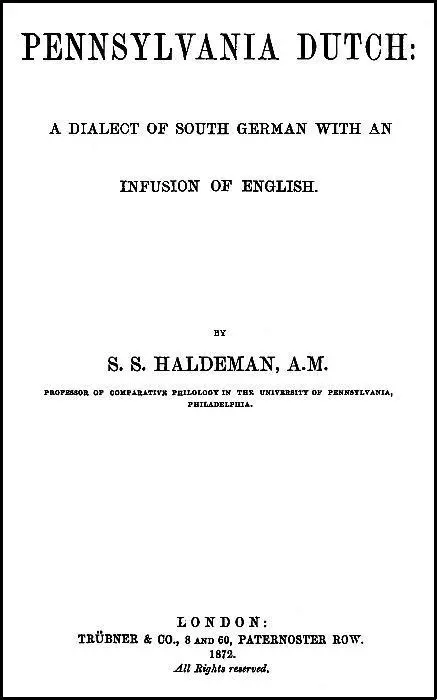
"Pennsylvania Dutch: A Dialect of South German With an Infusion of English" by S. S. Haldeman is a scientific publication written in the late 19th century. The book explores the unique linguistic characteristics of Pennsylvania Dutch, a dialect formed by German-speaking immigrants to Pennsylvania, highlighting its blend of South German roots and English influences. The text delves into various aspects of the dialect, including its phonology, vocabulary, and syntax, making it a valuable resource for those interested in comparative philology and language evolution. The opening of the work introduces the rationale behind studying this dialect, emphasizing its formation over a century within a linguistically diverse community. It describes the historical context of German immigration to Pennsylvania and how various dialects from regions like Rhenish Bavaria and Alsace contributed to the development of Pennsylvania Dutch. The author outlines the influences of limited interactions among the largely agricultural immigrant populations, which led to distinct linguistic changes, thus setting the stage for a detailed examination of phonology, vocabulary, and syntax in subsequent chapters.
Introduction adapted from the source catalogue; source summaries may be automatically generated.
Free to read · English · 27,823 words · No account needed
MAKE TIME FOR A GOOD BOOK
On by default. Untick to stop anonymous reading totals. Each page counts after 10 seconds in view. How this works.
Anonymous counting is on unless you have switched it off.
The Pennsylvania German appreciates humor, and to avoid the humorous and often illegitimate use of English words, the first examples in these pages will be selected from the advertisements of about a dozen different newspapers, all printed in the barbarous German character, and published at distant points in Pennsylvania. In such compositions, the attention of the public is called to common objects in a vocabulary which can be accepted without hesitation, and in a style somewhat above the colloquial, in which a horse is called 'gaul' and not pferd ('pfært') as usual in print. The spelling is sometimes English and sometimes more or less Germanised, without much affecting the pronunciation, as in "store" (a retail shop[30]) or "stohr" (buchstore, storehalter, stohrhaus), which are equally 'schtoor'; "frame," (främe, främ, frähm), are equally the English frame; "schap" (shap, schop, schopp, shop, pl. schöp); "township" (townschip, taunschip); "county" and "caunty"; "turnpike" and "turnpeik"; "cash" and "casch."
In some localities, English names of streets like King, Queen, High, Water, Chesnut Street, are used in German speech and print, and in others, Königstrasze, Quienstrasze, Highstrasze, Wasserstrasze and Chesnutstrasze, are preferred.
As parenthetic words like (Dry Goods) occur in the originals, explanations will be [in brackets], and attention will be called to strictly English words by putting them in italics.
The "Pennsylvanische Staats-Zeitung" (published at Harrisburg, the State Capital) claims a larger circulation than any English journal of that city, and the number for Nov. 25, 1869, will be quoted here in the original spelling. Here, where English introduced words might be expected throughout, certain French words are adopted from the German dictionaries, such as reparaturen, delikatessen, lagerbier salon (also saloon),[31] etablissement, engagiren, quotiren, instruiren, autorisiren, ordonnanz. Others are rather English than French, as pavements, arrangements, publikationspreisen, textbücher, jury, city, controle ( ... so wie dasz die City alleinige Controle über denselben Committee....), connektion, construktion, order, governör, provisionen, groceries.
Beste Familien-Mehl, in Fässern [in another journal--Roggenflauer per bärrel--preim flaur] superfine per Bärrel; Prime weitzen; Roggen [rye] per Buschel. Korn [maize or indian corn, properly called Welschkorn in the same column under the quoted Lancaster prices, where "Korn" means rye.] Hafer; Middlings; Shorts.
In the Price-current we find--
Fische ... Rock [Labrax lineatus]; Pike [for Hecht, pl. Hechte, a known term]; Halibut; Haddock; Sturgeon; Trout; White Perch [Labrax albus, vel mucronatus]; Weisze Fische [Coregonus albus]; Härringe; Catfische [Pimelodus, more commonly called 'katsǝfisch'].
Your reading position is saved on this browser. Take it to another device with a library code. Reading pages adapt to text, rather than matching a printed edition.
BEHIND THE BOOK
This eBook is for the use of anyone anywhere in the United States and most other parts of the world at no cost and with almost no restrictions whatsoever. You may copy it, give it away or re-use it under the terms of the Project Gutenberg License included with this eBook or online at www.gutenberg.org. If you are not located in the United States, you will have to check the laws of the country where you are located before using this eBook. Read the source licence.
The original source file, including credits and licence, is retained by this library. Request an original-format copy at no charge. Please include the book title and Project Gutenberg identifier #48417.
KEEP YOUR CURIOSITY GOING
Cécile Tormay

Moritz Busch
John L. Ransom
Frances Wright
Cécile Tormay

Mabel Potter Daggett