THE CLASSIC COLLECTION✦An outlaw’s diary: the CommuneCLASSIC FREE BOOKS
An outlaw’s diary: the Commune
Cécile Tormay
THE CLASSIC COLLECTION · 1872
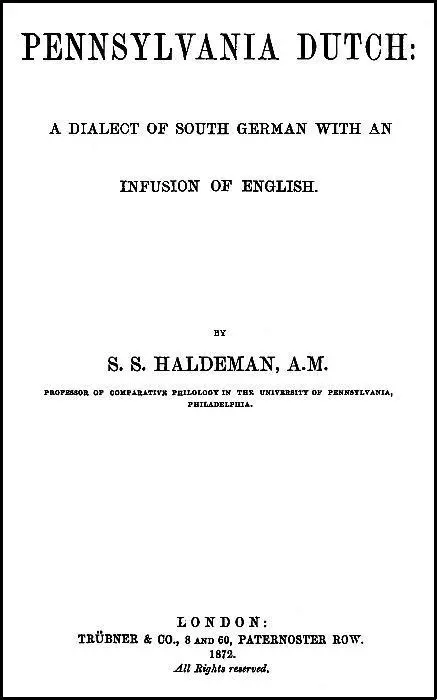
"Pennsylvania Dutch: A Dialect of South German With an Infusion of English" by S. S. Haldeman is a scientific publication written in the late 19th century. The book explores the unique linguistic characteristics of Pennsylvania Dutch, a dialect formed by German-speaking immigrants to Pennsylvania, highlighting its blend of South German roots and English influences. The text delves into various aspects of the dialect, including its phonology, vocabulary, and syntax, making it a valuable resource for those interested in comparative philology and language evolution. The opening of the work introduces the rationale behind studying this dialect, emphasizing its formation over a century within a linguistically diverse community. It describes the historical context of German immigration to Pennsylvania and how various dialects from regions like Rhenish Bavaria and Alsace contributed to the development of Pennsylvania Dutch. The author outlines the influences of limited interactions among the largely agricultural immigrant populations, which led to distinct linguistic changes, thus setting the stage for a detailed examination of phonology, vocabulary, and syntax in subsequent chapters.
Introduction adapted from the source catalogue; source summaries may be automatically generated.
Free to read · English · 27,823 words · No account needed
MAKE TIME FOR A GOOD BOOK
On by default. Untick to stop anonymous reading totals. Each page counts after 10 seconds in view. How this works.
Anonymous counting is on unless you have switched it off.
As G. 'ü' becomes 'i' in PG., G. lügen (to tell a lie) and liegen (to lie down--both having the first vowel long) might be confused, but the latter is shortened in PG., as in 'ær likt' (he lies down) 'ær liikt' (he tells a lie).
PG. Was wi't? What wilst thou? G. Was willst du? Woo't weepe? Woo't fight? Woo't teare thy ſelfe?[14]
Ich wil fischǝ gee˛. I will go to fish.
Ich hab kschriwwǝ. I have (geschrieben) written.
Sin mr net keiǝrt? Are we not married? G. Sind wir nicht geheirathet? (or verheirathet.)
Infinitive-n is rejected, as in the Swiss and Suabian dialects. In an Austrian dialect it is rejected when m, n, or ng precedes, as in singa, rena, nehma, for singen, rennen, nehmen.--Castelli, Wörterbuch, 1847, p. 31.
The length of some vowels is doubtful, as in 'rot' or 'root' (red, like English rŏte or rōde), 'so' or 'soo,' 'nochbǝr' or 'noochbǝr,' 'ǝmol' or 'ǝmool,' 'ja' or 'jaa,' 'sii' or 'sĭ' (she, they, ĭ in deceĭt, not in sit). Compare English 'Sēe!' and 'Sĕe thêre!'
Accent in PG. agrees with that of High German. When indicated, as in danóot or danoot' (for the 'oo' represent a single vowel, as in Eng. floor), it is to afford aid to the reader not familiar with German accent.
[6] For example, as the vowel of German schaf is long, the PG. word 'schafleit,' which occurs in a quoted passage farther on, would be likely to be read 'schaafleit' (sheep-people or shepherds) instead of 'schaffleit' (work-people), although it is stated that in the spelling used, a vowel must not be made long unless its letter is doubled. "This tendency, and a trick of reading words like nisbut, relation, qismut, fortune, as if written nizbut, qizmut, should be carefully guarded against.... Even is, as, rusm, will, in spite of the caveat, ... become again in his mouth iz, az, ruzm, rather than the iss, auss, russm, intended."--Gilchrist, 1806.
[7] High German letters which represent PG. sounds are in
parentheses.
[8] The long vowel used by native speakers in Bath,
Somersetshire, England.
[9] These two powers are not quite the same.
[10] Indicated in 1860 in my Analytic Orthography, §§ 661-3, and in my note to A. J. Ellis's Early English Pronunciation, 1869, p. 655, note 2, col. 2. "The lost final n is commonly recalled by a nasal vowel."
Your reading position is saved on this browser. Take it to another device with a library code. Reading pages adapt to text, rather than matching a printed edition.
BEHIND THE BOOK
This eBook is for the use of anyone anywhere in the United States and most other parts of the world at no cost and with almost no restrictions whatsoever. You may copy it, give it away or re-use it under the terms of the Project Gutenberg License included with this eBook or online at www.gutenberg.org. If you are not located in the United States, you will have to check the laws of the country where you are located before using this eBook. Read the source licence.
The original source file, including credits and licence, is retained by this library. Request an original-format copy at no charge. Please include the book title and Project Gutenberg identifier #48417.
KEEP YOUR CURIOSITY GOING
Cécile Tormay

Moritz Busch
John L. Ransom
Frances Wright
Cécile Tormay

Mabel Potter Daggett