THE CLASSIC COLLECTION✦An outlaw’s diary: the CommuneCLASSIC FREE BOOKS
An outlaw’s diary: the Commune
Cécile Tormay
THE CLASSIC COLLECTION · 1872
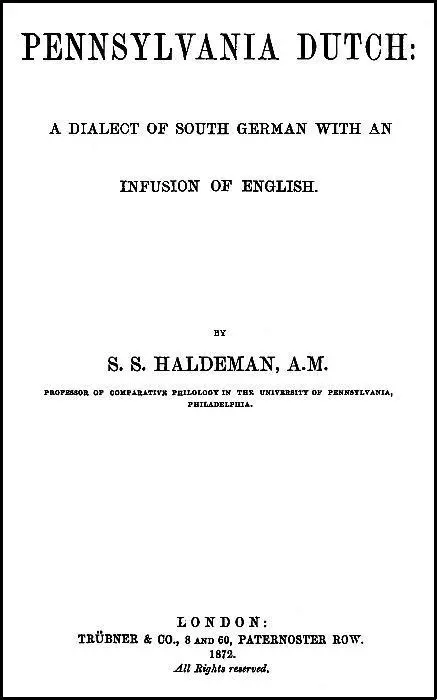
"Pennsylvania Dutch: A Dialect of South German With an Infusion of English" by S. S. Haldeman is a scientific publication written in the late 19th century. The book explores the unique linguistic characteristics of Pennsylvania Dutch, a dialect formed by German-speaking immigrants to Pennsylvania, highlighting its blend of South German roots and English influences. The text delves into various aspects of the dialect, including its phonology, vocabulary, and syntax, making it a valuable resource for those interested in comparative philology and language evolution. The opening of the work introduces the rationale behind studying this dialect, emphasizing its formation over a century within a linguistically diverse community. It describes the historical context of German immigration to Pennsylvania and how various dialects from regions like Rhenish Bavaria and Alsace contributed to the development of Pennsylvania Dutch. The author outlines the influences of limited interactions among the largely agricultural immigrant populations, which led to distinct linguistic changes, thus setting the stage for a detailed examination of phonology, vocabulary, and syntax in subsequent chapters.
Introduction adapted from the source catalogue; source summaries may be automatically generated.
Free to read · English · 27,823 words · No account needed
MAKE TIME FOR A GOOD BOOK
On by default. Untick to stop anonymous reading totals. Each page counts after 10 seconds in view. How this works.
Anonymous counting is on unless you have switched it off.
The Germanism of confusing b, p; t, d; k, g, is present in PG. and they are pronounced flat, that is, with more of the surface of the organs in contact than in English--a characteristic which distinguishes German from languages of the Dutch and Low-Saxon (Plattdeutsch) type.[11] This must be remembered in reading the examples, in which the ordinary usage of these letters will be nearly followed.
The consonants are b, ch, d, f, g (in get, give), gh, h, j (English y), k, l, m, n, ng, p, r (trilled), s (in seal, not as in miser), sch (in ship), t, w (a kind of v made with the lips alone). 'ch' has the two usual variations as in recht and buch, and its sonant equivalent 'gh' (written with 'g' in German) presents the same two phases, as in G. regen and bogen. 'ng' before a vowel as in singer, hence 'finger' is fing-er and not fing-ger. 'n' before 'k' is like 'ng,' as in G. links (on the left), which is pronounced like an English syllable. Vowels to be repeated are indicated by a hyphen, as in ge-ennǝrt (altered), nei-ichkeit (novelty).
Should letters be wanted for English j, z, v, w, the first may have dzh, and the others italic z, v, w, with ks for x.
As the reader of English who speaks PG. can learn the German alphabetic powers in half an hour, PG. should be written on a German basis, and not according to the vagaries of English spelling, with its uncertainty and reckless sacrifice of analogy. In print, PG. should appear in the ordinary roman type, in which so many German books are now published.[12]
§ 6. Stein or Schtein?
The sequents sp, st, are perhaps universally converted into 'schp' and 'scht' in PG., as in 'geescht' for gehest, 'hascht' for hast, 'Kaschp'r' for Caspar, 'schtee˛' for stein, and 'schpeck' for speck, all of which are genuine German, as distinguished from Saxon, Anglo-saxon, and Hollandish, because S is incompatible before labials (w, m, p) and dentals (l, n, t) in High German. Hence, where Dutch has zwijn, smidt, and speelen, German has schwein, schmidt, and schpielen; and for Dutch forms like slijm, snee, and steen, German has schleim, schnee, and schtein; but as the German uses the conventional spellings 'spielen' and 'stein,' he is apt to fancy that a law of speech is of less importance than the flourishes of a writing-master, or the practice of a printing-office, even when his own speech should teach him the law.
Your reading position is saved on this browser. Take it to another device with a library code. Reading pages adapt to text, rather than matching a printed edition.
BEHIND THE BOOK
This eBook is for the use of anyone anywhere in the United States and most other parts of the world at no cost and with almost no restrictions whatsoever. You may copy it, give it away or re-use it under the terms of the Project Gutenberg License included with this eBook or online at www.gutenberg.org. If you are not located in the United States, you will have to check the laws of the country where you are located before using this eBook. Read the source licence.
The original source file, including credits and licence, is retained by this library. Request an original-format copy at no charge. Please include the book title and Project Gutenberg identifier #48417.
KEEP YOUR CURIOSITY GOING
Cécile Tormay

Moritz Busch
John L. Ransom
Frances Wright
Cécile Tormay

Mabel Potter Daggett