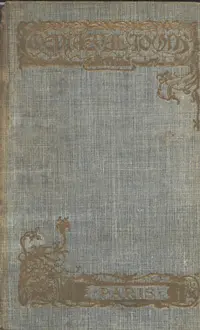
The Story of Paris
Thomas Okey
THE CLASSIC COLLECTION · 1904
"Paris and Its Story" by T. Okey is a historical account written in the early 20th century. This work chronicles the rich and complex history of Paris, focusing on its evolution from a Gallic settlement to the vibrant metropolis it is today. The narrative combines both factual history and the romantic legends that shape the city's identity, making it particularly appealing for readers interested in the cultural and historical significance of Paris. The opening of the book sets the tone by reflecting on the author’s admiration for Paris, establishing the city as a symbol of cultural significance and enduring spirit through centuries of struggle and triumph. Okey introduces the city's early beginnings as Lutetia, highlighting its geographical advantages that made it a center for trade and military importance. The narrative emphasizes the transformation Paris underwent under various rulers, starting from the Roman occupation and continuing through the medieval period, illustrating not only its resilience through invasions and internal conflicts but also its rich cultural tapestry woven through art, literature, and the continuous evolution of its society.
Introduction adapted from the source catalogue; source summaries may be automatically generated.
Free to read · English · 110,517 words · No account needed
MAKE TIME FOR A GOOD BOOK
On by default. Untick to stop anonymous reading totals. Each page counts after 10 seconds in view. How this works.
Anonymous counting is on unless you have switched it off.
With the three sons of Philip who successively became kings of France, the direct line of the Capetian dynasty ends: with the accession of Philip VI. in 1328, the house of Valois opens the sad century of the English wars--a period of humiliation and defeat, of rebellious and treacherous princes, civil strife, famine and plague, illumined only by the heroism of a peasant-girl, who, when king and nobles were sunk in shameless apathy or sullen despair, saved France from utter extinction. Pope after pope sought to make peace, but in vain: Hui sont en paix, demain en guerre ("to-day peace, to-morrow war") was the normal and inevitable situation until the English had wholly subjected France or the French driven the English to their natural boundary of the Channel.
Never since the days of Charlemagne had the French Monarchy been so powerful as when the Valois came to the throne: in less than a generation Crecy and Poitiers had made the English name a terror in France, and a French king, John the Good, was led captive to England. Once again, as in the dark Norman times, Paris rose and determined to save herself. Etienne Marcel, provost of the merchants, whose statue now stands near the site of the Maison aux Piliers, the old Hostel de Ville which he bought for the citizens of Paris, became the leader of the movement. The Dauphin,[81] who had assumed the title of Lieutenant-General, convoked the States-General at Paris, but he was forced by Marcel and his party to grant some urgent reforms, and a Committee of National Defence was organised by the provost, who became virtually dictator of Paris. The Dauphin fled to Compiègne to rally the nobles. During the ensuing anarchy the poor, dumb, starving serfs of France, in their hopeless misery and despair, rose in insurrection and swept like a flame over the land. Froissart, who writes from the distorted stories told him by the seigneurs, has woefully exaggerated the atrocities of the Jacquerie.[82] There was much arson and pillage, but barely thirty of the nobles are known to have perished. Of the merciless vengeance taken by the seigneurs there is ample confirmation. The wretched peasants were easily out-manoeuvred and killed like rats by the mail-clad nobles and their men-at-arms; so many were butchered in the market-place of Meaux that weariness stayed the arms of the slaughterers, and fire completed their work. Twenty thousand are estimated to have perished between the Seine and the Marne. Meanwhile the Dauphin was marching on Paris: Marcel had seized the Louvre, repaired and extended the wall of Paris, and raised an army. The provost turned for support to the Jacques, and on their suppression essayed to win over King Charles of Navarre, whose aid would decide the issue. Plot and counterplot followed. On 31st July 1358, Marcel was inspecting the gates of Paris, and at the Bastille[83] St. Denis ordered the keys to be given up to the treasurer of the king of Navarre, who was with him. The guards refused, and Jean Maillart, Marcel's sheriff and bosom friend, leapt on his horse, rode to the Halles, and crying;--"Au roi, au roi, mont-joie St. Denis," called the king's friends to arms, and hastened to intercept the provost at the Bastille St. Antoine. Marcel was holding the keys in his hand when they arrived. "Stephen, Stephen!" cried Maillart, "what dost thou here at this hour?" "I am here," answered the provost, "to guard the city whose governor I am." "Par Dieu," retorted Maillart, "thou art here for no good," and turning to his followers, said, "Behold the keys which he holds to the destruction of the city." Each gave the other the lie. "Good people," protested Marcel, "why would you do me ill? All I wrought was for your good as well as mine." Maillart for answer smote at him, crying, "Traitor, à mort, à mort!" There was a stubborn fight, and Maillart felled the provost by a blow with his axe; six of the provost's companions were slain, and the remainder haled to prison. Next day the Dauphin entered Paris in triumph, and the popular leaders were executed on the Place de Grève. The provost's body was dragged to the court of the church of St. Catherine du Val des Ecoliers, where it lay naked that it might be seen of all: after a long exposure it was cast into the Seine. All the reforms were revoked by the king, but the remembrance of the time when the merchants and people of Paris had dared to speak to their royal lord face to face of justice and good government, was never obliterated.
Your reading position is saved on this browser. Take it to another device with a library code. Reading pages adapt to text, rather than matching a printed edition.
Thomas Okey
BEHIND THE BOOK
This eBook is for the use of anyone anywhere in the United States and most other parts of the world at no cost and with almost no restrictions whatsoever. You may copy it, give it away or re-use it under the terms of the Project Gutenberg License included with this eBook or online at www.gutenberg.org. If you are not located in the United States, you will have to check the laws of the country where you are located before using this eBook. Read the source licence.
The original source file, including credits and licence, is retained by this library. Request an original-format copy at no charge. Please include the book title and Project Gutenberg identifier #45336.
KEEP YOUR CURIOSITY GOING
Wilfrid Scawen Blunt
Wilfrid Scawen Blunt

E. W. (Edgar Watson) Howe
Cécile Tormay

Moritz Busch
John L. Ransom