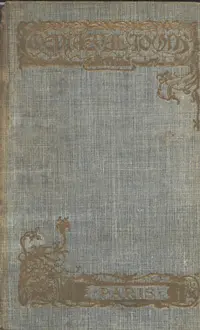
The Story of Paris
Thomas Okey
THE CLASSIC COLLECTION · 1904
"Paris and Its Story" by T. Okey is a historical account written in the early 20th century. This work chronicles the rich and complex history of Paris, focusing on its evolution from a Gallic settlement to the vibrant metropolis it is today. The narrative combines both factual history and the romantic legends that shape the city's identity, making it particularly appealing for readers interested in the cultural and historical significance of Paris. The opening of the book sets the tone by reflecting on the author’s admiration for Paris, establishing the city as a symbol of cultural significance and enduring spirit through centuries of struggle and triumph. Okey introduces the city's early beginnings as Lutetia, highlighting its geographical advantages that made it a center for trade and military importance. The narrative emphasizes the transformation Paris underwent under various rulers, starting from the Roman occupation and continuing through the medieval period, illustrating not only its resilience through invasions and internal conflicts but also its rich cultural tapestry woven through art, literature, and the continuous evolution of its society.
Introduction adapted from the source catalogue; source summaries may be automatically generated.
Free to read · English · 110,517 words · No account needed
MAKE TIME FOR A GOOD BOOK
On by default. Untick to stop anonymous reading totals. Each page counts after 10 seconds in view. How this works.
Anonymous counting is on unless you have switched it off.
Crowned vice was now succeeded by crowned folly. The grandson of Louis XV., a well-meaning but weak and foolish youth, and his thoughtless, pleasure-loving queen, were confronted by state problems that would have taxed the genius of a Richelieu in the maturity of his powers. Injustice, misery, oppression, discontent, were clamant and almost universal; taxes had doubled since the death of Louis XIV.; there were 30,000 beggars in Paris alone. The penal code was of inhuman ferocity; law was complicated, ruinous and partial and national credit so low that loans could be obtained only against material pledges and at interest five times as great as that paid by England. Wealthy bishops and abbots[152] and clergy, noblesse and royal officials were wholly exempt from the main incidents of taxation; for personal and land taxes, tithes and forced labour, were exacted from the common people alone. No liberty of worship, nor of thought: Protestants were condemned to the galleys by hundreds; booksellers met the same fate. Authors and books were arbitrarily sent by lettres de cachet to the Bastille. Yet in spite of all repression a generation of daring, witty, emancipated thinkers in Paris were elaborating a weapon of scientific, rationalistic and liberal doctrine that cut at the very roots of the old régime. And while France was in travail of the palingenesis of the modern world, the futile king was trifling with his locks and keys and colouring maps, the queen playing at shepherdesses at Trianon or performing before courtiers, officers and equerries the rôles of Rosina in the Barbier de Seville and of Colette in the Devin du Village, the latter composed by the democratic philosopher, whose Contrat Social was to prove the Gospel of the Revolution.[153] Jean Jacques Rousseau, the solitary self-centred Swiss engraver and musician, has described for us in words that will bear translation how an ineffaceable impression of the sufferings of the people was burnt into his memory, and the germs of an unquenchable hatred of their oppressors were sown in his breast. Journeying on foot between Paris and Lyons he was one day diverted from his path by the beauty of the landscape, and wandered about, seeking in vain to discover his way. "At length," he writes, "weary and dying of thirst and hunger I entered a peasant's house, not a very attractive one, but the only one I could see. I imagined that here as in Switzerland every inhabitant of easy means would be able to offer hospitality. I entered and begged that I might have dinner by paying for it. The peasant handed me some skim milk and coarse barley bread, saying that was all he had. The milk seemed delicious and I ate the bread, straw and all, but it was not very satisfying to one exhausted by fatigue. The man scrutinised me and judged by my appetite the truth of the story I had told. Suddenly, after saying that he perceived I was a good, honest youth and not there to spy upon him he opened a trap door, descended and returned speedily with some good wheaten bread, a ham appetising but rather high, and a bottle of wine which rejoiced my heart more than all the rest. He added a good thick omelette and I enjoyed a dinner such as those alone who travel on foot can know. When it came to paying, his anxiety and fears again seized him; he would have none of my money and pushed it aside, exceedingly troubled, nor could I imagine what he was afraid of. At last he uttered with a shudder the terrible words 'commis, rats de cave' ("assessors, cellar rats"). He made me understand that he hid the wine because of the aides,[154] and the bread because of the tailles[155] and that he would be a ruined man if it were supposed that he was not dying of hunger. That man, although fairly well-off, dared not eat the bread earned by the sweat of his brow, and could only escape ruin by pretending to be as miserable as those he saw around him. I issued forth from that house indignant as well as affected, deploring the lot of that fair land where nature had lavished all her gifts only to become the spoil of barbarous tax-farmers (publicans)." The elder Mirabeau has told how he saw a bailiff cut off the hand of a peasant woman who had clung to her kitchen utensils when distraint was made on her poor possessions for dues exacted by the tax-farmer. It is related in Madame Campan's Memoirs that Louis XV., hunting one day in the forest of Senard, about fifteen miles south of Paris, met a man on horseback carrying a coffin. "Whither are you carrying that coffin?" asked the king. "To the village of ----." "Is it for a man or a woman?" "For a man." "What did he die of?" "Hunger," bluntly returned the villager. The king spurred his horse and said no more.
Your reading position is saved on this browser. Take it to another device with a library code. Reading pages adapt to text, rather than matching a printed edition.
Thomas Okey
BEHIND THE BOOK
This eBook is for the use of anyone anywhere in the United States and most other parts of the world at no cost and with almost no restrictions whatsoever. You may copy it, give it away or re-use it under the terms of the Project Gutenberg License included with this eBook or online at www.gutenberg.org. If you are not located in the United States, you will have to check the laws of the country where you are located before using this eBook. Read the source licence.
The original source file, including credits and licence, is retained by this library. Request an original-format copy at no charge. Please include the book title and Project Gutenberg identifier #45336.
KEEP YOUR CURIOSITY GOING
Wilfrid Scawen Blunt
Wilfrid Scawen Blunt

E. W. (Edgar Watson) Howe
Cécile Tormay

Moritz Busch
John L. Ransom