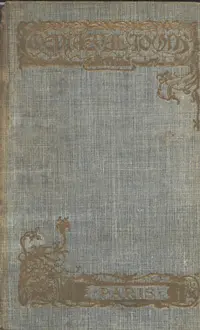
The Story of Paris
Thomas Okey
THE CLASSIC COLLECTION · 1904
"Paris and Its Story" by T. Okey is a historical account written in the early 20th century. This work chronicles the rich and complex history of Paris, focusing on its evolution from a Gallic settlement to the vibrant metropolis it is today. The narrative combines both factual history and the romantic legends that shape the city's identity, making it particularly appealing for readers interested in the cultural and historical significance of Paris. The opening of the book sets the tone by reflecting on the author’s admiration for Paris, establishing the city as a symbol of cultural significance and enduring spirit through centuries of struggle and triumph. Okey introduces the city's early beginnings as Lutetia, highlighting its geographical advantages that made it a center for trade and military importance. The narrative emphasizes the transformation Paris underwent under various rulers, starting from the Roman occupation and continuing through the medieval period, illustrating not only its resilience through invasions and internal conflicts but also its rich cultural tapestry woven through art, literature, and the continuous evolution of its society.
Introduction adapted from the source catalogue; source summaries may be automatically generated.
Free to read · English · 110,517 words · No account needed
MAKE TIME FOR A GOOD BOOK
On by default. Untick to stop anonymous reading totals. Each page counts after 10 seconds in view. How this works.
Anonymous counting is on unless you have switched it off.
[107] The image was stolen in 1545 and replaced by one of wood. This was struck down in 1551, and the bishop of Paris substituted for it one of marble.
[108] One thousand two hundred are said to have suffered death during
the month of vengeance.
[109] Henry of Guise had succeeded to the dukedom after his father's
assassination.
[110] Suspicions of poison were entertained by the Huguenots. Jeanne, in a letter to the Marquis de Beauvais, complained that holes were made in her rooms that she might be spied upon.
[111] Félibien and Lobïneau, 1725.
[112] "That to show pity was to be cruel to them: to be cruel to them
was to show pity."
[113] The municipality gave presents of money to the archers who had taken part in the massacre, to the watermen who prevented the Huguenots from crossing the Seine, and to grave-diggers for having buried in eight days about 1,100 bodies.
[114] Now known as the Galerie d'Apollon.
[115] Ugonottorum strages. Inscription on the obverse of the medal.
[116] Examples of magnificent costumes of the order may be seen in the
Cluny Museum.
[117] The Duke of Guise was so called from his face being scarred by a wound received at the battle of Dolmans.
[118] The king had premonitions of a violent end. One day, after keeping Easter at Negeon with great devotion, he suddenly returned to the Louvre and ordered all the lions, bears, bulls, and other wild animals he kept there for baiting by dogs, to be shot. He had dreamt that he was set upon and eaten by wild beasts.
[119] So called derisively, because he was born and brought up in the poor province of Bearn, in the Pyrenees.
[120] Her majesty, we learn from the Mémoires of L'Estoile, was of a rich figure, stout, fine eyes and complexion. She used no paint, powder or other vilanie.
[121] The new palace was situated in the parish of St. Germain l'Auxerrois, the parish church of the Louvre.
[122] The north tower was left only partially constructed, and was
finished by Louis XIII.
[123] By a curious coincidence the widening of the Rue de la Ferronnerie had been ordered just before the king was assassinated.
[124] They marked the seven resting-places of the saint as he journeyed to St. Denis after his martyrdom.
[125] The Grande Galerie.
[126] In the Hôtel de Bourbon, east of the old Louvre, sometimes known
as the Petit Bourbon.
[127] The church of Notre Dame des Victoires commemorates the victory.
[128] The Marché St. Honoré now occupies its site.
[129] In 1793 the tomb was desecrated, and the head removed from the body, but in 1863, as an inscription tells, the head was recovered by the historian Duruy, and after seventy years reunited to the trunk.
Your reading position is saved on this browser. Take it to another device with a library code. Reading pages adapt to text, rather than matching a printed edition.
Thomas Okey
BEHIND THE BOOK
This eBook is for the use of anyone anywhere in the United States and most other parts of the world at no cost and with almost no restrictions whatsoever. You may copy it, give it away or re-use it under the terms of the Project Gutenberg License included with this eBook or online at www.gutenberg.org. If you are not located in the United States, you will have to check the laws of the country where you are located before using this eBook. Read the source licence.
The original source file, including credits and licence, is retained by this library. Request an original-format copy at no charge. Please include the book title and Project Gutenberg identifier #45336.
KEEP YOUR CURIOSITY GOING
Wilfrid Scawen Blunt
Wilfrid Scawen Blunt

E. W. (Edgar Watson) Howe
Cécile Tormay

Moritz Busch
John L. Ransom