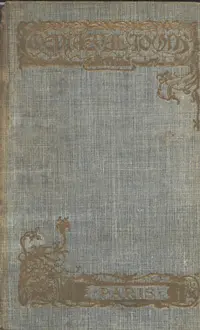
The Story of Paris
Thomas Okey
THE CLASSIC COLLECTION · 1904
"Paris and Its Story" by T. Okey is a historical account written in the early 20th century. This work chronicles the rich and complex history of Paris, focusing on its evolution from a Gallic settlement to the vibrant metropolis it is today. The narrative combines both factual history and the romantic legends that shape the city's identity, making it particularly appealing for readers interested in the cultural and historical significance of Paris. The opening of the book sets the tone by reflecting on the author’s admiration for Paris, establishing the city as a symbol of cultural significance and enduring spirit through centuries of struggle and triumph. Okey introduces the city's early beginnings as Lutetia, highlighting its geographical advantages that made it a center for trade and military importance. The narrative emphasizes the transformation Paris underwent under various rulers, starting from the Roman occupation and continuing through the medieval period, illustrating not only its resilience through invasions and internal conflicts but also its rich cultural tapestry woven through art, literature, and the continuous evolution of its society.
Introduction adapted from the source catalogue; source summaries may be automatically generated.
Free to read · English · 110,517 words · No account needed
MAKE TIME FOR A GOOD BOOK
On by default. Untick to stop anonymous reading totals. Each page counts after 10 seconds in view. How this works.
Anonymous counting is on unless you have switched it off.
The later master, of Flemish birth, known as Jean Clouet, a painter of great delicacy, simplicity and charm, who died between 1540 and 1541, having spent twenty-five years as court painter of France; his brother, Clouet of Navarre; and his son, François Clouet, who was his assistant during the ten later years of his life, are all more or less doubtfully represented. Nos. 126 and 127, portraits of Francis I., are attributed to Jean Clouet, or Jehannet as this elusive personality is sometimes known; Nos. 128 and 129, two admirable portraits of Charles IX. and his queen Elizabeth of Austria, to François Clouet; No. 134, a portrait of Louis de St. Gellais, is ascribed to Clouet of Navarre. Other portraits executed at this period will be found on the walls, and are of profound interest to the student of French history.
The two years' sojourn in France of Solario, at the invitation of the Cardinal d'Amboise, of Da Vinci at the solicitation of Louis XII., and the foundation of the school of Fontainebleau by Rosso and Primaticcio, mark the eclipse of whatever schools of French painting were then existing, for the grand manner and dramatic power of the Italians, fostered by royal patronage, carried all before them. Of Rosso, known to the French as Maître Roux, the Louvre has a Pietà and a classical subject--The Challenge of the Pierides (Nos. 1485 and 1486). Primaticcio is represented by some admirable drawings. But the sterility of the Fontainebleau school may be inferred from the fact that when Marie de' Medici desired to have the Luxembourg decorated with the events in the life of Henry IV., her late husband, she was compelled to apply to a foreigner--Rubens.
Of Vouet (1590-1649), who is important as the leader of the new French school of the seventeenth century, the Louvre has some dozen examples, among them being his masterpiece (No. 971)--The Presentation at the Temple. Bestowing a passing attention on the lesser masters, and pausing to appreciate the works of the three brothers Le Nain, who stand pre-eminent for the healthy, sturdy simplicity of their peasant types and scenes of lowly life, we turn to Nicolas Poussin (1594-1665), the greatest of the seventeenth-century masters, who spent the whole of his artistic career in Rome save two unhappy years (1640-1642) at the French court, which his simple habits and artistic conscience made intolerable to him. His exalted and lucid conceptions, admirable art and fertility of invention may be adequately appreciated at the Louvre alone, which holds nearly fifty examples of his work. The beautiful and pathetic Shepherds of Arcady (No. 734) is generally regarded as his masterpiece. A group of shepherds in the fulness of health and beauty are arrested in their enjoyment of life by the warning inscription on a tomb--"Et in arcadia ego" ("I, too, once lived in Arcady"). Equally rich is the Louvre in works of Vouet's pupil, Lesueur (1617-1655), one of the twelve ancients of the Royal Academy of Painting and Sculpture. No greater contrast could be imagined to the frank paganism of Poussin than the works of this fervently religious and tender artist, whose famous series from the life of St. Bruno is now placed in Room XII. His careful application to this monumental task may be estimated by the fact that 146 preliminary studies are preserved in the cabinet of drawings in the Louvre. The decorative skill, fertility and industry of his contemporary and fellow-pupil Lebrun (1617-1690), whom Louis XIV. loved to patronise, may perhaps be better appreciated at Versailles, but the Louvre displays the celebrated series of the Life of Alexander, executed for the Gobelins, and some score of his other works. His less talented rival, Mignard (1612-1695), also a pupil of Vouet, is seen at his best in the frescoes of the dome[173] of the Val de Grâce, but the oppressive influence of the Italian eclectics is all too evident in his style. He excelled in portraiture, and the visitor will not fail to remark the portraits of Madame de Maintenon, and of the Grand Dauphin with his wife and children. Louis XIV., who sat to him many times, one day, towards the end of his life, asked, "Do you find me changed?" "Sire," answered the courtly painter, "I only perceive a few more victories on your brow." We may now observe the more grave and virile style of Philippe de Champaigne of Brussels (1602-1674), who settled in Paris at nineteen years of age, and may fairly be classed among the French school. His intimate association with the austere and pious Jansenists of Port Royal is traceable in the Last Supper (No. 1928), and in his masterpiece, the portraits of Mother Catherine Agnes Arnauld and his own daughter, Sister Catherine (No. 1934), painted for the famous convent. He is perhaps better known for his portraits of Richelieu. Claude Lorrain (1600-1682), the best known and most appreciated of the seventeenth-century masters, and the greatest of the early landscape painters, is seen in sixteen examples.
Your reading position is saved on this browser. Take it to another device with a library code. Reading pages adapt to text, rather than matching a printed edition.
Thomas Okey
BEHIND THE BOOK
This eBook is for the use of anyone anywhere in the United States and most other parts of the world at no cost and with almost no restrictions whatsoever. You may copy it, give it away or re-use it under the terms of the Project Gutenberg License included with this eBook or online at www.gutenberg.org. If you are not located in the United States, you will have to check the laws of the country where you are located before using this eBook. Read the source licence.
The original source file, including credits and licence, is retained by this library. Request an original-format copy at no charge. Please include the book title and Project Gutenberg identifier #45336.
KEEP YOUR CURIOSITY GOING
Wilfrid Scawen Blunt
Wilfrid Scawen Blunt

E. W. (Edgar Watson) Howe
Cécile Tormay

Moritz Busch
John L. Ransom