THE CLASSIC COLLECTION✦An outlaw’s diary: the CommuneCLASSIC FREE BOOKS
An outlaw’s diary: the Commune
Cécile Tormay
THE CLASSIC COLLECTION · 1853
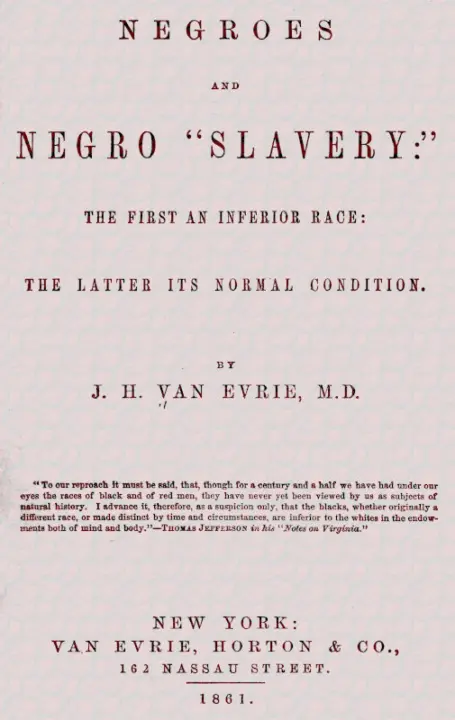
"Negroes and Negro 'Slavery:' the first an inferior race: the latter its normal condition" by J. H. Van Evrie, M.D. is a controversial treatise written in the mid-19th century. The work argues against the abolitionist movement, asserting that it is based on erroneous beliefs about racial equality and the nature of slavery. The author positions the black race as inherently inferior and maintains that slavery is the natural condition for those of African descent. At the start of the book, the author presents a preface discussing the political and social turmoil in America amid the rising anti-slavery sentiment and the onset of the Civil War. He critiques the abolitionist movement as rooted in delusion and foreign influence, particularly from European ideals. Van Evrie aims to provide a justification for the existing social order in the southern United States, asserting that it is rooted in natural law and necessity rather than moral failing. He sets the stage for a detailed exploration of the supposed differences between races, intending to argue for the social subordination of African Americans as not just preferable but essential for societal stability.
Introduction adapted from the source catalogue; source summaries may be automatically generated.
Free to read · English · 105,969 words · No account needed
MAKE TIME FOR A GOOD BOOK
On by default. Untick to stop anonymous reading totals. Each page counts after 10 seconds in view. How this works.
Anonymous counting is on unless you have switched it off.
Footnote 2:
Royalism, or a Hereditary Aristocracy, or class that attempts to create a permanent superiority over the great body of the people by incestuous intermarriage with its own members, is punished with similar results as those that attend the violation of the sexual relations of different Races. And the idiotic, impotent, and diseased offspring of hereditary kings has always a certain physiological resemblance to the effete and sterile mulatto. Both are violations of the normal order, and both are limited to a determinate existence, just as any other diseased conditions which nature forbids to live.
Nations are punished in this life, however it may be with individuals, and a sin so enormous, a crime and impiety against God so awful, an outrage on their own nature so boundless and bottomless as practical abolitionism, or the actual living out of the abolition theory, would drag after it, as an inexorable necessity, a corresponding punishment.
History is pregnant with examples of this inevitable law. Nations after nations have risen, flourished, decayed, and died on the African continent; millions upon millions of white Christian men have existed in the valley of the Nile alone; three hundred Christian bishops have met in convention on the site of ancient Carthage, when London was unknown and Rome itself the seat of the heathen Cæsars; and now, of the five hundred millions of Caucasians known to have existed on that continent since the Christian era began, there are probably not one million of typical white men left to tell the tale of their destruction, or to mourn over the desolation brought upon them by the crimes and sins of their progenitors. The vastly preponderating white element would doubtless save us from similar consequences, should we ever commit such a hideous crime as that involved in the practical application of the abolition theory; but, as has been said, we would most likely fall a conquest to some European power. But should this fate not overtake us, should we be left to struggle with the load of sin and disease thus brought upon ourselves by our crimes against reason and the ordinances of the Eternal, the nation would in time slough off mulattoism, and finally recover from the foul and horrible contamination of admixture with the blood of the negro. The twenty millions of pure and untainted blood would increase so rapidly over the diseased portion, that finally every trace, atom, and drop or globule of the latter would be utterly extinct, and though the time for this process to work itself out, or for the white race to recover its healthy and natural condition, cannot be estimated with any certainty, such would needs be the final result. This same process, though the parties are directly reversed, is now in active operation in Mexico, and all the Spanish-American States. The Spanish conquerors brought few countrywomen with them, and therefore sought wives among the natives or aboriginal race, and amalgamation became universal in all the Spanish provinces, the result of which has been the generation of a vast and wide-spread mongrelism. The Spanish dominion usually embodied in the pure blood, not from any prejudice against the mixed element, but from jealousy of the native born, preserved order and general prosperity. But the overthrow of this dominion brought the mongrel element into power, for though Iturbide, Santa Anna, Bravo, Bustamente, Parades, all or nearly all the chiefs of Independence were of pure Castilian blood, it was the mongrel element that overthrew the Spanish power and established the republic. Spaniards were constantly migrating to the American possessions of the Spanish crown, but, with the overthrow of the Spanish dominion, this supply of white blood was cut off, and instead of the generation of mongrelism, from that instant the reparatory process began, which can only end in sloughing off the mixed blood, and the restoration of the aboriginal race to its natural and healthy condition, as it was before the Spanish conquest and the admixture of the white element. This mixed or mongrel element is found in the cities, but it is rapidly declining. Mexico had, at the era of Independence, two hundred thousand inhabitants. It has now little over one hundred thousand people. Puebla, Perote, Jalapa, all the cities of Mexico decline in similar proportion, while the rural population—the pure, untainted, aboriginal element—though placed under great and striking disadvantages, holds its own, and were it guided and cared for, as it was one hundred years ago, would doubtless rapidly increase in number. Nor is it alone the fragility, feebleness, the vicious organization and imperfect vitality of mulattoism, or of the mongrel element, that is thus rapidly diminishing the population in Mexican cities. The morale of mongrelism partakes of the physical deformity, and the vices of the mind are as striking and constant as the defects of the body. A creature with half the nature and wants of the white man united in the same existence with those of the Indian, is confronted with another, perhaps three-fourths white, while on the other side of him is one who has three-fourths Indian blood, and population made up of such materials is necessarily and perpetually at war with itself. Hence in all the revolutions of Mexico there is no design, no common object that unite men in common purposes, no sense, reason, or common impulse whatever, except to destroy, to overturn, to seize power to-day without any purpose for to-morrow. And this goes on, and must go on until nature repairs the outrages inflicted on her, until mongrelism dies out and the aboriginal or Indian element is restored to its pristine condition, until every atom of the white blood is extinct and the Indian race is again what it was at the time of the Spanish conquest.
Your reading position is saved on this browser. Take it to another device with a library code. Reading pages adapt to text, rather than matching a printed edition.
BEHIND THE BOOK
This eBook is for the use of anyone anywhere in the United States and most other parts of the world at no cost and with almost no restrictions whatsoever. You may copy it, give it away or re-use it under the terms of the Project Gutenberg License included with this eBook or online at www.gutenberg.org. If you are not located in the United States, you will have to check the laws of the country where you are located before using this eBook. Read the source licence.
The original source file, including credits and licence, is retained by this library. Request an original-format copy at no charge. Please include the book title and Project Gutenberg identifier #61063.
KEEP YOUR CURIOSITY GOING
Cécile Tormay

Moritz Busch
John L. Ransom
Frances Wright
Cécile Tormay

Mabel Potter Daggett