THE CLASSIC COLLECTION✦An outlaw’s diary: the CommuneCLASSIC FREE BOOKS
An outlaw’s diary: the Commune
Cécile Tormay
THE CLASSIC COLLECTION · 1853
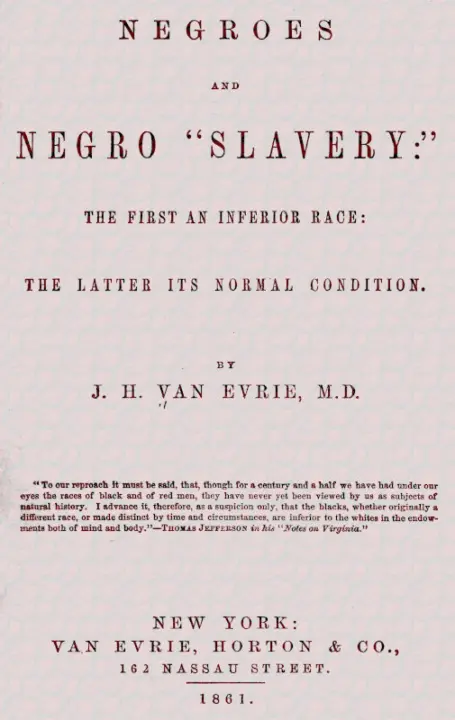
"Negroes and Negro 'Slavery:' the first an inferior race: the latter its normal condition" by J. H. Van Evrie, M.D. is a controversial treatise written in the mid-19th century. The work argues against the abolitionist movement, asserting that it is based on erroneous beliefs about racial equality and the nature of slavery. The author positions the black race as inherently inferior and maintains that slavery is the natural condition for those of African descent. At the start of the book, the author presents a preface discussing the political and social turmoil in America amid the rising anti-slavery sentiment and the onset of the Civil War. He critiques the abolitionist movement as rooted in delusion and foreign influence, particularly from European ideals. Van Evrie aims to provide a justification for the existing social order in the southern United States, asserting that it is rooted in natural law and necessity rather than moral failing. He sets the stage for a detailed exploration of the supposed differences between races, intending to argue for the social subordination of African Americans as not just preferable but essential for societal stability.
Introduction adapted from the source catalogue; source summaries may be automatically generated.
Free to read · English · 105,969 words · No account needed
MAKE TIME FOR A GOOD BOOK
On by default. Untick to stop anonymous reading totals. Each page counts after 10 seconds in view. How this works.
Anonymous counting is on unless you have switched it off.
But it is not the mere predominance of the senses, or the strength and acuteness of the sense which so broadly and radically separates whites and negroes. They are entirely different in the manifestations of these qualities. As has been observed, there are few if any near-sighted negroes, or negroes with other defects of vision, and the sense of smell in negroes permits them to discriminate and to indicate the presence of the rattle snake, or other venomous serpents. And in respect to the sense of touch or feeling, the peculiarity of the negro nature is perhaps most remarkable of all. This sense in the white person, though universal of course, is mainly located in the hand and fingers. Sir Charles Bell, an eminent English surgeon, has written an interesting work—one of the Bridgewater treatises—on the flexibility and adaptation of the human hand, and other volumes might be given to the world without exhausting the subject. The universal law of adaptation, indeed, demands that the sense of touch, the flexibility of the hand, the delicacy of the fingers, should be in accord with the large brain and commanding intellect, otherwise the world itself would long since have come to a stand-still, and human invention ended with the antediluvians. It is true the structure—the arrangement of the bones, muscles, tendons, etc., in short, the mere mechanism of the hand, is essential, but without the sense of feeling, or that delicacy of touch found only in the fingers of the Caucasian, the mechanical perfections of the hand would be comparatively useless.
All the nice manipulations in surgery, in the arts, in painting, statuary, and the thousands of delicate fabrics seen every day and all about us, demand both intellect and delicacy of hand, and these, too, in that complete perfection found alone in the Caucasian. The sense of touch, on the contrary, in the negro is not in the hand or fingers, or only partially so, but spreads all over the surface and envelops the entire person. The hand itself, in its mere mechanism, is incompatible with delicate manipulation. The coarse, blunt, webbed fingers of the negress, for example, even if we could imagine delicacy of touch and intellect to direct, could not in any length of time or millions of years be brought to produce those delicate fabrics or work those exquisite embroideries which constitute the pursuits or make up the amusements of the Caucasian female. The mechanism of the negro hand, the absence or rather the obtuseness of the sense of touch in the fingers, and the limited negro intellect, therefore, utterly forbid that negroes shall be mechanics, except it be in those grosser trades, such as coopers, blacksmiths, etc., which need little more than muscular strength and industry to practice them. But the sense of touch, though feeble in the hand or fingers, is none the less largely developed as are the other senses of the negro, and spreads over the whole surface of the body. This is witnessed every day at the South, where whipping, as with Northern children, is the ordinary punishment of negroes. As in all other foolish notions that spring from the one great misconception—that negroes have the same nature as white people, the “anti-slavery” people of the North and of Europe labor under a ludicrous mistake in respect to this matter. They take their notions of flogging from the practice of the British army and the Russian knout, where strong men are cut to pieces by the “cat” or beaten to death by clubs, and they suppose that precisely similar barbarity is practiced on the “poor slave.” And the runaway negro has doubtless added to these notions, perhaps, without meaning it. At Abolition conventicles he is expected, of course, to horrify the crowd with awful tales of his sufferings, but having always had plenty to eat and never overworked, he has really nothing to fall back on but the “cruel whippings,” which the imaginations of the former readily transform into their own notions, but which, in fact, correspond to that which they deal out to their own children without a moment’s compunction. The sensibility of the negro skin closely resembles that of childhood, and while there are doubtless cases of great barbarity in these respects, as we all know there are in cases of children, the ordinary flogging of negroes is much the same as that which parents, guardians, teachers, etc., deal out to white children, and the “terrible lash” so dolefully gloated over by the ignorant and deluded usually dwindles down into a petty switch in reality. But it is painful to the negro, perhaps more so than hanging would be, for while the local susceptibility of the skin makes him feel the slightest punishment in this respect, the obtuse sensibility of the brain and nervous system generally would enable him, as is often manifest, to bear hanging very well. Those who can remember being flogged in childhood will also remember the great pain that it gave them, though now in their adult age they would laugh at such a thing. The negro is a child forever, a child in many respects in his physical as well as his mental nature, and the flogging of the negro of fifty does not differ much, if any, from the flogging of a child of ten, and while the British soldier or Russian would receive his three hundred lashes without wincing, the big burly negro will yell more furiously than a school-boy when he receives a dozen cuts with an ordinary switch.
Your reading position is saved on this browser. Take it to another device with a library code. Reading pages adapt to text, rather than matching a printed edition.
BEHIND THE BOOK
This eBook is for the use of anyone anywhere in the United States and most other parts of the world at no cost and with almost no restrictions whatsoever. You may copy it, give it away or re-use it under the terms of the Project Gutenberg License included with this eBook or online at www.gutenberg.org. If you are not located in the United States, you will have to check the laws of the country where you are located before using this eBook. Read the source licence.
The original source file, including credits and licence, is retained by this library. Request an original-format copy at no charge. Please include the book title and Project Gutenberg identifier #61063.
KEEP YOUR CURIOSITY GOING
Cécile Tormay

Moritz Busch
John L. Ransom
Frances Wright
Cécile Tormay

Mabel Potter Daggett