THE CLASSIC COLLECTION✦An outlaw’s diary: the CommuneCLASSIC FREE BOOKS
An outlaw’s diary: the Commune
Cécile Tormay
THE CLASSIC COLLECTION · 1853
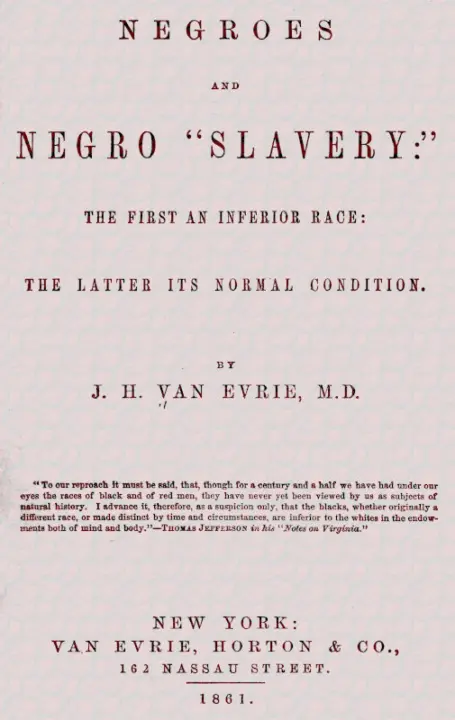
"Negroes and Negro 'Slavery:' the first an inferior race: the latter its normal condition" by J. H. Van Evrie, M.D. is a controversial treatise written in the mid-19th century. The work argues against the abolitionist movement, asserting that it is based on erroneous beliefs about racial equality and the nature of slavery. The author positions the black race as inherently inferior and maintains that slavery is the natural condition for those of African descent. At the start of the book, the author presents a preface discussing the political and social turmoil in America amid the rising anti-slavery sentiment and the onset of the Civil War. He critiques the abolitionist movement as rooted in delusion and foreign influence, particularly from European ideals. Van Evrie aims to provide a justification for the existing social order in the southern United States, asserting that it is rooted in natural law and necessity rather than moral failing. He sets the stage for a detailed exploration of the supposed differences between races, intending to argue for the social subordination of African Americans as not just preferable but essential for societal stability.
Introduction adapted from the source catalogue; source summaries may be automatically generated.
Free to read · English · 105,969 words · No account needed
MAKE TIME FOR A GOOD BOOK
On by default. Untick to stop anonymous reading totals. Each page counts after 10 seconds in view. How this works.
Anonymous counting is on unless you have switched it off.
The next great period in the history of the race—the historic era—is supposed to be entirely within the province of real knowledge. It begins with the history of the Greeks—not the symbolic but the real—that grand and glowing intellectualism which, in many respects, may be said to equal the intellectual development of our own times. The history of Greece and Rome is in truth the history of the race, of the world, of mankind. There were cotemporary nations of great power, extent and cultivation, but the Greeks and Romans, and the subject or servile populations that acknowledged their supremacy, made up the larger portion of the race. It is true the Persians were then pure Caucasians, and, in respect to numbers, largely surpassed the Greeks, but while they did not differ much in their general character, they were on the decline before the Greeks had reached their full national development. The latter always referred to Egypt as the source of their civilization, but it is more probable that they borrowed from Asia most of those things supposed to be of foreign origin. It is, however, quite possible that the earliest civilization was developed in Africa, that it receded from thence to Asia, as we know it afterwards did from the latter to Europe, and as we now witness it, passing to America. But what is civilization? It is, or it may be defined as, the result of intellectual manifestation. A nation or people who have most deeply studied and understood the laws of nature or the nature of things, and applied their knowledge to their own welfare, are the most civilized or we might say, in a word, that the nation that has the most knowledge is the most civilized. The Greeks, certainly, surpassed all cotemporary nations in the most essential of all knowledge, yet even this seems to have been rather a thing of chance than otherwise. Political intelligence, or a knowledge of men’s social relations to each other, is the most vital they can possess. The Greeks may be said both to have possessed this knowledge and to have been entirely deficient in it. Athens, with thirty thousand citizens all recognized as political equals, was a Democracy, but this so-called Democracy, with, perhaps, a hundred thousand slaves, was a burlesque on a democratic government. The Helots of Greece, the servile and subject population of which history gives no account, except to refer to them, were white men—men with all the natural capacities of Socrates, Demosthenes, or Alcibiades, but the Greek orators and writers of the day never even seemed to imagine that they had any rights whatever. They had much the same relation to the Greeks that the Saxons had to the Normans, that the Irish have to the English, and yet with all their political enlightenment and high intellectual development, the Greeks gave them no rights, and treated them as different and subordinate beings. The notion, therefore, taught in our schools, that the Greeks were the authors of political liberty, is unsound—they neither practised nor understood liberty, and the external forms mistaken for democracy had no necessary connection with it. Aristotle could not form even a conception of a political system that did not rest upon slavery, and this was doubtless the general condition of the Greek mind. It was merely accidental that the Greek States assumed a democratic form, or rather approximated to a democratic form; but while they were utterly ignorant of individual relations they certainly had clear views of the relations of states and the duties that independent communities owe to each other. The Asiatic nations seem to have had no conception whatever of these duties—conquest or slavery were the only alternatives. A nation must conquer or be conquered—a dynasty must destroy all others, or expect to fall itself—and the Asiatic character still partakes largely of these habitudes. Except, therefore, in the mere externals or outward arrangements of political society, the Greeks can hardly be said to have done anything for political liberty or to advance political science. The Romans did more—vastly more—but they had little or no conception of democracy or of individual liberty. The proud boast, “I am a Roman citizen,” unlike the idea of the American democrat, partook of the spirit of a British aristocrat of our own days, claiming the privileges of his order. The men who founded the city of Rome, though doubtless fillibusters and adventurers, perhaps even outcasts of the neighboring populations, were assumed to be superior to the later emigrants, and their descendants especially claimed exclusive privileges. And when Rome expanded into a mighty empire and ruled the world, the senatorial order ruled the empire—at all events, until Cæsar crossed the Rubicon and seized the supreme power. The change from a republic to an empire had little or no bearing upon the question of liberty, for the condition of the great body of the people remained the same. Rome conquered all, or nearly all, the then known world, for, except the Persians, and perhaps some few populations in the far North, the whole Caucasian race recognized the Romans as their rulers. The Parthians, so often waging desperate war with the Romans, were doubtless a mixed people, something like the modern Turks, and very possibly their ancestors. Following the rude code of early times, the Romans enslaved the conquered populations. All the prisoners of war were deemed to have forfeited their lives, and were parceled out among the Roman conquerors, while the rural populations were compelled to pay tribute to the Roman civil officers. It is quite probable that the Romans conquered some of the inferior races, but except the Numidians, Lybians, Ethiopians, etc., of Africa, Roman writers are silent on the subject. It has been said that the history of the Romans was the history of the Caucasian race, and that was the history of the world. This is literally true, for though we cannot suppose that the conquered populations were the miserable barbarians that the Roman writers represent them to have been, Rome was the most advanced portion of the race, and therefore the embodiment of its civilization and intellectual life. At this moment Paris represents all France; and the city of Rome bore a somewhat similar relation to the populations that composed the empire, however distant they may have been from the capital. It was not an unusual thing for the same general that commanded in Britain or that had conquered in Gaul, to administer the government of the African provinces or to conduct a campaign against the Persians on the bank of the Euphrates. And however much the vanity of Roman authors may have been gratified by assuming that they alone were civilized, it is altogether irrational to suppose that the conquered populations, with the same nature and same capacities as themselves, and moreover, in frequent and often intimate intercourse with themselves, could have differed widely or remained barbarians, even if such when conquered. The Romans advanced far beyond the Greeks in political knowledge, but with them also the state was every thing and the individual nothing. As with the Greeks, the great majority were slaves; and Roman citizenship, or the rights claimed by a Roman citizen, was at best a special privilege; and prior to the advent of Christianity, the idea of individual rights, of equality, of democracy, seems never to have dawned upon the intellectual horizon of the race. Nor did the primitive Christians (even) accept it in theory, though they lived it out in practice. Their mental habits were formed under the old social order, and though the spirit of the new doctrine impelled them to live it out in practice, few, if any, ever adopted it in theory. Christ had said, “love each other,” and “do unto others as you would have them do unto you,” that is, “grant to others the rights claimed for yourselves,” but while they often lived together, owning things in common like the modern communists and socialists, perhaps not one in a million ever thought of applying their doctrines to the state, or even supposing for a moment that the artificial distinctions which separated classes could ever be altered or modified. Even the forced and unnatural relation of master and slave, which necessarily violated the fundamental doctrine of their religion, was clung to and respected in theory, and it needed several centuries of practice and faithful obedience to the spirit of the new faith before this ancient barbarism was finally obliterated from the Roman world. The conquest of Rome, by the so-called northern barbarians, was followed by an eclipse of learning—by a mental darkness in Western Europe at least, that is fitly enough denominated the dark ages. Was this irruption of the northern nations into Italy the true cause of this darkness? For several centuries previous there had been an immense and almost continuous emigration from Asia, not of individuals, as we witness in the present day, to America, but of tribes, communities, whole nations. History is indeed imperfect, if not altogether silent, in respect to the cause of these mighty migrations which so long pressed upon Europe. But there can be little doubt that the Mongolian race about this time changed, to a considerable extent, its location, and pressing down on the old Caucasian populations of Asia, impelled those vast masses to seek shelter and safety, if not homes and happiness, in Europe. In the mighty invasions of Italy in the fifth century by Attila, the truth of this is certainly demonstrated. He himself was doubtless a white man, and so were his chiefs; but the mighty populations he ruled over, and which extended from the Danube to the frontiers of China, were mainly Mongolian. But no Mongolians settled permanently in Europe—none but Caucasians, and except the modern Turks, none but pure Caucasians—and, being the same men as the Romans themselves, why should they be barbarians? They were conquerors; a pretty good proof that, though not so refined perhaps, certainly not so effeminate as the Romans had become, they could not have been barbarians. Other things being equal, the nation that has made the greatest advance in knowledge will be able to conquer, because it has only to apply its knowledge to this object to succeed. There can be no doubt that we ourselves surpass all the nations of our times in knowledge, or in our capacity to apply our knowledge to the purposes of material existence. Our railroads, canals, public works, our ship-building, commerce, etc., prove this, and we have only to apply this knowledge to purposes of offence or defence, to invade others or to defend ourselves, to demonstrate our immense superiority. Nevertheless, if we should conquer Spain, or any other ancient and effete empire, doubtless their writers would take their revenge in calling us barbarians, as indeed the poor, feeble, and adulterated hybrids of Mexico actually did thus represent us when in possession of their capital. Nothing, therefore, can be more improbable than the theory of Gibbon and others, that the nations that conquered Rome were barbarians, and that the dark ages were the result of that conquest. But there was a cause for the subsequent darkness which so long spread over the European world much more palpable. Christianity had become generally accepted, and bad and ambitious men, in the then general ignorance of the masses of the populations, might wield it with stupendous effect in advancing their ambition and securing their own personal objects. The assumption that Christ had delegated a power on earth to interpret the will of Heaven, both as to temporal as well as religious interests, was enough; of course all human investigation and mental activity terminated, and was denounced as impiety.
Your reading position is saved on this browser. Take it to another device with a library code. Reading pages adapt to text, rather than matching a printed edition.
BEHIND THE BOOK
This eBook is for the use of anyone anywhere in the United States and most other parts of the world at no cost and with almost no restrictions whatsoever. You may copy it, give it away or re-use it under the terms of the Project Gutenberg License included with this eBook or online at www.gutenberg.org. If you are not located in the United States, you will have to check the laws of the country where you are located before using this eBook. Read the source licence.
The original source file, including credits and licence, is retained by this library. Request an original-format copy at no charge. Please include the book title and Project Gutenberg identifier #61063.
KEEP YOUR CURIOSITY GOING
Cécile Tormay

Moritz Busch
John L. Ransom
Frances Wright
Cécile Tormay

Mabel Potter Daggett