THE CLASSIC COLLECTION✦An outlaw’s diary: the CommuneCLASSIC FREE BOOKS
An outlaw’s diary: the Commune
Cécile Tormay
THE CLASSIC COLLECTION · 1853
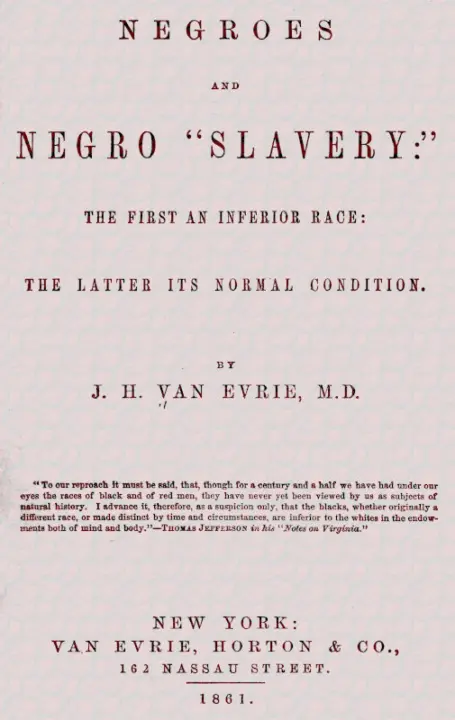
"Negroes and Negro 'Slavery:' the first an inferior race: the latter its normal condition" by J. H. Van Evrie, M.D. is a controversial treatise written in the mid-19th century. The work argues against the abolitionist movement, asserting that it is based on erroneous beliefs about racial equality and the nature of slavery. The author positions the black race as inherently inferior and maintains that slavery is the natural condition for those of African descent. At the start of the book, the author presents a preface discussing the political and social turmoil in America amid the rising anti-slavery sentiment and the onset of the Civil War. He critiques the abolitionist movement as rooted in delusion and foreign influence, particularly from European ideals. Van Evrie aims to provide a justification for the existing social order in the southern United States, asserting that it is rooted in natural law and necessity rather than moral failing. He sets the stage for a detailed exploration of the supposed differences between races, intending to argue for the social subordination of African Americans as not just preferable but essential for societal stability.
Introduction adapted from the source catalogue; source summaries may be automatically generated.
Free to read · English · 105,969 words · No account needed
MAKE TIME FOR A GOOD BOOK
On by default. Untick to stop anonymous reading totals. Each page counts after 10 seconds in view. How this works.
Anonymous counting is on unless you have switched it off.
Finally, we have the Negro—last and least, the lowest in the scale but possibly the first in the order of Creation, for there are many reasons in the nature and structure of things that indicate, if they do not altogether warrant, the inference that the Negro was first and the Caucasian latest in the programme or order of Creation. The typical, woolly-haired Negro may have been created in tropical Asia, and carried thence to Africa, as in modern times he has been carried to tropical America. Like other subordinate races, it never migrates, but the extensive traces of its former existence in Asia show beyond doubt that that was either its primal home, or that it had been carried there by the Caucasian long anterior to the historic era. But it is now found in its pure state or specific form in Africa alone, and even here large portions of it have undergone extensive adulteration. Our knowledge of Africa is very limited and consequently very imperfect. African travelers, explorers, missionaries, etc., ignorant of the ethnology, of the physiology, of the true nature of the Negro, and moreover, bitten by modern philanthropy, a disease more loathsome and fatal to the moral than small-pox or plague to the physical nature, have been bewildered, and perverted, and rendered unfit for truthful observation or useful discovery before they set foot on its soil or felt a single flush of its burning sun. With the monstrous conception that the Negro was a being like themselves, with the same instincts, wants, etc., and the same (latent) mental capacities, all they saw, felt, or reasoned upon in Africa was seen through this false medium, and therefore of little or no value. Thus Barth and Livingston encountering a mongrel tribe or community, with, of course, a certain degree or extent of civilization—the result of Caucasian innervation, or perhaps the remains of a former pure white population, note it down and spread it before the world as evidence of Negro capacity, and an indication of the future progress of the race! Myriads and countless myriads of white men have lived and died on the soil of Africa; vast populations and entire nations have emigrated to that continent. At one time there were half a million of Christians (white) and forty thousand inmates of religious houses in the valley of the Nile alone, while three hundred Christian Bishops assembled at Carthage, and it will be a reasonable assumption to say that since the Christian era, there have been five hundred millions of whites in Africa. What has become of them? They have not emigrated—have not been slaughtered in battle, nor destroyed by pestilence, nor devoured by famine, and yet these countless hosts, these innumerable millions, these Christian devotees and holy bishops have all disappeared, as utterly perished as if the earth had opened and swallowed them up. With the downfall of the Roman empire, civilization receded from Africa, and the white population were gradually swallowed up by mongrelism. The Negro, being the predominant element, absorbed, or rather annihilated, the lesser one, and the result is now seen in numerous, almost countless, mixed hybrid or mongrel tribes and populations spread all over that continent. It is certainly possible, indeed probable, that there are two or three, or more species of men, closely approximating, it is true, nevertheless specifically different from the woolly-haired or typical Negro. One of these (the Hottentots or Bushmen) with the true negro features but of dirty yellow color, it would seem almost certain must be a separate species; but until some one better qualified to judge, than those hitherto relied on, has investigated this subject, it is only safe to assume but a single species, and that the other and numerous populations of Africa, however resembling or approximating to the typical Negro, are hybrids and mongrels, the effete and expiring remains of the mighty populations and imposing civilizations that once flourished upon its soil. There may be also other species besides the Mongol in Asia, and beside the Malay in Oceanica, and it is quite probable that some species have totally perished. But it is certain that those thus briefly discussed now exist; that their location, their history, as far as they can be said to have a history, their physical qualities and mental condition, in short, their specific characters, are plainly marked and well understood. Nevertheless, and though all this belongs to the domain of fact, and it is as absurd to question it as it would be to question the existence of diverse species in any of the genera or families of the animal creation, the “world” generally holds to the notion of a single human race. It is not designed to expressly argue this point, for, to the American mind, it is so obvious, if not self-evident, that the Human Creation is composed of diverse species, that argument is misplaced if not absolutely absurd. The European people rarely see the Negro or other species of men, and therefore the notion of a single human race or species (with them) is natural enough, indeed a mental necessity. Ethnologists—men of vast erudition, of noble intellect and honest and conscientious intentions—have devoted their powers to this subject, and volume upon volume has been published to demonstrate the assumption of a single race. Buffon, Blumenbach, Tiedemann, Prichard, even Cuvier himself, have given in their adherence to this dogma, or rather it should be said have set out with the assumption of a single race and collected a vast amount of material—of fact or presumed fact—to demonstrate its supposed truth. Nor is it an easy matter to explode their sophistries or to disprove their assumptions. With great and admitted claims to scientific acquirement and powers of reasoning, they combine undoubted honesty of intention and seemingly careful and patient investigation, and the amount or extent of evidence adduced, the elaborate and mighty array of fact, of learned and imposing authority appealed to, and the fatiguing if not unwarrantable argument put forward, made it, and still make it difficult to reply to them or to disprove their assumptions. Any question, no matter what its nature, or however deficient in the elements of truth, still admits of argument, and falsehood may often lead astray the reason even when the judgment itself is convinced to the contrary. And these European advocates of the dogma of a single race have such a boundless field for discussion, can so bewilder and fatigue the reason as well as pervert the imagination by their plausible arguments, drawn from the analysis of animal life, that it is not wonderful they should lead astray the popular mind; nor is it surprising that those among us claiming to be men of science should bow to their authority, for though common sense rejects their arguments, there are few of sufficient mental independence to withstand that authority, when backed up by such an imposing array of distinguished names. But the strong common sense that distinguishes our people will not be, indeed, cannot be, deceived on this subject. The American or the Southern knows that the Negro is a Negro, and is not a Caucasian, just as clearly, absolutely and unmistakably as he knows that black is black and is not white, that a man is a man and is not a woman—that a pigeon is a pigeon and is not a robin—or a shad a shad and not a salmon. He sees negro parents have negro offspring; that Indians have Indian offspring; and that whites have white offspring, “each after its kind,” with the same regularity, uniformity and perfect certainty that is witnessed in all other forms of existence. There is not a white man or woman in the Union who, if told of such a thing as white parents with negro offspring, or negroes with white offspring, would believe it, even if sworn to by a million of witnesses. Such a belief or such a conception would be as monstrous, and indeed impossible, as to suppose that robins had begotten pigeons or horses asses. And the constant witnessing of this—this undeviating and perpetual order in the economy of animal life, demonstrates the specific character of the Negro beyond doubt or possible mistake. Irishmen, Germans, Frenchmen, etc., come here, settle down, become citizens, and their offspring born and raised on American soil differ in no appreciable or perceptible manner from other Americans. But Negroes may have been brought here three centuries ago, and their offspring of to-day is exactly as it was then, as absolutely and specifically unlike the American as when the race first touched the soil and first breathed the air of the New World. It is not intended, as already observed, to argue this matter, for it is a palpable and unavoidable fact that Negroes are a separate species; and though in succeeding chapters of this work the specific qualities are examined in detail, these detailed demonstrations are merely designed to present the physical differences in order to determine the moral relations, and not by any means to demonstrate a fact always palpable to the senses. Even those foolish people, disposed to pervert terms or play upon words—to admit the fact, thus palpable, but ready to confound and distort the reason by the application or use of false terms, cannot avoid the inevitable conclusion of distinct species. To conceal or keep out of sight this truth, some have thus admitted these every day seen and unmistakable specific differences in dividing races, but a silly as strange perversity has prompted them to use the term “permanent varieties” instead of “species,” as if white and black were variations and not specialties. It is a fact, an existing, unalterable, demonstrable, and unmistakable fact, that the Negro is specifically different from ourselves—a fact uniform and invariable, which has accompanied each generation, and under every condition of circumstances, of climate, social condition, education, time and accident, from the landing at Jamestown to the present day. The Naturalist, reasoning alone on this basis of fact, says, that which has been uniform and undeviating for three hundred years, in all kinds of climate and under all kinds of circumstances, in a state of “freedom” or condition of “slavery,” under the burning Equator and amid the snows of Canada, without change or symptom of change, must have been thus three thousand years ago. And he reasons truly, for the excavations of Champolion and others demonstrate the specific character of this race four thousand years ago, with as absolute and unmistakable certainty as it is now actually demonstrated to the external sense of the present generation. And the Naturalist, reasoning still further on this basis of fact, says, “that which has existed four thousand years, without the slightest change or modification, which in all kinds of climate and under every condition of circumstances preserves its integrity and transmits, in the regular and normal order, to each succeeding generation the exact and complete type of itself, must have been thus at the beginning, and when the existing order was first called into being by the Almighty Creator.” And contemplating the subject from this stand-point, and reasoning from analogy, or exactly as we do in respect to other and all other forms of existence, the conclusion is irresistible and unavoidable that the several human races or species originally came into being exactly as they now exist, as we know they have existed through all human experience, and without a re-creation, must continue to exist so long as the world itself lasts, or the existing order remains. But a large portion of the “world” believe that the Bible teaches the descent of all mankind from a single pair, and consequently that there must have been a supernatural interposition at some subsequent period, which changed the human creation into its actual and existing form of being. And if there has been, at any time a special revelation made to man, and supernatural interposition in regard to other things, then this alteration or re-creation of separate species is no more irrational or improbable than other things pertaining to that revelation, and which are universally assented to by the religious world. A revelation is necessarily supernatural—that is, in direct contradiction to the normal order; but it may be said that the Creator is not the slave of His own laws, and in His immaculate wisdom and boundless power might see fit to change the order of the human creation; and certainly the same Almighty power which took the Hebrews over the Red Sea on dry land, that saved a pair of all living things in the ark of Noah, or dispersed the builders of Babel, could, with equal ease, reform, or re-create human life, and in future ordain that instead of one there should be several species of men. This is a matter, however, in regard to which the author does not assume to decide, to question, to venture an opinion, or even to hazard a conjecture. It is clearly and absolutely beyond the reach of human intelligence, and therefore not within the province of legitimate enquiry. The Almighty has, in His infinite wisdom and boundless beneficence, hidden from us many things, a knowledge of which would doubtless injure us, and the origin of the human races belongs to this catalogue. Men may labor to investigate it, to tear aside the veil the Creator has drawn about it, to unlock the mystery in which He has shrouded it, and after millions of years thus appropriated, come back to the starting-point, the simple, palpable, unavoidable truth. They exist, but why or wherefore, whither they came or whence they go, is beyond the range of human intelligence. We only know, and are only permitted to know, that the several species now known to exist have been exactly as at present in their physical natures and intellectual capacities, through all human experience and without a supernatural interposition or re-creation, must continue thus through countless ages, and as long as the existing order of creation itself continues. This we know beyond doubt or possible mistake, while, whether it was thus at the beginning, or changed by a supernatural interposition at some subsequent period, is now, and always must be, left to conjecture. Those who interpret the Book of Genesis, or who believe that the Book of Genesis teaches the origin of the human family from a single pair, will, of course believe that the Creator subsequently changed them into their present form, while those who do not thus interpret the Bible will believe, with equal confidence perhaps, that they were created thus at the beginning. It is not, nor could it be of the slightest benefit to us to really and truly know the truth of this matter. All that is essential to our welfare we already know, or may know, if we properly apply the faculties with which the Creator has so beneficently endowed us. We only need to apply these faculties—to investigate the question—to study the differences existing among the general species of men, and compare their natures and capabilities with our own, to understand our true relations with them, and thus to secure our own happiness as well as their well-being, when placed in juxtaposition with them. All this is so obvious, and the remote and abstract question of origin so hypothetical and entirely non-essential, that it seems impossible that intelligent and conscientious men would ever seek to raise an issue on it, or that they would overlook the great practical duties involved in the question and engage in a visionary and unprofitable discussion about that of which they neither do nor can know anything whatever. Nevertheless, some few persons seem to be especially desirous to provoke an issue on this matter, not only with science but with common sense, and a certain reverend and rather distinguished gentleman has publicly and repeatedly declared “that the doctrine of a single human race underlies the whole fabric of religious belief, and if it is rejected, Christianity will be lost to mankind!” What miserable folly, if nothing worse, is this! It is a virtual declaration that we must believe or pretend to believe, what we know to be a lie, in order to preserve what we believe to be a truth. The existence of different species of men belongs to the category of physical fact—a thing subject to the decision of the senses, and belief neither has nor can have anything to do with the matter. It is true, the reverend gentleman in question may shut his eyes and remain in utter ignorance of the fact, or rather of the laws governing the fact, and while thus ignorant, may believe, or pretend to believe, that widely different things constitute the same thing—that white and black are identical—that white parents had at some remote time and in some strange and unaccountable manner given birth to Negro offspring; but what right has he to say, to those who are conscious of the fact of different species, and who know, moreover, that negroes could no more originate from white parentage than they could from dogs or cats, that they shall stultify themselves and dishonestly pretend to believe otherwise, on pain of eternal reprobation, or what he doubtless considers such, the loss of Christianity to the world? It is not the desire of the writer to either reconcile the merits of science with those peculiar interpretations of the Bible, or to exhibit any contradictions with those interpretations. An undoubting believer himself in the great doctrines of Christianity, he finds no difficulty whatever in this respect, and would desire to simply state the facts or what he knows to be truth, and leave the reader to form his own conclusions. But the seemingly predetermined design of some to make an issue on this matter, to appeal to a supposed popular bigotry and fanaticism in order to conceal the most vital and most stupendous truth of modern times—a truth underlying all our sectional difficulties, and which, truly apprehended by the mind of the masses, will instantly explode those difficulties—renders it an imperative duty to expose the folly and sophistry of those who strive to keep it out of sight. They assume that the Bible teaches the origin of all mankind from a single pair—that the Mongol, Indian, Negro, etc., with the same origin, have the same nature as the white man, and consequently have the same natural rights, and that we owe to them the same duties that we owe to ourselves or to our own race. And, moreover, they proclaim a belief in this assumption as essential to salvation, or, in other words, that if it be rejected Christianity will disappear from the world. It need not be repeated that the writer will not condescend to argue a self-evident, actually existing, every-day palpable and unavoidable physical fact, or insult the reader’s understanding by presenting proofs to show that the Negro is specifically different from himself—that is a matter beyond the province of rational discussion, and entirely within the domain of the senses; yet, as already observed, in the subsequent chapters of this work the extent of these differences separating whites and blacks will be demonstrated, their physical differences and approximations shown, in order to determine their moral relations and social adaptations. But the assumption that belief in the dogma of a single human race or species is vital to the preservation of Christianity needs to be exposed, as it is in reality as monstrous in morals as stupid and absurd in fact. We cannot believe that which we know to be untrue, and to affect such belief, however good the motive may seem, must necessarily debauch and demoralize the whole moral structure. There are many things—such as the belief in the doctrine of election, original sin, of justification by faith, that admit of belief—honest, earnest, undoubting belief—for they are abstractions and purely matters of faith that can never be brought to the test of physical demonstration, or to the standard of material fact, but the question of race—the fact of distinct races or rather the existence of species of Caucasian, Mongols, Negroes, etc., are physical facts, subject to the senses, and it is beyond the control of the will to refuse assent to their actual presence. Can a man, by taking thought, add a cubit to his stature? Can he believe himself something else—a woman, a dog, or that he does not exist—that black is white, or that red is yellow, or that the Negro is a white man? It is possible to deceive and delude ourselves, and believe or think that we believe many things which our interest, our prejudices, and our caprices prompt us to believe, but they must be things of an abstract nature, where there are no physical tests to embarrass us or to compel the will to bow to that fixed and immutable standard of truth which the Eternal has planted in the very heart of things, and which otherwise the laws of the mental organism absolutely force us to recognize. But the existence of distinct species of men does not belong to this category. It is fact, a palpable, immediate, demonstrable and unescapable fact. We know, and we cannot avoid knowing, that the negro is a negro and is not a white man, and therefore we cannot believe, however much we may strive to do so, that he is the same being that we are, or in other words, that all mankind constitute a single race or species. All that is possible or permissible is to make liars and hypocrites of ourselves—to pretend to believe in a thing that we do not and cannot believe in—to force this hypocrisy and pretended belief on others who may happen to have confidence in our honesty and respect for our ability; and finally, as a salve for our outraged conscience, to deceive ourselves with the notion that our motives are good, and the end justifies the means.
Your reading position is saved on this browser. Take it to another device with a library code. Reading pages adapt to text, rather than matching a printed edition.
BEHIND THE BOOK
This eBook is for the use of anyone anywhere in the United States and most other parts of the world at no cost and with almost no restrictions whatsoever. You may copy it, give it away or re-use it under the terms of the Project Gutenberg License included with this eBook or online at www.gutenberg.org. If you are not located in the United States, you will have to check the laws of the country where you are located before using this eBook. Read the source licence.
The original source file, including credits and licence, is retained by this library. Request an original-format copy at no charge. Please include the book title and Project Gutenberg identifier #61063.
KEEP YOUR CURIOSITY GOING
Cécile Tormay

Moritz Busch
John L. Ransom
Frances Wright
Cécile Tormay

Mabel Potter Daggett