THE CLASSIC COLLECTION✦An outlaw’s diary: the CommuneCLASSIC FREE BOOKS
An outlaw’s diary: the Commune
Cécile Tormay
THE CLASSIC COLLECTION · 1853
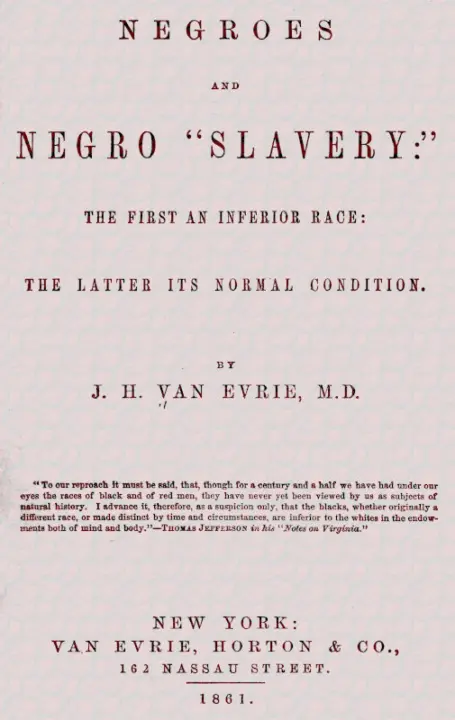
"Negroes and Negro 'Slavery:' the first an inferior race: the latter its normal condition" by J. H. Van Evrie, M.D. is a controversial treatise written in the mid-19th century. The work argues against the abolitionist movement, asserting that it is based on erroneous beliefs about racial equality and the nature of slavery. The author positions the black race as inherently inferior and maintains that slavery is the natural condition for those of African descent. At the start of the book, the author presents a preface discussing the political and social turmoil in America amid the rising anti-slavery sentiment and the onset of the Civil War. He critiques the abolitionist movement as rooted in delusion and foreign influence, particularly from European ideals. Van Evrie aims to provide a justification for the existing social order in the southern United States, asserting that it is rooted in natural law and necessity rather than moral failing. He sets the stage for a detailed exploration of the supposed differences between races, intending to argue for the social subordination of African Americans as not just preferable but essential for societal stability.
Introduction adapted from the source catalogue; source summaries may be automatically generated.
Free to read · English · 105,969 words · No account needed
MAKE TIME FOR A GOOD BOOK
On by default. Untick to stop anonymous reading totals. Each page counts after 10 seconds in view. How this works.
Anonymous counting is on unless you have switched it off.
In all the changes and mutations of human society, there is scarcely any parallel to this change of ideas in Virginia, or to this extraordinary transformation which has changed the descendants of the old Norman aristocracy into the firmest and most reliable defenders of democracy. Of course, the early colonists of Virginia were of all classes and conditions of English society; not a few of them, perhaps, were kidnapped young peasants, without friends or relatives to protect them or to punish the base wretches who carried them over the sea and sold them here, as elsewhere, in the American colonies. But it is undoubtedly true that a larger, vastly larger body of “gentlemen” emigrated to Virginia than to any other colony, and as these were all cadets, or younger branches of the great houses in England, nearly all of which were Norman in descent, and nearly all of which in the direct line afterward perished in the wars of the commonwealth, it would seem equally certain that if there be any Norman blood anywhere, it must now be found, or mainly found, in Virginia.
The cause of this transformation, this radical and extraordinary change of opinion, which has made the descendants of the proudest and most despotic aristocracy ever known the authors and main supporters of democracy, must be a potent one, and as far removed from the ordinary causes which, in the progress of time, modify men’s opinions and habits, as the results themselves are extraordinary and without parallel. As has been remarked, all our ideas and mental habits are the result of circumstances, the external influences that surround us, the changed conditions of our existence, which give origin to new thoughts and new modes of mental action. And when we take these things into view and contemplate the changed conditions, the new and altogether different circumstances that surrounded these Virginia descendants of the cavaliers and gentlemen of England, then the causes are obvious—the new ideas that sprung up in men’s minds, legitimate and consistent with the extraordinary and indeed unparalleled circumstances under which they lived. They were in juxtaposition with negroes, with an inferior race, with widely different and subordinate social elements, and new thoughts, new ideas, as well as altogether different habits, naturally and necessarily followed. They saw these negroes were different beings from themselves, not in color alone, or in other physical characteristics, but in their mental qualities, their affections, their wants, in short, in their nature and the necessities of their social life, their welfare and happiness, and indeed the welfare of this subordinate element, demanded corresponding action, with, of course, corresponding ideas and modes of thought. They saw that this negro was not artificially or accidentally, but naturally different from themselves, that God himself had made him different and given him different faculties and different wants, and therefore designed him for different purposes, and that it was an imperative and unavoidable duty as well as necessity to adapt their social habits and legal and political institutions to this state or condition of fixed and unalterable fact. But this was not all, nor the limit to the new ideas that thus originated in the changed conditions under which they were living. Their traditions, the mental habits of their old cavalier ancestry, the ideas they carried from the mother country, taught them to regard the person of a king as something quite sacred, and to whom an absolute and unquestioning obedience was always due, while the class of gentlemen, the nobility, or aristocracy, that more immediately surrounded royalty was deemed to be altogether superior and different from the vulgar multitudes that made up the people. The celebrated formula of Archbishop Laud, that “passive obedience and non-resistance” was the absolute and universal duty of the people to the will of the king, expressed with brevity and accuracy the prevalent sentiment of the cavaliers, and they demanded from their special retainers the same unquestioning submission which they themselves accorded to royalty. The ignorance of the great mass of the people on one hand, and the actual power and tyranny of the nobles on the other, sunk so deep into the common mind of England and other European people during the middle ages, that though many generations have passed since, the sentiment of superiority in one class and of inferiority in the other, remains yet, and in England at this day is nearly as potent as ever.
Your reading position is saved on this browser. Take it to another device with a library code. Reading pages adapt to text, rather than matching a printed edition.
BEHIND THE BOOK
This eBook is for the use of anyone anywhere in the United States and most other parts of the world at no cost and with almost no restrictions whatsoever. You may copy it, give it away or re-use it under the terms of the Project Gutenberg License included with this eBook or online at www.gutenberg.org. If you are not located in the United States, you will have to check the laws of the country where you are located before using this eBook. Read the source licence.
The original source file, including credits and licence, is retained by this library. Request an original-format copy at no charge. Please include the book title and Project Gutenberg identifier #61063.
KEEP YOUR CURIOSITY GOING
Cécile Tormay

Moritz Busch
John L. Ransom
Frances Wright
Cécile Tormay

Mabel Potter Daggett