READ · DISCOVER · ENJOYClassic literature · Always free
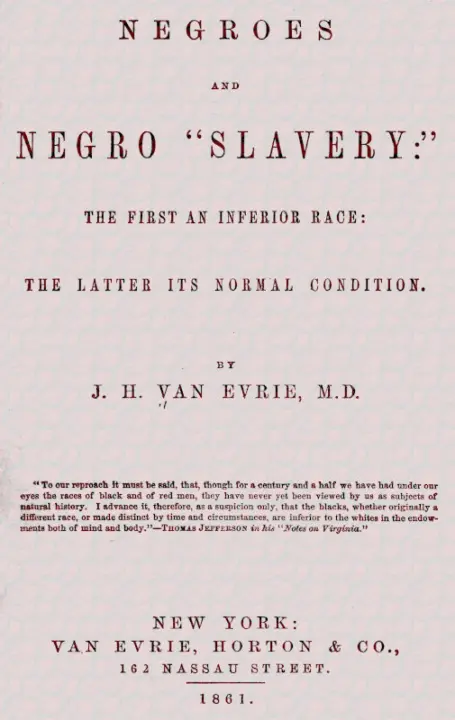
Negroes and Negro “Slavery:” the first an inferior race: the latter its normal condition. — digital edition cover

THE CLASSIC COLLECTION · 1853

Negroes and Negro “Slavery:” the first an inferior race: the latter its normal condition.

"Negroes and Negro 'Slavery:' the first an inferior race: the latter its normal condition" by J. H. Van Evrie, M.D. is a controversial treatise written in the mid-19th century. The work argues against the abolitionist movement, asserting that it is based on erroneous beliefs about racial equality and the nature of slavery. The author positions the black race as inherently inferior and maintains that slavery is the natural condition for those of African descent. At the start of the book, the author presents a preface discussing the political and social turmoil in America amid the rising anti-slavery sentiment and the onset of the Civil War. He critiques the abolitionist movement as rooted in delusion and foreign influence, particularly from European ideals. Van Evrie aims to provide a justification for the existing social order in the southern United States, asserting that it is rooted in natural law and necessity rather than moral failing. He sets the stage for a detailed exploration of the supposed differences between races, intending to argue for the social subordination of African Americans as not just preferable but essential for societal stability.

Introduction adapted from the source catalogue; source summaries may be automatically generated.

Start reading ↓

Free to read · English · 105,969 words · No account needed

MAKE TIME FOR A GOOD BOOK

Negroes and Negro “Slavery:” the first an inferior race: the latter its normal condition.

On by default. Untick to stop anonymous reading totals. Each page counts after 10 seconds in view. How this works.

Anonymous counting is on unless you have switched it off.

Negroes and Negro “Slavery:” the first an inferior race: the latter its normal condition.

Marriage, is of course, a natural relation among negroes as well as ourselves, and were it true that these four millions of people were living without it, then the denunciations heaped upon the people of the South would doubtless be merited. But a moment’s reflection should be sufficient to convince any one, at all events any American, that with a different nature, with different faculties, different wants, and different duties of these people, there must follow a different form or modification of this relation. The negro is substantially a child or undeveloped and undevelopable man, with affections, moral wants and faculties approximating, of course, to our own, but yet so different that his happiness as well as that of the white man demands a corresponding development. The affection of the sexes strongly resembles that of our school-children. It is sudden, capricious, superficial, and temporary, and sometimes violent, but rarely permanent, or would be rarely permanent were it not for the example of the whites, whose habitudes in these respects the imitative instincts of the negro impel him to copy after. In their native Africa, and without the influence and example of the superior race, polygamy is universal, the affection of the husband being a mere caprice in most cases, they sell their wives and children without compunction, but the mother, with that universal maternal instinct common to all human creatures, and to animals of the higher classes, clings tenaciously to her offspring, while perfectly willing to change husbands or owners, as they really are in fact. Many of the “rich men” of Africa are only so in the number of their wives and children, and they trade and traffic in this property as coolly and regularly as if they were legitimate subjects of commerce. Nevertheless, the natural law and the natural tendency of this people is to a single union, and probably a large majority of the native Africans have only one wife. There is no natural tendency to polygamy in any race, for the numbers of the sexes being equal, the natural impulse is to a single union. But their feeble and capricious affections lead to polygamy, and their incapacity to purchase or support wives is the only limit to the negro practice in these respects. Under the teachings and restraints of the superior race at the South, the negroes, male and female, are vastly elevated in this regard, as well as others above their African habitudes. They form sexual unions or marry essentially like the whites. The parties become intimate, an affection springs up, they ask and receive the consent of their masters, and they are married by a white clergyman or by a minister of their own people. Thus far, marriage among “slaves” is, on the surface at least, an exact copy of the marriage of whites. They ask the consent of their masters, as white persons ask the consent of their parents or guardians, and they are married with the same ceremonies either by a minister of their own, or, as very often occurs, by a white clergyman. But here they diverge. The negro does not and can not constitute a part or portion of that mighty fabric we term society. He has no social interests, no property to guard or to devise, for though he receives and enjoys a larger portion of the proceeds of his labor than any mere laborer in Europe, every thing legally belongs to the master. There are no family interests for which to provide, no reputation or character to protect, no social duties to perform, or rights to defend in his case; in short, he has no connection whatever with that vast and complicated machinery which we call society. Marriage, therefore, from our stand-point—that legal formula and social pledge so vital to the very existence of social order—is obviously absurd and impossible in the case of negroes. The natural affinity, the union of affection, the perfect adaptation so essential to a true marriage in our race, is substantially imitated and substantially similar in the case of negroes at the South, but to seek to force the negro beyond this—to force upon him the social responsibilities that attach to white people; or, in other words, to make marriage a legal contract in the case of negroes, would be as absurd as to force him to vote at an election, or to perform any other high social duties, and which are evidently impossible. In regard to his own wants, the well-being of his offspring, every thing connected with the best welfare and highest happiness that his race is capable of, he now enjoys, and any attempt to force him to marry as white people marry—that is, to make marriage a civil or legal contract—is not merely impossible, but it would be a crime and a monstrous outrage upon the nature God has given him. The Almighty has endowed the negro with wonderful imitative powers: of course, it is impossible for him to imitate all our higher qualities—he can only approximate to them—but when the master has presented him with a proper example, in this respect as well as in other respects, as parents and guardians are expected to do in the case of children, they have fulfilled their duties to these “slaves,” and generally the negro is restrained and governed by these examples. But the feeble and capricious affections of the negro give their masters much annoyance, and perhaps the greatest trouble they experience with these people is their faithlessness to their marital obligations. The ignorant “anti-slavery” lecturer at the North has distressing tales to tell of cruel masters who separate wives and husbands, and break up families; but while such things have doubtless happened, it is quite certain that masters have interfered a hundred times to keep them together to one instance to the contrary, or to sell them apart. Such things happen occasionally, when estates are to be settled and property divided; but the instincts of the whites and the happiness of the whites are more disturbed by them than the negroes themselves. The limited intellectual power—the feeble moral nature, and superficial and capricious affections of the negro lead him to regard these separations of wives and husbands—of parents and children, with indifference, or rather we should say he has none of our perceptions or our instincts in respect to these family relations, and therefore when they do happen he is relatively or comparatively unconscious of suffering. In his native Africa he sells his wife and children without hesitation, and all the suffering he now feels is borrowed or imitated from the whites—a feeling scarcely perceptible in his native state, but in his better and higher life at the South, it is doubtless exalted into something like a sentiment of family. Nevertheless, he readily adapts himself to whatever changes the chances of life may bring him, and where the white husband, and certainly the white wife, might despair and die, the negro and the negress, with new partners and another marriage, are quite as happy as if they had never been separated from their former ones.

Your reading position is saved on this browser. Take it to another device with a library code. Reading pages adapt to text, rather than matching a printed edition.

BEHIND THE WORDS

About John H. Van Evrie

John H. Van Evrie (1814–1896). Explore Negroes and Negro “Slavery:” the first an inferior race: the latter its normal condition. in this collection. These books span history.

Explore this author’s books →

THE READERS’ VERDICT

How did this story stay with you?

Not rated yet
Your rating for Negroes and Negro “Slavery:” the first an inferior race: the latter its normal condition.

Be the first to share your verdict.

One rating per browser, which you can change or remove. A necessary browser identifier remembers your vote. How ratings work

A GOOD STORY DESERVES COMPANY

Pass this book along.

A great read is even better when it’s shared.

SEND A LITTLE INSPIRATION

Share this book

BEHIND THE BOOK

Edition & source details.

Title
Negroes and Negro “Slavery:” the first an inferior race: the latter its normal condition.
Author
John H. Van Evrie
First publication (Open Library catalogue match)
1853
Digital edition publisher
Project Gutenberg
Gutenberg release date
2019-12-31
Language
English
Source edition imprint
Not stated in source catalogue
Source identifier
Project Gutenberg #61063
Contributors
No additional named contributors in source metadata

Public-domain source & licence

This eBook is for the use of anyone anywhere in the United States and most other parts of the world at no cost and with almost no restrictions whatsoever. You may copy it, give it away or re-use it under the terms of the Project Gutenberg License included with this eBook or online at www.gutenberg.org. If you are not located in the United States, you will have to check the laws of the country where you are located before using this eBook. Read the source licence.

Full source licence and obtaining an original copy

The original source file, including credits and licence, is retained by this library. Request an original-format copy at no charge. Please include the book title and Project Gutenberg identifier #61063.

the full Project Gutenberg License must appear
prominently whenever any copy of a Project Gutenberg work (any work
on which the phrase “Project Gutenberg” appears, or with which the
phrase “Project Gutenberg” is associated) is accessed, displayed,
performed, viewed, copied or distributed:

This eBook is for the use of anyone anywhere in the United States and most
other parts of the world at no cost and with almost no restrictions
whatsoever. You may copy it, give it away or re-use it under the terms
of the Project Gutenberg™ License included with this eBook or online
at www.gutenberg.org. If you
are not located in the United States, you will have to check the laws
of the country where you are located before using this eBook.

1.E.2. If an individual Project Gutenberg electronic work is
derived from texts not protected by U.S. copyright law (does not
contain a notice indicating that it is posted with permission of the
copyright holder), the work can be copied and distributed to anyone in
the United States without paying any fees or charges. If you are
redistributing or providing access to a work with the phrase “Project
Gutenberg” associated with or appearing on the work, you must comply
either with the requirements of paragraphs 1.E.1 through 1.E.7 or
obtain permission for the use of the work and the Project Gutenberg
trademark as set forth in paragraphs 1.E.8 or 1.E.9.

1.E.3. If an individual Project Gutenberg electronic work is posted
with the permission of the copyright holder, your use and distribution
must comply with both paragraphs 1.E.1 through 1.E.7 and any
additional terms imposed by the copyright holder. Additional terms
will be linked to the Project Gutenberg License for all works
posted with the permission of the copyright holder found at the
beginning of this work.

1.E.4. Do not unlink or detach or remove the full Project Gutenberg
License terms from this work, or any files containing a part of this
work or any other work associated with Project Gutenberg.

1.E.5. Do not copy, display, perform, distribute or redistribute this
electronic work, or any part of this electronic work, without
prominently displaying the sentence set forth in paragraph 1.E.1 with
active links or immediate access to the full terms of the Project
Gutenberg License.

1.E.6. You may convert to and distribute this work in any binary,
compressed, marked up, nonproprietary or proprietary form, including
any word processing or hypertext form. However, if you provide access
to or distribute copies of a Project Gutenberg work in a format
other than “Plain Vanilla ASCII” or other format used in the official
version posted on the official Project Gutenberg website
(www.gutenberg.org), you must, at no additional cost, fee or expense
to the user, provide a copy, a means of exporting a copy, or a means
of obtaining a copy upon request, of the work in its original “Plain
Vanilla ASCII” or other form. Any alternate format must include the
full Project Gutenberg License as specified in paragraph 1.E.1.

1.E.7. Do not charge a fee for access to, viewing, displaying,
performing, copying or distributing any Project Gutenberg works
unless you comply with paragraph 1.E.8 or 1.E.9.

1.E.8. You may charge a reasonable fee for copies of or providing
access to or distributing Project Gutenberg electronic works
provided that:

• You pay a royalty fee of 20% of the gross profits you derive from
the use of Project Gutenberg works calculated using the method
you already use to calculate your applicable taxes. The fee is owed
to the owner of the Project Gutenberg trademark, but he has
agreed to donate royalties under this paragraph to the Project
Gutenberg Literary Archive Foundation. Royalty payments must be paid
within 60 days following each date on which you prepare (or are
legally required to prepare) your periodic tax returns. Royalty
payments should be clearly marked as such and sent to the Project
Gutenberg Literary Archive Foundation at the address specified in
Section 4, “Information about donations to the Project Gutenberg
Literary Archive Foundation.”

• You provide a full refund of any money paid by a user who notifies
you in writing (or by e-mail) within 30 days of receipt that s/he
does not agree to the terms of the full Project Gutenberg™
License. You must require such a user to return or destroy all
copies of the works possessed in a physical medium and discontinue
all use of and all access to other copies of Project Gutenberg™
works.

• You provide, in accordance with paragraph 1.F.3, a full refund of
any money paid for a work or a replacement copy, if a defect in the
electronic work is discovered and reported to you within 90 days of
receipt of the work.

• You comply with all other terms of this agreement for free
distribution of Project Gutenberg™ works.


1.E.9. If you wish to charge a fee or distribute a Project
Gutenberg™ electronic work or group of works on different terms than
are set forth in this agreement, you must obtain permission in writing
from the Project Gutenberg Literary Archive Foundation, the manager of
the Project Gutenberg™ trademark. Contact the Foundation as set
forth in Section 3 below.

1.F.

1.F.1. Project Gutenberg volunteers and employees expend considerable
effort to identify, do copyright research on, transcribe and proofread
works not protected by U.S. copyright law in creating the Project
Gutenberg™ collection. Despite these efforts, Project Gutenberg™
electronic works, and the medium on which they may be stored, may
contain “Defects,” such as, but not limited to, incomplete, inaccurate
or corrupt data, transcription errors, a copyright or other
intellectual property infringement, a defective or damaged disk or
other medium, a computer virus, or computer codes that damage or
cannot be read by your equipment.

1.F.2. LIMITED WARRANTY, DISCLAIMER OF DAMAGES - Except for the “Right
of Replacement or Refund” described in paragraph 1.F.3, the Project
Gutenberg Literary Archive Foundation, the owner of the Project
Gutenberg™ trademark, and any other party distributing a Project
Gutenberg™ electronic work under this agreement, disclaim all
liability to you for damages, costs and expenses, including legal
fees. YOU AGREE THAT YOU HAVE NO REMEDIES FOR NEGLIGENCE, STRICT
LIABILITY, BREACH OF WARRANTY OR BREACH OF CONTRACT EXCEPT THOSE
PROVIDED IN PARAGRAPH 1.F.3. YOU AGREE THAT THE FOUNDATION, THE
TRADEMARK OWNER, AND ANY DISTRIBUTOR UNDER THIS AGREEMENT WILL NOT BE
LIABLE TO YOU FOR ACTUAL, DIRECT, INDIRECT, CONSEQUENTIAL, PUNITIVE OR
INCIDENTAL DAMAGES EVEN IF YOU GIVE NOTICE OF THE POSSIBILITY OF SUCH
DAMAGE.

1.F.3. LIMITED RIGHT OF REPLACEMENT OR REFUND - If you discover a
defect in this electronic work within 90 days of receiving it, you can
receive a refund of the money (if any) you paid for it by sending a
written explanation to the person you received the work from. If you
received the work on a physical medium, you must return the medium
with your written explanation. The person or entity that provided you
with the defective work may elect to provide a replacement copy in
lieu of a refund. If you received the work electronically, the person
or entity providing it to you may choose to give you a second
opportunity to receive the work electronically in lieu of a refund. If
the second copy is also defective, you may demand a refund in writing
without further opportunities to fix the problem.

1.F.4. Except for the limited right of replacement or refund set forth
in paragraph 1.F.3, this work is provided to you ‘AS-IS’, WITH NO
OTHER WARRANTIES OF ANY KIND, EXPRESS OR IMPLIED, INCLUDING BUT NOT
LIMITED TO WARRANTIES OF MERCHANTABILITY OR FITNESS FOR ANY PURPOSE.

1.F.5. Some states do not allow disclaimers of certain implied
warranties or the exclusion or limitation of certain types of
damages. If any disclaimer or limitation set forth in this agreement
violates the law of the state applicable to this agreement, the
agreement shall be interpreted to make the maximum disclaimer or
limitation permitted by the applicable state law. The invalidity or
unenforceability of any provision of this agreement shall not void the
remaining provisions.

1.F.6. INDEMNITY - You agree to indemnify and hold the Foundation, the
trademark owner, any agent or employee of the Foundation, anyone
providing copies of Project Gutenberg™ electronic works in
accordance with this agreement, and any volunteers associated with the
production, promotion and distribution of Project Gutenberg™
electronic works, harmless from all liability, costs and expenses,
including legal fees, that arise directly or indirectly from any of
the following which you do or cause to occur: (a) distribution of this
or any Project Gutenberg work, (b) alteration, modification, or
additions or deletions to any Project Gutenberg work, and (c) any
Defect you cause.

Section 2. Information about the Mission of Project Gutenberg

Project Gutenberg is synonymous with the free distribution of
electronic works in formats readable by the widest variety of
computers including obsolete, old, middle-aged and new computers. It
exists because of the efforts of hundreds of volunteers and donations
from people in all walks of life.

Volunteers and financial support to provide volunteers with the
assistance they need are critical to reaching Project Gutenberg’s
goals and ensuring that the Project Gutenberg collection will
remain freely available for generations to come. In 2001, the Project
Gutenberg Literary Archive Foundation was created to provide a secure
and permanent future for Project Gutenberg and future
generations. To learn more about the Project Gutenberg Literary
Archive Foundation and how your efforts and donations can help, see
Sections 3 and 4 and the Foundation information page at www.gutenberg.org.

Section 3. Information about the Project Gutenberg Literary Archive Foundation

The Project Gutenberg Literary Archive Foundation is a non-profit
501(c)(3) educational corporation organized under the laws of the
state of Mississippi and granted tax exempt status by the Internal
Revenue Service. The Foundation’s EIN or federal tax identification
number is 64-6221541. Contributions to the Project Gutenberg Literary
Archive Foundation are tax deductible to the full extent permitted by
U.S. federal laws and your state’s laws.

The Foundation’s business office is located at 41 Watchung Plaza #516,
Montclair NJ 07042, USA, +1 (862) 621-9288. Email contact links and up
to date contact information can be found at the Foundation’s website
and official page at www.gutenberg.org/contact

Section 4. Information about Donations to the Project Gutenberg
Literary Archive Foundation

Project Gutenberg™ depends upon and cannot survive without widespread
public support and donations to carry out its mission of
increasing the number of public domain and licensed works that can be
freely distributed in machine-readable form accessible by the widest
array of equipment including outdated equipment. Many small donations
($1 to $5,000) are particularly important to maintaining tax exempt
status with the IRS.

The Foundation is committed to complying with the laws regulating
charities and charitable donations in all 50 states of the United
States. Compliance requirements are not uniform and it takes a
considerable effort, much paperwork and many fees to meet and keep up
with these requirements. We do not solicit donations in locations
where we have not received written confirmation of compliance. To SEND
DONATIONS or determine the status of compliance for any particular state
visit www.gutenberg.org/donate.

While we cannot and do not solicit contributions from states where we
have not met the solicitation requirements, we know of no prohibition
against accepting unsolicited donations from donors in such states who
approach us with offers to donate.

International donations are gratefully accepted, but we cannot make
any statements concerning tax treatment of donations received from
outside the United States. U.S. laws alone swamp our small staff.

Please check the Project Gutenberg web pages for current donation
methods and addresses. Donations are accepted in a number of other
ways including checks, online payments and credit card donations. To
donate, please visit: www.gutenberg.org/donate.

Section 5. General Information About Project Gutenberg electronic works

Professor Michael S. Hart was the originator of the Project
Gutenberg concept of a library of electronic works that could be
freely shared with anyone. For forty years, he produced and
distributed Project Gutenberg eBooks with only a loose network of
volunteer support.

Project Gutenberg eBooks are often created from several printed
editions, all of which are confirmed as not protected by copyright in
the U.S. unless a copyright notice is included. Thus, we do not
necessarily keep eBooks in compliance with any particular paper
edition.

Most people start at our website which has the main PG search
facility: www.gutenberg.org.

This website includes information about Project Gutenberg,
including how to make donations to the Project Gutenberg Literary
Archive Foundation, how to help produce our new eBooks, and how to
subscribe to our email newsletter to hear about new eBooks.


KEEP YOUR CURIOSITY GOING

Your next chapter awaits.

Your privacy choices

Reading is always free. You can change these settings at any time.

Book banners link to our books on simonward.net. They do not use advertising cookies or tracking.

Privacy & cookie policy · Reading data and privacy controls