THE CLASSIC COLLECTION✦An outlaw’s diary: the CommuneCLASSIC FREE BOOKS
An outlaw’s diary: the Commune
Cécile Tormay
THE CLASSIC COLLECTION · 1853
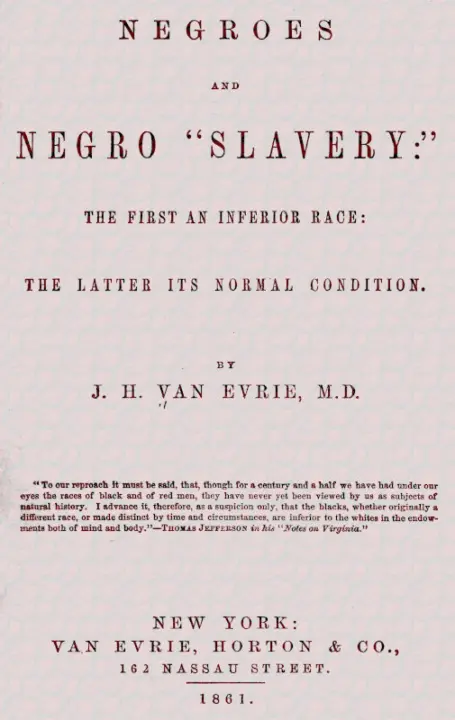
"Negroes and Negro 'Slavery:' the first an inferior race: the latter its normal condition" by J. H. Van Evrie, M.D. is a controversial treatise written in the mid-19th century. The work argues against the abolitionist movement, asserting that it is based on erroneous beliefs about racial equality and the nature of slavery. The author positions the black race as inherently inferior and maintains that slavery is the natural condition for those of African descent. At the start of the book, the author presents a preface discussing the political and social turmoil in America amid the rising anti-slavery sentiment and the onset of the Civil War. He critiques the abolitionist movement as rooted in delusion and foreign influence, particularly from European ideals. Van Evrie aims to provide a justification for the existing social order in the southern United States, asserting that it is rooted in natural law and necessity rather than moral failing. He sets the stage for a detailed exploration of the supposed differences between races, intending to argue for the social subordination of African Americans as not just preferable but essential for societal stability.
Introduction adapted from the source catalogue; source summaries may be automatically generated.
Free to read · English · 105,969 words · No account needed
MAKE TIME FOR A GOOD BOOK
On by default. Untick to stop anonymous reading totals. Each page counts after 10 seconds in view. How this works.
Anonymous counting is on unless you have switched it off.
The affections harmonize, of course, with the mental nature, and the love of the negro mother corresponds with the wants of the offspring. She has a boundless affection for her infant; it grows feebler as the capacities of the child are developed; at twelve to fifteen she is relatively indifferent to it; at forty she scarcely recognizes it; and all of these phases in the maternal instinct or domestic affections of the race are in accord with its specific nature and the purposes assigned it by the Almighty Creator. Without the enlarged brain and reasoning power of the white mother, nature has made amends to the negress, and provided for the wants of her offspring by giving her a more imperative maternal instinct, that shall insure its safety and welfare. When the negro reaches maturity, at twelve to fifteen, nature has accomplished her purposes. The offspring no longer needs her care, and the mother becomes indifferent to it, and it cares little for the mother. A few years later, and she forgets it altogether, for her affections corresponding with her intellectual nature, there is no basis, or material, or space for such things. Of course, living in juxtaposition with the superior race, and the imitative faculty of the negro constantly brought into action, there is a seeming resemblance to white people in these respects. But one only needs to remember the mental qualities of the negro—the small and widely different brain, and consequently feeble, and, as compared with us, limited sphere of intellectualism, to see the absurdity of endowing the negro with domestic affections corresponding with ours. At twelve to fifteen, as has been said, the purposes of nature are accomplished. The offspring no longer needs the care of the mother—the affections with which nature endowed her are no longer needed. Why should they exist, then? Isolated in Africa, they perhaps rarely feel any interest in their offspring after the latter reach maturity, and, separated a few years, would not know them, would have no recollection of them, for there is no civilization, no social development, nothing whatever of that which we call society, and in which with us the domestic affections—the family relationship—the love of mother, wife, sisters, brothers, and offspring constitute so large and essential a part. The limited intelligence of the negro, the small brain and feeble (scarcely perceptible) reasoning faculties, it will be evident to the reader, must be accompanied by corresponding domestic affections and an emotional nature that accords with this limited intellectualism. And this is manifested in the habits, wants, and condition of the negro at the South, in his feeble and capricious love for his wife and indifference to his offspring, redeemed only in the potent and instinctive affection of the mother in its earlier years for her child. The strongest affection the negro nature is capable of feeling is love of his master, his guide, protector, friend, and indeed Providence, who takes care of him in sickness and shelters and provides for him in old age and helplessness. God has adapted all His creatures for the wisest and most beneficent purposes, has endowed the negro with affections harmonizing with his wants, has given the negro mother imperative maternal instincts that shall secure the safety and welfare of her offspring, but little more, for little more is needed; for society or civilization neither does nor can belong to negro existence, while affection for his master, love and devotion to him who protects and provides for him through life, is both a necessity and an enjoyment, and therefore God has made it the strongest and most enduring feeling of the negro nature. Of the four or five millions in our midst, great numbers are the children or grandchildren of African parents, a few even are of African birth, but probably not one has any distinct memory, recollection, or tradition of their forefathers[3]—not one that cherishes any past family sentiment or affection of any kind whatever, indeed not one that even preserves an African name! We trace back not alone the general but the family histories, the loves and affections, the hopes and fears, and sacrifices and sufferings of our pilgrim forefathers of two or three centuries ago, because all this accords with the large brain and expanded intellectualism, and the corresponding strength and breadth of the affections, which may be said to be the motive forces which impel the whole social phenomena in question. But the negro neither has nor can have any thing in common with this. He has no capacities of the kind, no civilization or social development, and therefore no wants of the kind, no affections even resembling our own, though at the same time God has endowed him with all that is necessary to his happiness and to the mutual welfare of both races when in juxtaposition.
Your reading position is saved on this browser. Take it to another device with a library code. Reading pages adapt to text, rather than matching a printed edition.
BEHIND THE BOOK
This eBook is for the use of anyone anywhere in the United States and most other parts of the world at no cost and with almost no restrictions whatsoever. You may copy it, give it away or re-use it under the terms of the Project Gutenberg License included with this eBook or online at www.gutenberg.org. If you are not located in the United States, you will have to check the laws of the country where you are located before using this eBook. Read the source licence.
The original source file, including credits and licence, is retained by this library. Request an original-format copy at no charge. Please include the book title and Project Gutenberg identifier #61063.
KEEP YOUR CURIOSITY GOING
Cécile Tormay

Moritz Busch
John L. Ransom
Frances Wright
Cécile Tormay

Mabel Potter Daggett