THE CLASSIC COLLECTION✦An outlaw’s diary: the CommuneCLASSIC FREE BOOKS
An outlaw’s diary: the Commune
Cécile Tormay
THE CLASSIC COLLECTION · 1853
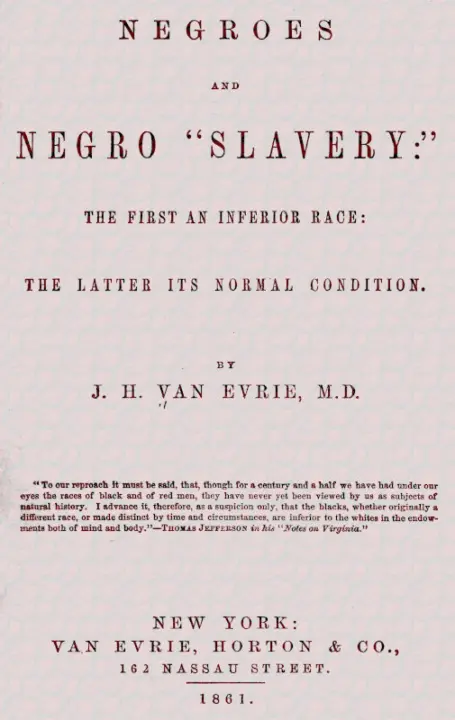
"Negroes and Negro 'Slavery:' the first an inferior race: the latter its normal condition" by J. H. Van Evrie, M.D. is a controversial treatise written in the mid-19th century. The work argues against the abolitionist movement, asserting that it is based on erroneous beliefs about racial equality and the nature of slavery. The author positions the black race as inherently inferior and maintains that slavery is the natural condition for those of African descent. At the start of the book, the author presents a preface discussing the political and social turmoil in America amid the rising anti-slavery sentiment and the onset of the Civil War. He critiques the abolitionist movement as rooted in delusion and foreign influence, particularly from European ideals. Van Evrie aims to provide a justification for the existing social order in the southern United States, asserting that it is rooted in natural law and necessity rather than moral failing. He sets the stage for a detailed exploration of the supposed differences between races, intending to argue for the social subordination of African Americans as not just preferable but essential for societal stability.
Introduction adapted from the source catalogue; source summaries may be automatically generated.
Free to read · English · 105,969 words · No account needed
MAKE TIME FOR A GOOD BOOK
On by default. Untick to stop anonymous reading totals. Each page counts after 10 seconds in view. How this works.
Anonymous counting is on unless you have switched it off.
As depicted on the monuments, the negro was then as he is now at the South, in a position of subordination; while isolated, he was as he is now, a simple, unproductive, non-advancing savage. In this condition of isolation he multiplies himself, and therefore is in a natural condition. His acute and powerful senses make amends for his limited intelligence, and enable him to contend with the fiercer and more powerful creatures of the animal creation, while the fervid suns and luxuriant soils of the tropics, where the earth may be said to produce spontaneously, enable him to live with little more exertion than simply to gather their rich and nutritious products. It is a natural condition, so far as it goes, for, as has been said, he increases and multiplies his kind; but it can not have been designed as the permanent condition of the race, for that involves the anomaly of waste, uselessness, a broad blank in the economy of the universe. But as that aspect of the subject will be discussed in another place, it need not be entered on here.
The condition of savagism, or whatever we may term it, where the negro is isolated and without any thing to call his wonderful powers of imitation into action, where he is simply a useless, non-advancing heathen, surely no one, however perverted his mind may be on this subject, will venture to say is a preferable condition to that which he enjoys at the South. It might suffice to say that he increases with more than double rapidity, to demonstrate the fact of his superiority of condition in the latter; but there are moral considerations that show this with still greater distinctness. It is true that we must not take our own standard to test this matter, or we must not assume that that which would constitute our own happiness would also secure the greatest happiness of the negro. Of course the white man never did and never could live such a life as the isolated negro; but, contemplating the negro in the South as he now exists, in comparison with the condition of the isolated negro in Africa, will any one or can any one doubt for an instant the immense superiority of the former condition? He is cared for in his childhood by his master as well as his mother, taken care of when ill, always supplied with an abundance of food and clothing, given every chance for the development of his imitative faculties, permitted to marry generally as he pleases, to feel always that he has a guide and protector, and a constant, peaceful home; and in his old age will be cared for and decently buried with all the sanctions and comforts of the Christian religion. In Africa, a negro, isolated from the white man, rarely has a home, rarely knows his father, is left unprotected in his childhood to all the chances and uncertainties of savagism, sometimes nearly starved, at other times gorged with unwholesome food, without any possible chance for education or the development of his faculties, liable at any moment of his life, in some wild eruption of hostile tribes, to be carried off a slave, perhaps to be eaten by the victors, and after running the gauntlet of savagism, if he lives to old age, to be left to perish of hunger, if no longer able to seek food for himself. But it is quite unnecessary to multiply words on this point; the condition of the negro in America, under the broad glare of American civilization and the beneficent influences of Christianity, is so vastly and indeed immeasurably superior to that of the African or isolated negro, that we have no terms in our language that can truly or fully express it. We ourselves, under our beneficent democratic institutions, doubtless enjoy an extent of happiness or well-being, over that of the masses of our race in the Old World, somewhat difficult to measure or express in words, and it is reasonable to say that the negro population of the South, relatively or comparatively, enjoys even greater happiness, when contrasted with African savagism. There is, in fact, no other condition to compare with, for freedom, the imaginary state that the Abolitionists have labored for so long, is not a condition, and has an existence in their imaginations alone, and not in the actual breathing and living world about us. They have a theory, or rather an abstract idea, that the negro is a black-white man, a black Caucasian, a creature like ourselves except in color, and therefore that, placed under the same circumstances—that is, given the same rights and held to the same responsibilities—he will manifest the same qualities, etc. On this foolish assumption legislatures and individuals have acted, and both in the South and in the North considerable numbers of these people have been thrust from their normal condition into what? Why, into the condition of widely different beings.
Your reading position is saved on this browser. Take it to another device with a library code. Reading pages adapt to text, rather than matching a printed edition.
BEHIND THE BOOK
This eBook is for the use of anyone anywhere in the United States and most other parts of the world at no cost and with almost no restrictions whatsoever. You may copy it, give it away or re-use it under the terms of the Project Gutenberg License included with this eBook or online at www.gutenberg.org. If you are not located in the United States, you will have to check the laws of the country where you are located before using this eBook. Read the source licence.
The original source file, including credits and licence, is retained by this library. Request an original-format copy at no charge. Please include the book title and Project Gutenberg identifier #61063.
KEEP YOUR CURIOSITY GOING
Cécile Tormay

Moritz Busch
John L. Ransom
Frances Wright
Cécile Tormay

Mabel Potter Daggett